

Tag Archives: freedom

20 Practical Principles for Godly Dating

Godly dating is a relationship approach rooted in spiritual principles, prioritizing character, faith, and long-term compatibility over fleeting attraction or personal convenience. It involves intentionally seeking a partner who shares core values, a commitment to moral integrity, and a desire to honor God in their actions, decisions, and interactions. Unlike casual dating, godly dating emphasizes emotional and physical boundaries, open communication, and mutual respect, fostering growth and accountability for both individuals. The purpose is not merely companionship or romantic pleasure but preparation for a covenantal, lifelong partnership—often marriage—that reflects God’s design for love, unity, and shared purpose.

Godly dating is about more than attraction—it’s a journey of intentional love guided by faith and values. It’s choosing partners who share your principles, honor God in their actions, and prioritize character over convenience. Boundaries, honesty, and mutual respect are the foundation, while prayer and discernment guide decisions. This approach teaches patience, emotional maturity, and alignment of life goals, preparing individuals for a healthy, lasting, and spiritually grounded relationship.

In a world of fleeting connections, godly dating reminds us that love is best nurtured with intention, integrity, and divine guidance. By dating with purpose, you not only find a partner but build a relationship that grows in harmony, trust, and shared faith—a love that honors God and enriches both lives.

In godly dating, prayer, spiritual guidance, and discernment play key roles. Decisions are made thoughtfully, avoiding impulsive choices driven by societal pressures or superficial attraction. Partners are encouraged to cultivate patience, grace, and understanding, recognizing that true compatibility emerges from aligned character, vision, and values rather than chemistry alone. Financial responsibility, emotional maturity, and honesty are also essential, as godly dating seeks to build a foundation for sustainable, stable relationships that honor both individuals and God’s principles.

  1. Prioritize spiritual alignment – date someone who shares your faith and core values. Flee fornication, stay holy and pure.
  2. Practice patience – wait for the right person rather than settling for convenience.
  3. Set healthy boundaries – emotional, physical, and financial boundaries protect both partners.
  4. Communicate openly – honesty and transparency are essential from the start.
  5. Seek mutual respect – honor your partner’s dignity, opinions, and differences.
  6. Engage in prayer together – invite God’s guidance into your dating journey.
  7. Observe character – watch actions more than words; integrity matters most.
  8. Avoid rushed intimacy – physical or emotional closeness should develop gradually.
  9. Evaluate shared vision – discuss life goals, family planning, and career aspirations early.
  10. Practice forgiveness – misunderstandings will arise; grace fosters growth and trust.
  11. Involve accountability – trusted mentors or leaders can offer guidance and perspective.
  12. Build emotional intelligence – understand your feelings and empathize with your partner.
  13. Maintain financial wisdom – discuss money habits and stewardship before commitment.
  14. Identify red flags early – dishonesty, abuse, or disrespect should never be ignored.
  15. Avoid distractions – social media or peer pressure should not dictate dating decisions.
  16. Focus on long-term growth – choose relationships that edify both partners spiritually and emotionally.
  17. Celebrate individuality – maintain personal goals, hobbies, and friendships.
  18. Learn from past relationships – reflect on lessons without letting past hurt dictate choices.
  19. Keep accountability in conflicts – disagreements should be resolved with respect and humility.
  20. Seek covenantal commitment – date with the intention of discerning marriage or lifelong partnership.

Godly dating transforms the pursuit of love into a disciplined, intentional, and spiritually guided journey. It teaches that meaningful relationships are cultivated through respect, patience, and shared faith, not convenience or impulsivity. By prioritizing character, values, and long-term purpose, godly dating prepares individuals for healthy, fulfilling, and enduring partnerships. Ultimately, it emphasizes that love guided by divine principles is not only emotionally rewarding but also spiritually enriching, shaping individuals to grow together in harmony, integrity, and mutual devotion.

References
Holy Bible, King James Version. (2017). Hendrickson Publishers. (Original work published 1611).
Cloud, H., & Townsend, J. (2018). Boundaries in dating. Zondervan.
Chapman, G. (2015). The five love languages: How to express heartfelt commitment to your mate. Northfield Publishing.
Keller, T. (2017). The meaning of marriage: Facing the complexities of commitment with the wisdom of God. Dutton.
Fowler, J. W. (2019). Stages of faith: The psychology of human development and the quest for meaning. HarperOne.
The Freedom of Evolving

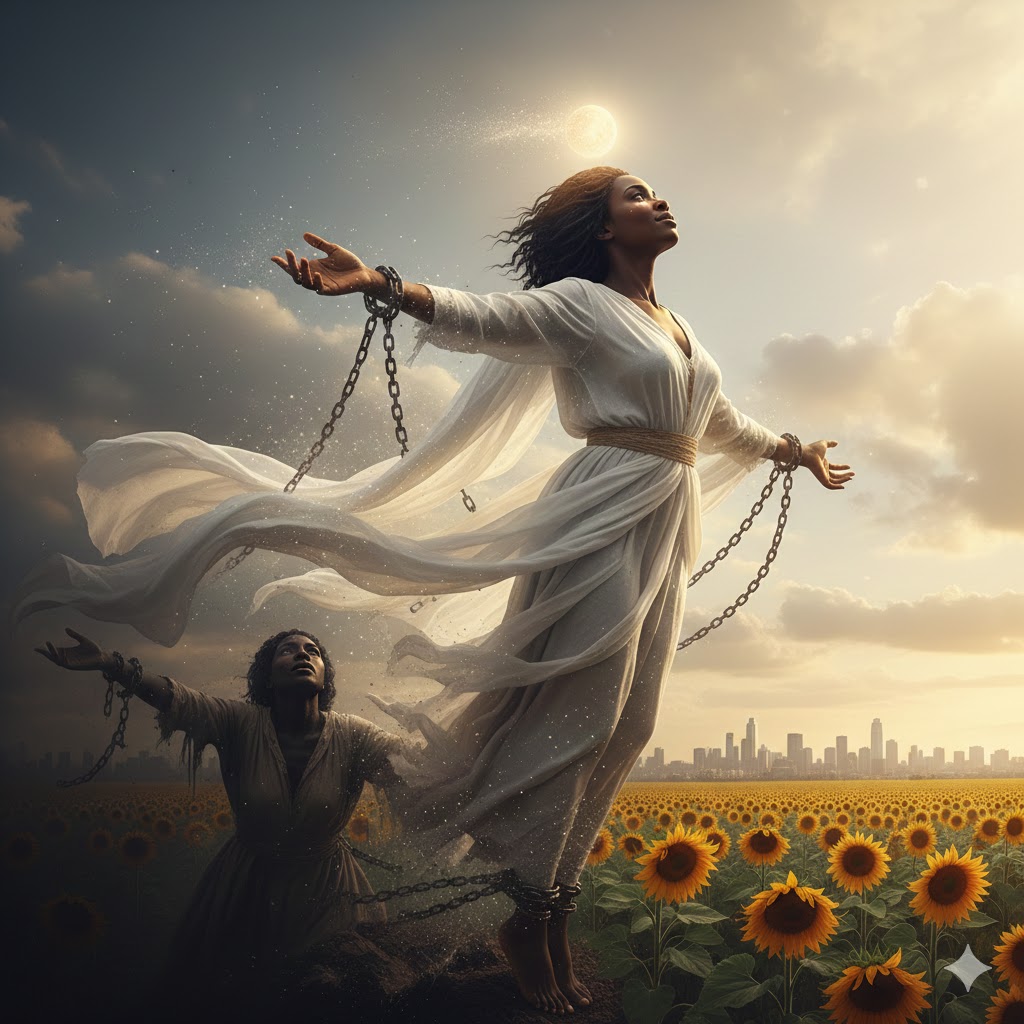
The journey of becoming is both sacred and disruptive. It is the quiet shedding of former versions of oneself in order to rise into purpose, identity, and inner alignment. To evolve is to confront the limitations of yesterday with the courage to embrace the unknown possibilities of tomorrow. For many Black women navigating the intersections of history, faith, and personal growth, evolution is more than a process—it is liberation.

Evolution requires the bravery to examine inherited narratives. Many women carry stories shaped by family, culture, trauma, or expectations that never belonged to them in the first place. The freedom of evolving lies in acknowledging these inherited patterns, blessing what once served them, and releasing what no longer aligns with their calling.

At the core of evolution is self-awareness. It is impossible to transform while avoiding the mirror. Becoming demands honesty, introspection, and a willingness to confront one’s own desires, fears, and habits. When a woman begins to understand herself, she gains the spiritual authority to rewrite her life from a place of truth.

The beauty of evolving is that it does not demand perfection—only progress. Growth is a series of small, courageous decisions made repeatedly in the direction of authenticity. These choices shape a narrative where healing becomes more than survival; it becomes creation.

As a Black woman evolves, she inevitably reclaims her voice. This reclamation is revolutionary in a society that has historically silenced, minimized, or misrepresented Black womanhood. Evolution becomes a declaration: I am no longer shrinking to fit narratives that dishonor my existence.

Faith is a central anchor in the journey of transformation. Scripture reminds believers that renewal is a divine mandate—“Be ye transformed by the renewing of your mind” (Romans 12:2, KJV). Evolution, then, is not merely personal; it is spiritual obedience. It is alignment with the creator’s design.

Through evolution, a woman learns to separate her worth from her wounds. Trauma may explain parts of her story, but it does not define her identity. Healing becomes an act of reclamation, a sacred right to wholeness. This freedom allows her to step forward without dragging the weight of her past.

The freedom of evolving also teaches discernment. As one grows, the soul becomes sensitive to environments, relationships, and habits that cannot accompany the next season. Letting go is not abandonment—it is wisdom. Pruning is necessary for spiritual and emotional fruit to flourish.

Evolving encourages rest. In a world that celebrates overworking, overachieving, and overextending, growth often happens in stillness. Rest becomes resistance; silence becomes clarity; solitude becomes strength. Through rest, the soul recalibrates and regains spiritual focus.

Another dimension of evolution is identity. Many women are conditioned to define themselves by roles—mother, wife, leader, daughter, caretaker. But evolving reveals that identity is rooted not in tasks but in essence. It is the discovery of one’s God-given purpose beyond social labels.

The freedom of evolving empowers women to dream again. Childhood aspirations buried beneath responsibility or disappointment begin to resurface. Dreams become evidence of hope—a reminder that the future still holds promise. Reimagining life becomes an act of resurrection.

Confidence begins to rise naturally through evolution, not from ego but from alignment. When a woman knows who she is and whose she is, she walks differently. She speaks with clarity, sets boundaries with conviction, and cultivates spaces that nourish her spirit.

Evolution also invites forgiveness. Not only forgiveness of others, but the deeper, more challenging forgiveness of self. Releasing past mistakes liberates the heart to move forward without shame. In this release, love becomes expansive, compassionate, and restorative.

At times, evolution can feel lonely. Growth often separates the evolving from the familiar. But this solitude is purposeful; it allows God to reveal identity without external noise. In this sacred isolation, one learns that being alone is not abandonment—it is refinement.

The freedom of evolving transforms relationships. As one becomes whole, the types of connections they attract shift. Evolution demands reciprocity, emotional maturity, and peace. The evolving woman learns to cultivate love that aligns with her healed self.

Strength arises not from resistance but from surrender. Evolution teaches that surrendering to God’s plan opens doors human effort could never unlock. Letting go of control becomes the first step toward divine alignment.

As a woman evolves, she becomes a mirror for others. Her transformation inspires those around her to pursue healing and purpose. She becomes a testimony—living evidence that change is possible and freedom is attainable.

The freedom of evolving culminates in self-love. Not the shallow self-love promoted by culture, but the deep, spiritual love rooted in worthiness and identity. This love empowers her to honor her boundaries, nurture her gifts, and protect her peace.

Ultimately, evolution is liberation. It is stepping into the highest version of oneself—mind renewed, spirit awakened, identity restored. It is embracing the divine truth that becoming is not a destination but a lifelong journey of freedom, faith, and transformation.

The evolving woman is evidence that God still creates masterpieces in motion. Every season shapes her, every lesson strengthens her, and every breakthrough elevates her. This is the freedom of evolving—the sacred art of becoming who she was always meant to be.


References

Brown, B. (2012). Daring greatly: How the courage to be vulnerable transforms the way we live, love, parent, and lead. Gotham Books.

hooks, b. (1992). Black looks: Race and representation. South End Press.

Morrison, T. (2003). Sula. Vintage Books.

Myers, D. G. (2014). Exploring psychology (9th ed.). Worth Publishers.

Piper, J. (2007). When the darkness will not lift: Doing what we can while we wait for God—and joy. Crossway.

Tatum, B. D. (1997). Why are all the Black kids sitting together in the cafeteria? And other conversations about race. Basic Books.

Tolle, E. (1999). The power of now: A guide to spiritual enlightenment. New World Library.

Willard, D. (1998). The spirit of the disciplines: Understanding how God changes lives. HarperCollins.

Pathways to Liberation: The Freedom Fighters of the Underground Railroad and Their Legacy in Black Resistance.

Introduction

In the harrowing chapters of American history, few movements embody both the resilience of the oppressed and the defiance against systemic cruelty as powerfully as the Underground Railroad. This clandestine network of routes, safe houses, and allies helped thousands of enslaved African Americans flee bondage in pursuit of liberty. Central to this movement were extraordinary men and women—freedom fighters—who risked everything to resist the institution of slavery. Among them, figures like Harriet Tubman and Frederick Douglass emerged as enduring symbols of Black courage, leadership, and hope. This essay explores their biographies, the origins of the Underground Railroad, the treatment of African Americans during slavery, and the broader sociopolitical context under which this resistance occurred.


Understanding the Underground Railroad

The Underground Railroad was neither underground nor a literal railroad. It was a covert network established in the early 19th century, primarily between 1810 and 1860, that provided escape routes and safe havens for enslaved African Americans fleeing from Southern plantations to freedom in the North and Canada. Conductors, stationmasters, and abolitionist allies—both Black and white—worked in secrecy to protect fugitives from capture and re-enslavement.

The term was symbolic: “conductors” guided fugitives, “stations” were hiding places, and “cargo” referred to those escaping bondage. This movement represented a large-scale act of civil disobedience against federal laws like the Fugitive Slave Act (1850), which penalized those aiding escapees. The Underground Railroad was a revolutionary act of Black agency and interracial cooperation (Horton & Horton, 1997).


Top 5 Freedom Fighters of the Underground Railroad

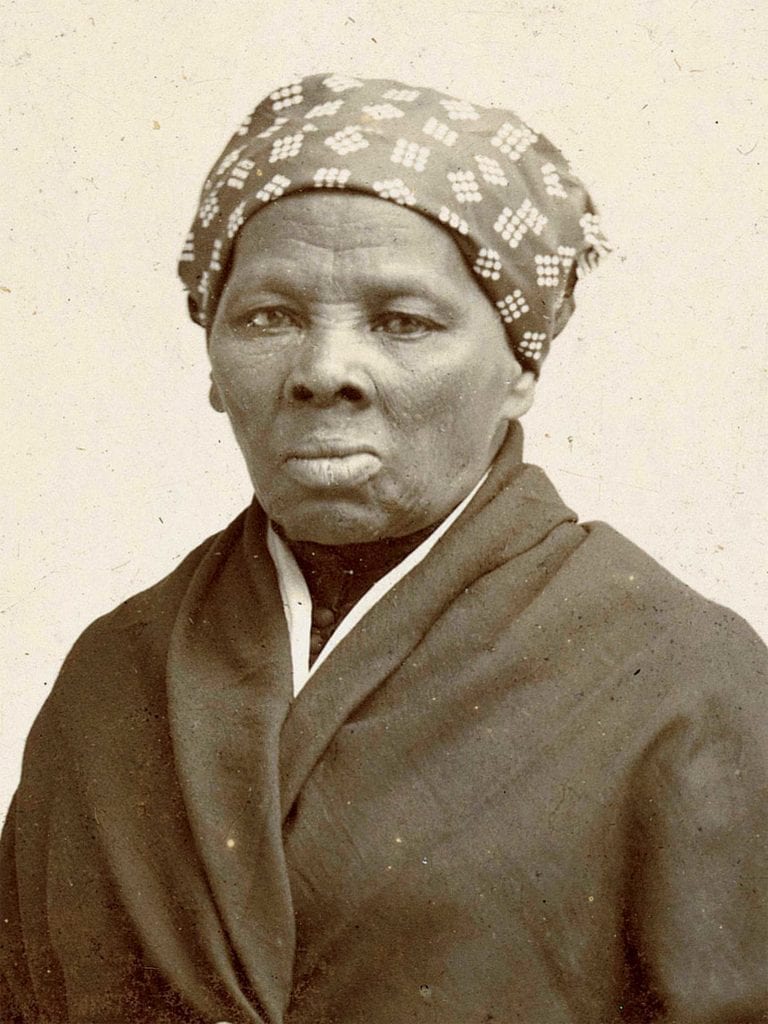
  1. Harriet Tubman (c. 1822–1913)
    Born Araminta Ross in Dorchester County, Maryland, Tubman escaped slavery in 1849 and went on to become the most famous conductor of the Underground Railroad. She made over 13 missions to the South, rescuing around 70 enslaved individuals, including family members. Tubman later served as a Union spy during the Civil War and advocated for women’s suffrage. She never had biological children but adopted a daughter, Gertie Davis, with her second husband, Nelson Davis. Her contribution is unparalleled in symbolizing Black resistance and unwavering commitment to freedom (Clinton, 2004).
  2. Frederick Douglass (1818–1895)
    Born Frederick Augustus Washington Bailey in Talbot County, Maryland, Douglass escaped slavery in 1838. He became a leading orator, abolitionist, writer, and statesman. His autobiographies, especially Narrative of the Life of Frederick Douglass, an American Slave, exposed the cruelty of slavery to a wide audience. Douglass married Anna Murray, a free Black woman who helped him escape, and they had five children. After Anna’s death, he married Helen Pitts, a white feminist. Douglass’s home in Rochester, New York, was a known stop on the Underground Railroad. He was also an advisor to President Abraham Lincoln (Blight, 2018).
  3. William Still (1821–1902)
    Often called the “Father of the Underground Railroad,” Still was a free Black man born in New Jersey. He documented the stories of hundreds of fugitives he helped through Philadelphia. His records, later published in The Underground Railroad (1872), are a crucial historical source. Still coordinated operations with conductors like Tubman and was instrumental in the Philadelphia Vigilance Committee. His brother, Peter Still, was enslaved, which gave William a personal stake in the cause (Still, 1872).
  4. Sojourner Truth (c. 1797–1883)
    Born Isabella Baumfree in Ulster County, New York, Truth escaped slavery in 1826. She became a powerful abolitionist and women’s rights advocate. Known for her speech “Ain’t I a Woman?”, she traveled across the nation preaching the injustices of slavery and gender inequality. Truth had five children and legally fought to recover her son, making her one of the first Black women to win a court case against a white man. While not a conductor per se, her speeches inspired the abolitionist cause deeply (Painter, 1996).
  5. Levi Coffin (1798–1877)
    A white Quaker and businessman from North Carolina, Coffin helped an estimated 3,000 slaves to freedom, earning him the title “President of the Underground Railroad.” He and his wife, Catharine, used their home in Indiana—and later Ohio—as a major depot. Though not Black himself, Coffin’s lifelong dedication to abolition was a crucial link in the network, showing interracial cooperation in the fight for justice (Coffin, 1876).

A Brief History of Slavery in the United States

Slavery in America began in 1619 with the arrival of the first enslaved Africans in Virginia. By the 18th century, chattel slavery had become a cornerstone of the Southern economy. Enslaved people were legally considered property, denied basic rights, and subjected to inhumane conditions, forced labor, sexual violence, and family separations.

By the early 1800s, over 4 million African Americans were enslaved in the United States. Resistance took many forms—rebellions, literacy, culture, and escape via the Underground Railroad. The psychological and physical torment endured under this system forged a legacy of trauma, resilience, and cultural endurance that shapes Black identity today.


Black Treatment by Society During the Period

Enslaved Black people were denied citizenship, education, autonomy, and family stability. The Fugitive Slave Acts (1793 and 1850) criminalized escape and punished those aiding fugitives. Free Blacks faced racial violence, segregation, and systemic disenfranchisement. Society regarded African Americans as subhuman, a sentiment codified in the infamous 1857 Dred Scott v. Sandford decision, which declared that no Black person could claim U.S. citizenship (Fehrenbacher, 1978).


Presidential Response: Abraham Lincoln and the Slavery Question

During the height of Underground Railroad activity, Abraham Lincoln (1809–1865), the 16th president, played a complicated role. Elected in 1860, Lincoln initially prioritized preserving the Union over ending slavery. However, his views evolved under the pressures of war and abolitionist influence. He issued the Emancipation Proclamation in 1863, which declared freedom for slaves in Confederate territories. While limited in scope, it marked a turning point in U.S. policy and helped shift the Civil War into a moral battle over slavery (McPherson, 1988).


Conclusion

The story of the Underground Railroad is one of profound moral courage and strategic resistance against one of the greatest evils in American history. Harriet Tubman, Frederick Douglass, and their allies—Black and white—offered the enslaved more than just escape; they embodied the possibility of a new life and future. These freedom fighters’ legacy endures in the ongoing struggle for racial justice, freedom, and human dignity.


References

  • Blight, D. W. (2018). Frederick Douglass: Prophet of Freedom. Simon & Schuster.
  • Clinton, C. (2004). Harriet Tubman: The Road to Freedom. Little, Brown and Company.
  • Coffin, L. (1876). Reminiscences of Levi Coffin. Western Tract Society.
  • Fehrenbacher, D. E. (1978). The Dred Scott Case: Its Significance in American Law and Politics. Oxford University Press.
  • Horton, J. O., & Horton, L. E. (1997). In Hope of Liberty: Culture, Community and Protest Among Northern Free Blacks, 1700-1860. Oxford University Press.
  • McPherson, J. M. (1988). Battle Cry of Freedom: The Civil War Era. Oxford University Press.
  • Painter, N. I. (1996). Sojourner Truth: A Life, A Symbol. W. W. Norton & Company.
  • Still, W. (1872). The Underground Railroad: Authentic Narratives and First-Hand Accounts. Porter & Coates.