
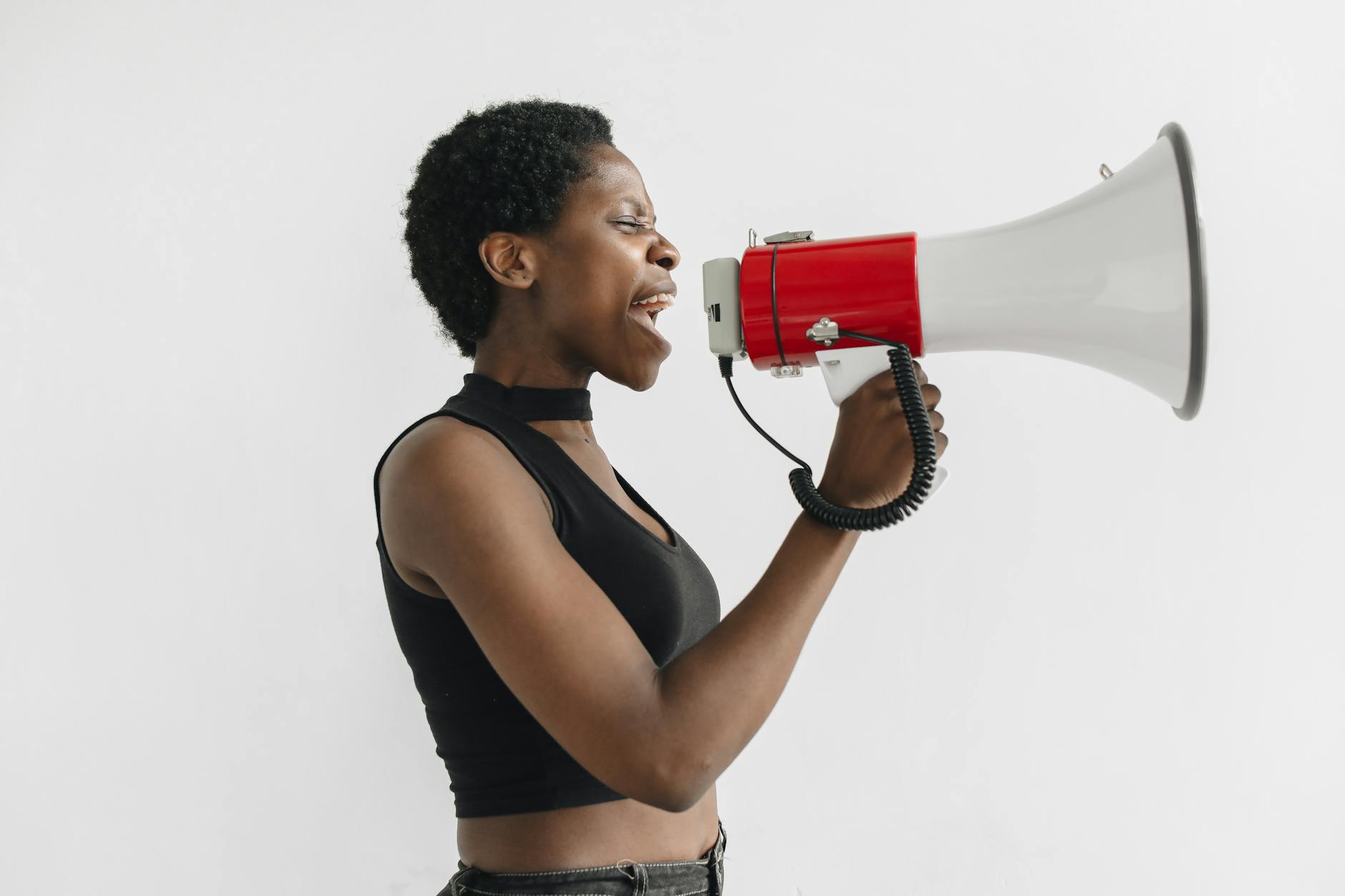
The assertion that “Brown girls are loud” functions as both a stereotype and a silencing mechanism. This phrase, often uttered casually or as social commentary, conceals a deeper historical bias against women of color who assert themselves vocally or emotionally. The term “loud” becomes a racialized label that delegitimizes self-expression while maintaining Eurocentric standards of femininity and decorum (Collins, 2000).
For centuries, the voices of Black and brown women have been controlled, muted, or mocked. Under slavery, colonization, and segregation, their words were often dismissed as irrational or impertinent. Today, these historical prejudices persist through modern stereotypes like the “angry Black woman” or the “fiery Latina,” both of which frame passionate communication as emotional instability (Walley-Jean, 2009). Thus, “loudness” becomes a weaponized term used to reassert social hierarchies.
To be called “loud” is rarely about volume; it is about visibility. When women of color speak confidently or express emotion, they challenge the systems designed to keep them silent. This so-called loudness is, in essence, a refusal to disappear. It is the sound of resistance echoing across generations who were denied speech.
The racialization of voice and tone stems from colonial constructs of civility. Western norms associated femininity with quietness, politeness, and restraint — ideals rooted in white, patriarchal structures (hooks, 1981). Any deviation from this mold was deemed unruly or primitive. For brown women, whose cultural communication styles are often rich in rhythm, gesture, and emotion, this framework was particularly limiting.
The result is tone-policing: a subtle but pervasive form of control where the manner of a woman’s speech overshadows the content of her message. In classrooms, workplaces, and media, brown women are often told to “calm down,” “lower their voices,” or “speak professionally.” These directives disguise racial discomfort as etiquette (Pittman, 2012).
In educational spaces, this dynamic begins early. Studies show that Black girls are more likely to be disciplined for “disruptive behavior” even when engaging in classroom discussion (Morris, 2016). What is interpreted as rudeness or defiance is often simple participation, filtered through racial bias. The message received is clear: intellectual curiosity and emotional expression are dangerous when spoken in a brown voice.
Over time, many young women of color internalize this message. They learn to perform quietness as a form of protection — softening their tone, diluting their opinions, and practicing invisibility to avoid social punishment. This self-censorship comes at the cost of authenticity and mental well-being (Jones & Norwood, 2017).
The workplace continues this narrative of containment. Brown women who are assertive in leadership are often labeled “intimidating” or “difficult.” The corporate world rewards those who fit neatly within the norms of “professionalism,” which are historically white and male-centered (Wingfield, 2010). Thus, emotional expressiveness and cultural authenticity are misread as unprofessionalism rather than strength.
Yet the so-called “loudness” of brown women has fueled some of the most transformative movements in history. From Sojourner Truth’s “Ain’t I a Woman?” speech to Fannie Lou Hamer’s testimony during the Civil Rights Movement, loudness has always been synonymous with liberation (Guy-Sheftall, 1995). The voice has functioned as both weapon and witness.
In artistic and spiritual traditions, voice is sacred. Within African and Afro-diasporic communities, song and speech have long served as vessels for memory and survival. From the griots of West Africa to the blues singers of the American South, the act of speaking — or singing — truth aloud is a form of cultural continuity (Gates, 1988).
Brown women’s expressiveness must therefore be understood within this historical continuum. Their tone is not aggression but ancestral resonance. The cadence, warmth, and emotionality of their voices carry centuries of resilience. To misinterpret that as loudness is to mishear history itself.
Media representations, however, continue to distort this narrative. Television and film often portray brown women as “sassy,” “overly dramatic,” or “ghetto,” reinforcing the myth that they lack emotional control (Gray, 2013). These depictions not only shape public perception but also influence how brown women see themselves.
Representation, as bell hooks (1992) reminds us, is a site of struggle. When brown women are consistently portrayed as one-dimensional caricatures, the world forgets that their “loudness” has context — a response to generations of silence and misrepresentation.
Nevertheless, modern movements in art and media are reclaiming the narrative. Figures like Issa Rae, Viola Davis, and Michaela Coel embody unapologetic authenticity, turning what was once labeled as “too much” into a badge of power. Their presence affirms that loudness and grace can coexist.
Community also plays a crucial role in healing the internal wounds caused by tone-policing. Safe spaces where brown women can speak freely — whether through sister circles, creative writing, or therapy — allow them to rediscover the sound of their unfiltered voices. These spaces become sanctuaries of affirmation.
Spiritual traditions, especially within the African diaspora, have long affirmed the power of voice. In the Black church, for example, “call and response” reflects communal validation — a sacred rhythm where one voice calls forth another. This cultural form rejects Western silence and instead celebrates collective expression (Lincoln & Mamiya, 1990).
The intersection of race, gender, and expression requires a reimagining of what it means to communicate effectively. Emotional expression should not be pathologized but valued as an indicator of passion, creativity, and humanity (Lord, 2000).
Moreover, educators and employers must practice cultural humility — learning to interpret communication through a multicultural lens rather than penalizing difference. This shift from tolerance to understanding is essential to dismantling linguistic bias.
For brown girls and women, unlearning internalized shame takes courage. It involves reclaiming the parts of oneself that were silenced, mocked, or misunderstood. It is a journey toward self-definition, where voice becomes both therapy and testimony.
Healing means allowing oneself to be “too much” in a world that demands less. It means crying loudly, laughing deeply, and speaking boldly — not for validation but liberation.
Cultural pride also strengthens this reclamation. By reconnecting with heritage, language, and tradition, brown women remember that expressiveness is not a flaw but a legacy. Their voices echo the resilience of ancestors who refused silence even when the cost was life itself.
When society tells brown women to quiet down, it is not requesting peace but compliance. Loudness, then, becomes a form of protest — an assertion of life in the face of erasure.
The “Brown Girl Blues” encapsulates the emotional dissonance of being seen yet unheard. It is the ache of visibility without validation, of expression met with resistance. Yet it also symbolizes beauty — the soulful rhythm of survival set to the melody of truth.
To be called “loud” is to be told that your presence disrupts. But disruption births change. In reclaiming the label, brown women transform insult into empowerment, noise into narrative, and stereotype into song.
Today’s brown girls stand on the shoulders of those who dared to speak when speaking was forbidden. Their loudness is not rebellion — it is inheritance.
The world must learn to listen differently. To hear not volume, but value. To perceive not threat, but truth.
For when brown girls speak, they do not merely raise their voices; they raise history. Their sound reverberates through time as proof that silence never saved anyone.
So, the next time the world says, “Brown girls are loud,” the answer should be unapologetic: “Yes, we are — and the world is finally listening.”
References
Collins, P. H. (2000). Black feminist thought: Knowledge, consciousness, and the politics of empowerment. Routledge.
Gates, H. L. (1988). The signifying monkey: A theory of African-American literary criticism. Oxford University Press.
Gray, H. (2013). Cultural moves: African Americans and the politics of representation. University of California Press.
Guy-Sheftall, B. (Ed.). (1995). Words of fire: An anthology of African-American feminist thought. The New Press.
hooks, b. (1981). Ain’t I a woman: Black women and feminism. South End Press.
hooks, b. (1992). Black looks: Race and representation. South End Press.
Jones, C., & Norwood, K. (2017). Aggressive, angry, and affirming: Black women’s labor, speech, and resistance. Communication and Critical/Cultural Studies, 14(3), 253–273.
Lincoln, C. E., & Mamiya, L. H. (1990). The Black church in the African American experience. Duke University Press.
Lord, A. (2000). Sister outsider: Essays and speeches. Crossing Press.
Morris, M. W. (2016). Pushout: The criminalization of Black girls in schools. The New Press.
Pittman, C. T. (2012). Racial microaggressions: The narratives of African American women in the workplace. The Journal of Black Psychology, 38(2), 185–205.
Walley-Jean, J. C. (2009). Debunking the myth of the “angry Black woman”: An exploration of anger in young African American women. Black Women, Gender + Families, 3(2), 68–86.
Wingfield, A. H. (2010). Are some emotions marked “whites only”? Racialized feeling rules in professional workplaces. Social Problems, 57(2), 251–268.
 THE BROWN GIRL DILEMMA