
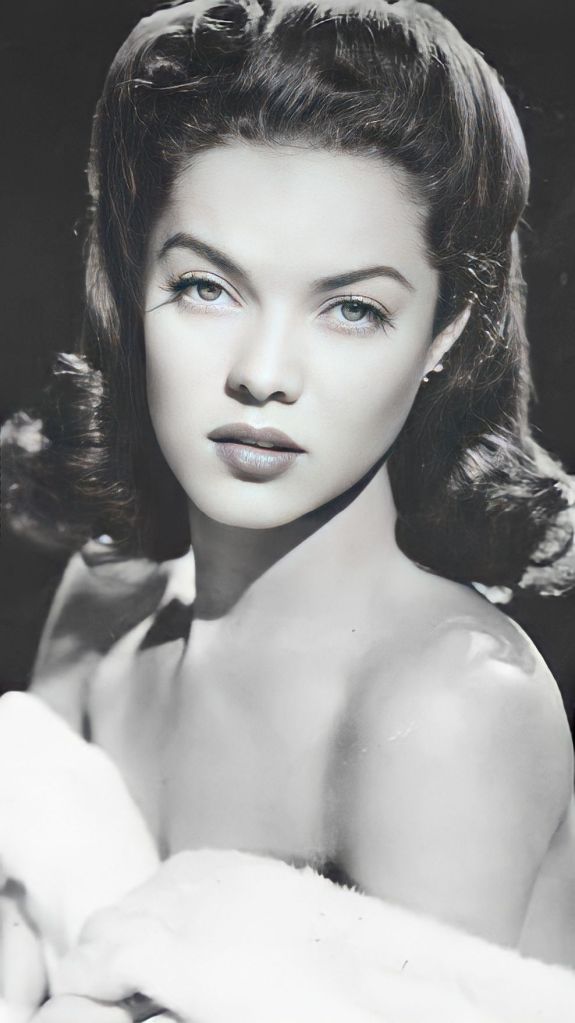
Dona Drake occupies a complex and often painful place in Hollywood history as a woman of color who was forced to “pass” as white and Latina to survive within a racially segregated film industry. Born Eunice Westmoreland in the early twentieth century, Drake’s career reveals the psychological and structural pressures placed on racially ambiguous performers in an era when Black identity was treated as a professional death sentence. Her story is not merely one of personal reinvention, but of institutional coercion, cultural erasure, and racial deception demanded by Hollywood itself.
Drake was born in 1914 to African American parents, despite later studio narratives claiming she was of Spanish or Latin descent. Her father, Amos Westmoreland, was a Black vaudeville performer, and her mother was also African American. This factual lineage directly contradicts the racial mythology constructed around her public persona, illustrating how studios deliberately rewrote her identity to make her palatable to white audiences.
In the 1930s and 1940s, Hollywood operated under a rigid racial caste system shaped by Jim Crow ideology, the Production Code, and deeply entrenched white supremacy. Black actresses were almost exclusively limited to roles as maids, mammies, or comic relief, for a light-skinned woman like Drake, passing offered a pathway into lead roles, romance, and upward mobility that would otherwise be inaccessible.
Drake first entered Hollywood under the name “Dona Drake” in the early 1940s, a carefully crafted identity that obscured her African American origins. Studios promoted her as “Mexican,” “Spanish,” or “Latin American,” depending on the role, allowing her to be cast in exoticized but non-Black parts. This racial ambiguity functioned as a form of commercial camouflage, enabling her to navigate a racist system while concealing her true heritage.
Her most notable film appearances during this period included roles in Road to Morocco (1942) and The Falcon in San Francisco (1945), where she was marketed as a glamorous “foreign” woman rather than a Black American. These roles would have been impossible had her racial background been publicly known, revealing how Hollywood’s casting practices were fundamentally racialized and exclusionary.
Drake’s passing was not merely professional but psychological. To maintain her career, she had to continuously deny her family, ancestry, and community. This form of racial performance required constant vigilance, as discovery could mean immediate blacklisting. Passing thus became a survival strategy rooted in fear rather than freedom.
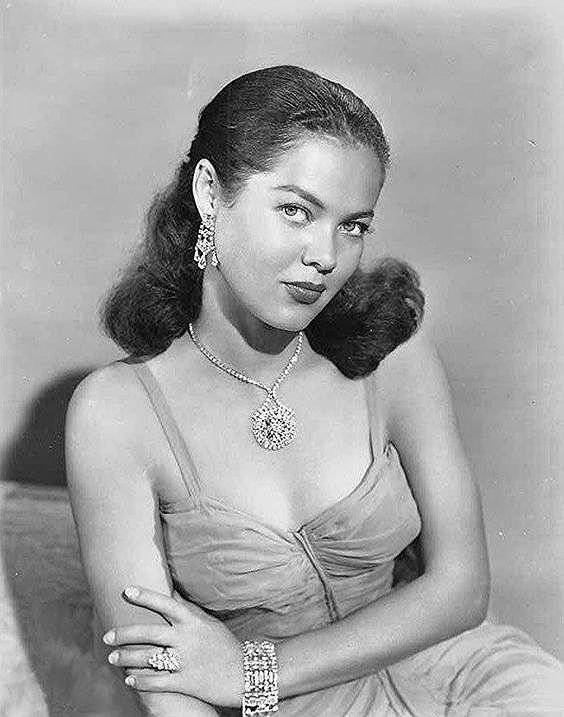
In 1941, Drake also performed under the name “Rita Rio” during her singing and nightclub career, another identity layer that distanced her from Blackness and aligned her with Latin exoticism. These shifting names reflect how racial identity in Hollywood was not self-defined but corporate-controlled, reshaped to fit market demands.
Hollywood actively taught Drake how to lie about herself. Studio publicists constructed false biographies, altered her speech patterns, and discouraged any association with Black spaces or people. This training in racial deception was not unique to Drake but part of a broader system in which light-skinned performers were coached to “perform whiteness” as a professional skill.
The reason Drake wanted to be perceived as white or non-Black was rooted in the brutal reality of racial economics. Black actresses earned less, had fewer roles, and were denied romantic narratives. Passing offered access to dignity, complexity, and visibility in a world that refused to humanize Black women on screen.
However, Drake’s success was fragile. As racial scrutiny increased and Hollywood’s gossip culture intensified, questions about her background followed her throughout her career. The constant pressure of concealment reportedly took an emotional toll, contributing to personal struggles and career instability later in life.
Drake’s downfall reflects the psychological cost of racial erasure. Passing requires not only external performance but internal fragmentation, where one must suppress authentic identity to maintain social survival. Scholars often describe this as a form of racial dissociation or identity splitting.
Her story also exposes the hypocrisy of Hollywood’s racial politics. While studios claimed to celebrate diversity through “ethnic” characters, they simultaneously excluded real Black identity, preferring racial fantasy over racial truth. Drake’s Latin persona was acceptable precisely because it was not Black.
From a sociological perspective, Drake represents what W.E.B. Du Bois called “double consciousness,” the internal conflict of seeing oneself through the eyes of a society that devalues your true identity. Her life illustrates how racial passing is not individual deception but structural coercion embedded in white supremacy.
Drake never publicly reclaimed her Black identity during her lifetime, which reflects how deeply the fear of racial exposure had been internalized. Even in death, her racial background remained contested, showing how thoroughly her original identity had been overwritten by Hollywood myth.
Dona Drake’s legacy forces us to confront uncomfortable truths about representation, race, and survival. She was not simply pretending to be white; she was responding rationally to a system that punished Blackness and rewarded proximity to whiteness. Her life stands as a historical case study in racial capitalism and identity trauma.
Ultimately, Drake’s passing reveals that Hollywood did not merely reflect racism; it engineered it. By forcing performers like her to erase themselves, the industry taught generations that Black identity was something to escape rather than embrace. Her story is not about individual shame, but about institutional violence against Black existence itself.
References
Bogle, D. (2016). Toms, coons, mulattoes, mammies, and bucks: An interpretive history of Blacks in American films (5th ed.). Bloomsbury.
Du Bois, W. E. B. (2007). The souls of Black folk. Oxford University Press. (Original work published 1903)
Gaines, J. M. (2017). Fire and desire: Mixed-race movies in the silent era. University of Chicago Press.
Hoberman, J. (2018). Hollywood and the color line. Film Quarterly, 71(3), 12–19.
Smith, S. (2019). Passing and performance: Racial ambiguity in classical Hollywood. Journal of American Culture, 42(2), 145–158.
 THE BROWN GIRL DILEMMA