
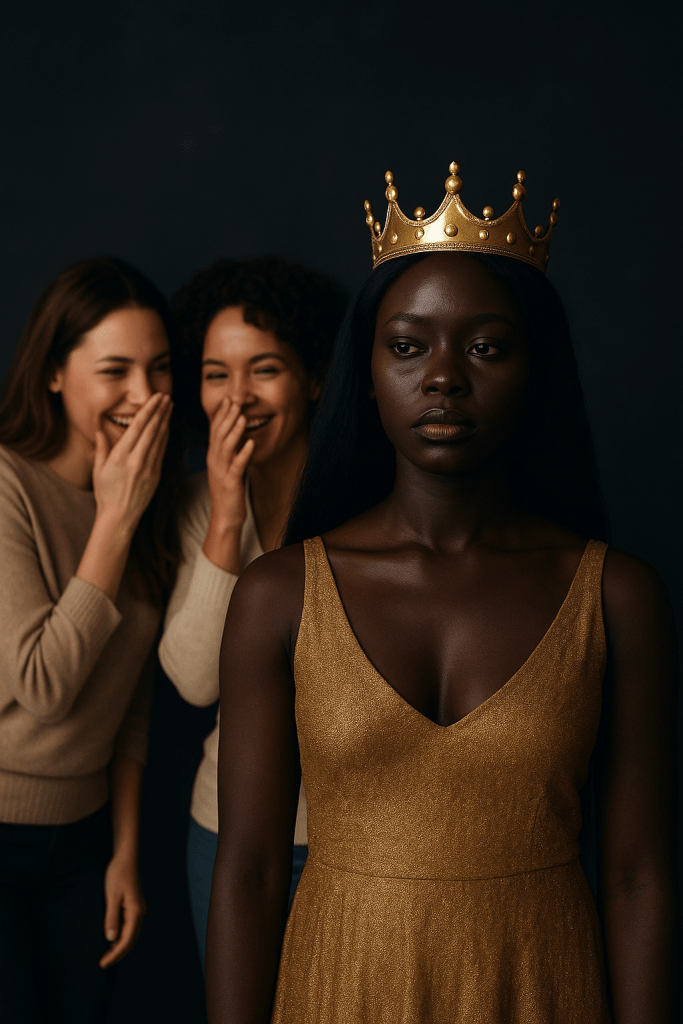
The conversation around beauty in the Black community is incomplete without examining the “light-skinned illusion”—the socially constructed belief that lighter skin inherently equals greater beauty, value, and opportunity. This illusion was not born organically; it was engineered by systems of racial domination, refined through centuries of media messaging, and internalized in ways that continue to shape identity, desirability, and self-worth. To understand its power is to confront both history and the psychological imprint of colonial beauty standards.
Light skin in the African diaspora carries a unique duality. On one hand, it is placed on a pedestal in many societal contexts. On the other, it often carries the burden of resentment, suspicion, and stereotype within the community. This paradox sits at the intersection of privilege and pain, advantage and alienation. The illusion promises elevation, yet it often delivers conflict and confusion.
The roots of the light-skinned illusion trace back to slavery, where proximity to whiteness became synonymous with proximity to power. Lighter-skinned enslaved people—often born of violence and exploitation—were sometimes afforded different labor roles, better clothing, or limited education. These differences were not gifts; they were control mechanisms designed to divide Black unity and reinforce white supremacy. Beauty became racial hierarchy in physical form.
Colonialism extended these ideologies globally. Across Africa, the Caribbean, and the Americas, skin bleaching industries flourished because European aesthetics were marketed as the pinnacle of desirability and modernity. Lighter skin was framed not only as beautiful, but as aspirational—a passport to social mobility. It became beauty not by nature, but by propaganda.
Modern media continued the cycle. For decades, lighter-skinned actresses, models, and entertainers were promoted as the preferred face of Black beauty. Hollywood offered glamour to the light-skinned woman while offering caricature or invisibility to her darker-skinned sister. Magazine covers, music videos, and advertising reinforced the notion: lighter was safer, marketable, and more palatable to mainstream audiences.
Yet the illusion has a cost. The light-skinned woman is often reduced to symbol rather than self. Society expects her to embody a fantasy of softness, delicate femininity, and non-threatening Blackness. When she asserts identity beyond these constraints, she is judged more harshly, as though she is breaking a contract she never signed. The pedestal becomes a cage.
Within the Black community, she may find her beauty questioned as unearned, her achievements dismissed as byproducts of complexion privilege. Genuine talent or character may be overshadowed by assumptions that she “has it easier.” The illusion creates resentment—not because of who she is, but because of what history made her skin represent. She often stands at the crossroad of envy, desire, and historical trauma.
Relationships add another layer. Some men idolize light skin not out of love, but out of internalized hierarchy. Others avoid dating light-skinned women out of fear of stereotype or backlash. In both extremes, she becomes object rather than individual. True intimacy requires seeing her beyond complexion—but the illusion blinds many.
Psychologically, the light-skinned woman may battle identity confusion—simultaneously envied and distrusted, desired yet doubted. She may feel pressure to prove her Blackness, perform humility, or apologize for advantages she did not ask for. Beauty becomes labor, not liberation. And while she benefits from the illusion, she also suffers from it.
Spiritually, this tension reflects humanity’s broken vision. Scripture warns against judging by appearance: “For man looketh on the outward appearance, but the Lord looketh on the heart” (1 Samuel 16:7, KJV). God does not elevate one shade of melanin over another. It is mankind that builds hierarchies where Heaven has none. The illusion is not divine design; it is human distortion.
In truth, the light-skinned woman’s beauty is real—but it is not a superior category. Her radiance is simply one expression of a wide and wondrous Black spectrum. When culture elevates her above others, it dishonors not only dark-skinned women, but the fullness of God’s creation. Beauty, in its truest form, is variety without hierarchy.
The light-skinned illusion harms dark-skinned women through exclusion, but it also harms light-skinned women through expectation. It demands that she embody perfection, gentleness, and gratitude for privileges she may not feel she possesses. It robs her of complexity, humanity, and sometimes community.
Breaking this illusion does not require diminishing light-skinned beauty—it requires dethroning it. The goal is not reverse hierarchy but liberation from hierarchy altogether. To recognize all beauty as valid without ranking it is to heal the wound left by oppression.
Healing begins with truth-telling. It means acknowledging colorism without hostility, privilege without guilt, and pain without blame. It asks the light-skinned woman to stand in sisterhood—not defensively, but consciously. And it asks the community to see her not as symbol, but as soul.
Culturally, we are witnessing a shift. Dark-skinned beauty is receiving overdue celebration. Afrocentric features are embraced. Natural hair crowns run proudly and unapologetically. This evolution does not erase the illusion yet, but it destabilizes it. New generations breathe freer.
Still, true liberation requires vigilance. Systems do not dissolve without intention. We must continually interrogate our language, attraction patterns, media consumption, and subconscious biases. Beauty must become communal dignity, not competitive economy.
The light-skinned woman, when rooted in self-awareness and humility, becomes part of the solution. She models grace by affirming others’ beauty without feeling diminished. She rejects pedestal identity and embraces purpose identity. Her beauty becomes a bridge, not a barrier.
Ultimately, the illusion crumbles when we embrace divine truth: that melanin is miracle in every shade. No hue of brown is accidental. Each tone reflects a facet of sacred design. When the community remembers this, beauty ceases to divide and begins to restore.
For the light-skinned woman, freedom comes not in denying privilege, nor in carrying shame, but in embracing identity that transcends complexion. She is not illusion; she is creation. And her power lies not in being preferred, but in choosing to stand with, not above, her sisters.
References
Hunter, M. (2002). “If you’re light you’re alright”: Light skin color as social capital for women of color. Gender & Society, 16(2), 175–193.
Russell, K., Wilson, M., & Hall, R. (2013). The color complex: The politics of skin color in a new millennium. Anchor Books.
Wilder, C. S. (2015). Ebony and ivy: Race, slavery, and the troubled history of America’s universities. Bloomsbury.
1 Samuel 16:7 (KJV).
 THE BROWN GIRL DILEMMA