
Tag Archives: Business

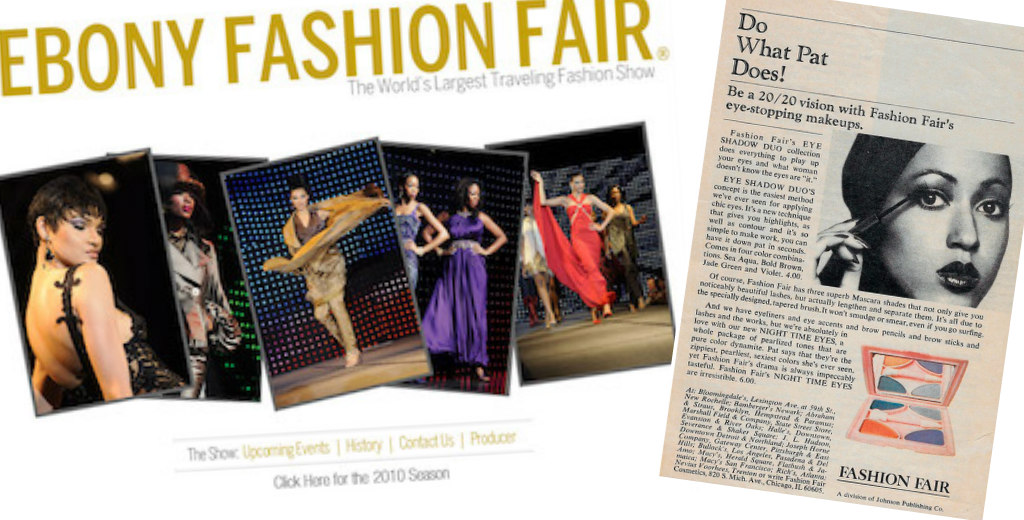
💄 Shades of Success: The Fashion Fair Legacy 💄

These advertisements are the property of their respective owners.

💄💄💄💄

Fashion Fair Cosmetics was founded in 1973 by Eunice Johnson, the trailblazing wife of John H. Johnson, founder of Ebony and Jet magazines. Born Eunice Walker in Selma, Alabama, in 1916, she married John in 1941 and became an influential force in both publishing and fashion. The couple had one daughter, Linda Johnson Rice, who would later lead Johnson Publishing Company. Eunice Johnson’s vision for Fashion Fair emerged from her experience organizing the Ebony Fashion Fair, a traveling fashion show she began in 1958 to raise money for Black charities. While touring, she discovered a lack of makeup shades for darker skin tones—prompting her to create a cosmetics line specifically designed for women of color (Taylor, 2016).

The Fashion Fair brand quickly became an international success. Ebony and Jet magazines, both owned by Johnson Publishing, were instrumental in promoting the cosmetics line, featuring glamorous spreads of Black models such as Pat Cleveland, Barbara Summers, and Jennifer Lawson. These models embodied elegance and sophistication, challenging Eurocentric beauty norms. The line expanded beyond foundation and lipsticks to include skincare products, eventually becoming the largest Black-owned cosmetics company in the world. At its peak in the late 1970s and 1980s, Fashion Fair reportedly generated annual revenues exceeding $20 million from its cosmetics division alone (Byrd & Tharps, 2014). While its core was cosmetics, the company did not primarily sell clothing; instead, the Ebony Fashion Fair fashion shows featured high-end designer garments from global couture houses as part of its fundraising and branding strategy.

✨ Ebony Fashion Fair vs. Fashion Fair Cosmetics ✨

Ebony Fashion FairFashion Fair Cosmetics
Founded: 1958 by Eunice Johnson as a traveling fashion show.Founded: 1973 by Eunice Johnson as a cosmetics line for women of color.
Purpose: Raise funds for African American charities while showcasing high fashion to Black audiences.Purpose: Provide makeup shades that catered specifically to darker skin tones, which were ignored by mainstream beauty brands.
Products: No physical products for sale; featured garments from top designers like Yves Saint Laurent, Givenchy, and Oscar de la Renta.Products: Cosmetics (foundation, lipsticks, eyeshadow, skincare), with shades suited for a diverse range of Black complexions.
Promotion: Advertised in Ebony and Jet magazines, plus national press; toured across the U.S., Canada, and Caribbean.Promotion: Featured in Ebony and Jet magazines, department store counters, and special events tied to the fashion shows.
Key Figures: Models like Pat Cleveland, Barbara Summers, and Jennifer Lawson graced the runway.Key Figures: Many of the same Ebony Fashion Fair models were used in cosmetics ads, linking beauty and fashion images.
Impact: Elevated Black representation in haute couture, inspiring cultural pride.Promotion: Advertised in Ebony and Jet magazines, plus national press; toured across the U.S., Canada, and the Caribbean.

The era of Fashion Fair’s dominance spanned the 1970s through the 1990s, a time when Black representation in beauty and fashion industries was still severely limited. The brand’s products filled a void in the marketplace, offering shades that had never been available in mainstream beauty lines. Fashion Fair not only thrived financially but also reshaped the beauty landscape by validating and celebrating darker skin tones. Even as competition grew in the 2000s, the company’s legacy as a cultural pioneer remained strong, influencing today’s inclusive beauty brands. Eunice Johnson’s work stands as a testament to how one woman’s vision—rooted in cultural pride and social responsibility—could transform both an industry and the self-image of generations of Black women.


References

Byrd, A. D., & Tharps, L. L. (2014). Hair story: Untangling the roots of Black hair in America (2nd ed.). St. Martin’s Press.

Taylor, U. Y. (2016). The promise of patriarchy: Women and the Nation of Islam. University of North Carolina Press.


Entrepreneurship in the Black Community.

The Hustle and the Heart: Blending definitions, data, real voices, practical insights, and broader purpose.


Photo by Christina Morillo on Pexels.com

What Is Entrepreneurship?

At its core, entrepreneurship is the act of identifying and pursuing opportunities beyond the resources currently controlled. Harvard scholar Howard Stevenson defines it as “the pursuit of opportunity beyond resources controlled,” while Stanford frames it as striking out on an original path to create a business, assuming risk, and standing to reap rewards.Investopedia.

The term itself, “entrepreneur,” comes from the French entreprendre, meaning “to undertake.” Early theorists like Jean-Baptiste Say and later scholars such as Schumpeter emphasized entrepreneurs as pivotal agents of innovation, economic dynamism, and creative disruption.Investopedia


How Does It Affect the Black Community?

Entrepreneurship within the Black community carries profound social and economic significance:

  • Economic Contribution: Black-owned businesses contribute significantly—over 5 million Black entrepreneurs represent around 14.5% of all business owners, generating $207 billion in economic impact and providing 1.3 million jobs.Association for Enterprise Opportunity
  • Recent Growth Trends: From 2017 to 2022, employer businesses owned by Black Americans grew by 56.9%, adding more than 70,000 new employer firms.Brookings
  • Ongoing Underrepresentation: Yet, the share of Black-owned employer firms remains low—just 3.3% compared to a 14.4% share of the population.BrookingsPew Research Center
  • Financial Disparities: Black women lead new ventures, but face revenue gaps—average yearly revenue for Black-owned businesses stands significantly lower than their non-minority counterparts ($58k vs. $170k).WifiTalentsMarketing Scoop
  • Barriers to Capital: Nearly half of Black entrepreneurs cite difficulty accessing funding. Only 1% of Black-owned businesses receive bank loans in their first year, compared to 7% for white-owned firms.Expert BeaconMarketing Scoop

Top Black Entrepreneurs Leading the Way

Here are several prominent names making waves:

  • Kathryn Finney – Founder of Genius Guild, a $20 million venture fund for Black entrepreneurs, and The Doonie Fund, supporting Black women founders.Wikipedia
  • Derrius Quarles – Co-founder of BREAUX Capital (fintech for Black men) and Million Dollar Scholar, helping students secure scholarships. He’s been celebrated by outlets including CNN and recognized with awards like Obama’s Points of Light.Wikipedia
  • Eric Collins – Influential UK investor, author, and host of The Money Maker, dedicated to investing in underrepresented entrepreneurs.Wikipedia

Their work underscores the intersection of entrepreneurship, empowerment, and community impact.


The Science of Money: Financial Foundations for Entrepreneurs

An entrepreneurial journey is tied deeply to financial understanding:

  • Bootstrapping & Human Capital: Entrepreneurs often rely on their own time, ideas, and minimal funds—a strategy aligned with the definition of entrepreneurship that includes starting beyond available resources.Investopedia
  • Capital Access Disparities:

These gaps reflect structural inequities that hinder access to capital and growth.


Tips on Becoming an Entrepreneur

  • Consistency & Mindset: As one aspiring Black entrepreneur shared: “Mindset and consistency. Those two dynamics have affected my trajectory… more often than not… imposter syndrome.”Reddit+1
  • Build Skills: Know your competition, audience, and practice time management and clear short-term goals.Reddit
  • Leverage Alternative Capital: Seek credit unions, community development financial institutions (CDFIs), online lenders, or funds focused on underserved entrepreneurs.BrookingsAfricans in America
  • Join Support Ecosystems: Entrepreneurship centers, community networks, and mentorship platforms provide strategic support and guidance.

How Many Black People Become Entrepreneurs Annually?

  • New Employer Firms: Between 2017 and 2022, over 70,000 new Black-owned employer businesses launched.Brookings
  • Existing Scale: In 2022, there were close to 195,000 majority Black-owned firms, a steep rise from 124,000 in 2017.Pew Research Center

These numbers highlight significant growth—though the overall representation remains comparatively modest.


What Does It Take & What Is the Success Rate?

Becoming a successful entrepreneur requires:

  • Resourcefulness in bootstrapping ventures.
  • Financial savvy with money management and capital strategies.
  • Resilience to overcome systemic hurdles and self-doubt.
  • Vision and leadership, especially when scaling to employer-level businesses.

Data on survival shows challenges:

  • Sole proprietorships, which account for 96% of Black-owned businesses, have high failure rates—22% close within a year, compared to 13% for white counterparts.Brookings

Why Is It Important?

Entrepreneurship in Black communities enriches at multiple levels:

  • Empowerment: It’s a pathway to autonomy, wealth creation, and breaking generational cycles.
  • Representation: Entrepreneurs like Finney, Quarles, and Collins serve as role models and expand perceptions of who can lead.
  • Economic Impact: If business ownership matched population share, Black-owned businesses could add $824 billion and 6.3 million jobs nationwide.Brookings
  • Social Innovation: Many Black founders address community needs—whether through financial inclusion, education access, or cultural platforms.

Voices of Experience

A real-life voice of resilience and reflection from Reddit:

“Even when I’m talking about something I know … I still feel inadequate… imposter syndrome.”
“Racism… people don’t see you as skilled enough—they dismiss you.”Reddit+1

These sentiments echo across many aspiring entrepreneurs, underscoring the emotional and systemic battles faced.


Conclusion

Entrepreneurship for Black communities is about more than business—it blends hustle, heart, vision, and transformation. While growth is undeniable, barriers persist. Success requires financial strategy, foundational resilience, access to capital and networks, and the courage to lean into identity and innovation. As more Black entrepreneurs rise, they widen the path for future generations—creating not only economic value, but lasting cultural and systemic shifts.

*********************References**********************

Entrepreneurial Definitions & Theory

  • Investopedia: Defines entrepreneurship as opportunity pursuit beyond controlled resources and traces its etymological roots to French and early theorists like Say and Schumpeter. USAFacts (embedded via related Investopedia sources)

2. Scale, Growth & Economic Impact of Black Entrepreneurship

  • U.S. Census Annual Business Survey / Pew Research Analysis (2022): About 194,585 majority Black-owned firms (≈3% of U.S. companies), marking a leap from 124,000 in 2017; gross revenues rose 66%, from $127.9 billion to $211.8 billion. These businesses employed ~1.6 million people with $61.2 billion in payroll. Pew Research Center
  • USAFacts (2021): Recorded 161,031 Black-owned businesses employing over 1.4 million, generating $206.1 billion. Growth since 2017 outpaced all U.S. businesses. USAFacts
  • Brookings Institute: From 2017–2022, Black-owned employer-businesses grew by 56.9%—adding 70,000 new firms and $212 billion in revenue; Black entrepreneurs lag behind population parity. Brookings
  • Governing.com: Employer firms owned by Black entrepreneurs rose from 2.2% (2017) to 3.3% (2022), albeit still short of the 14.4% Black population share. Governing
  • EPOP fact sheet (2024): ~5 million Black entrepreneurs in the U.S. (14.5% of all business owners); substantial economic impact including $207 billion in revenue and 1.3 million jobs. EPOP

3. Black Women & Capital Barriers

  • Business Insider & LendingTree: In 2022, Black-owned businesses made up 3.3% of all businesses—a 22% year-over-year increase; 39.1% of Black-owned businesses are women-run (well above the general average), but access to capital remains severely limited. LendingTreeInc.com
  • SBA small business data / SBA infographic (2024): 3.5 million Black-owned businesses in U.S., employing over 1.2 million—reflecting annual employment growth over 7%. Office of Advocacy
  • Wikipedia on Black Women Entrepreneurs: Highlights historical exclusion from capital; 75% of Black women founders cite funding access as a barrier, relying heavily on personal savings or credit. Wikipedia

4. Example Black Entrepreneurs

  • Kathryn Finney: Launched Genius Guild, a $20M+ venture fund targeting scalable Black-led businesses; published Build the Damn Thing (Wall Street Journal bestseller). Wikipedia
  • Derrius Quarles: Co-founder of BREAUX Capital, a fintech platform for Black men focusing on collective investing and financial wellness; recognized on Inc.’s 30 Under 30. Wikipedia

5. Broader Context & Initiatives

  • Time / Erin Horne McKinney: Leading entrepreneurship efforts via HBCUs—founding a center at Howard University to support Black founders amid persistent funding gaps. TIME

6. National Trends & Growth Drivers

  • AP News (2023): Small business applications hit record highs—5.5 million new filings, with Black entrepreneurs accounting for about 6% of new business owners, doubling from pre-pandemic rates. AP News
  • Time Magazine: Noted a 19% surge in Black-owned businesses, outpacing national averages, alongside increases in household wealth among Black Americans. TIME
  • Axios (Indianapolis Focus): Marion County (Indy) saw remarkable gains in new Black business applications and revenue—yet capital access remains a challenge. Axios

Summary Table

TopicSource & Key Insight
Scale & GrowthCensus, Pew, USAFacts, Brookings, Governing, EPOP
Women-led BusinessesLendingTree, SBA data, Wikipedia on Black women entrepreneurs
Entrepreneur ExamplesKathryn Finney, Derrius Quarles
Capital & Institutional SupportTime (HBCU initiatives)
Broader TrendsAP News, Time, Axios (local trends)

Building Economic Legacy

A Comprehensive Guide to Entrepreneurship, Business Structures, and Wealth Creation for Black Entrepreneurs.

Photo by Tom Fisk on Pexels.com

The pursuit of economic independence has long been recognized as a pathway to freedom, stability, and generational wealth. For African Americans, entrepreneurship holds the potential to counter historical economic exclusion and build lasting community assets. However, starting a business requires more than ambition—it demands strategic planning, legal knowledge, and financial literacy. This essay explores the steps to start a business, the distinctions between entrepreneurship and business ownership, the formation of legal entities such as LLCs and C-Corporations, business credit development, and the importance of structures such as trusts for long-term protection.


I. Understanding Entrepreneurship vs. Business Ownership

Although often used interchangeably, entrepreneurship and business ownership are distinct. Entrepreneurship is the process of identifying, developing, and bringing a new idea, product, or service to market—often involving innovation and risk-taking (Drucker, 1985). Business ownership, in contrast, may involve operating an established business model without necessarily creating something new (Scarborough & Cornwall, 2018). An entrepreneur may be a business owner, but not all business owners are entrepreneurs.

  • Entrepreneurship = Innovation + Risk + Vision.
  • Business Ownership = Management + Profitability + Stability.

For Black entrepreneurs, understanding this distinction is key in determining whether the goal is to disrupt industries with new ideas or to operate a sustainable, income-generating business.


II. What It Takes to Start a Business

Starting a business requires several key steps:

  1. Concept Development – Defining the value proposition and target market.
  2. Market Research – Studying competitors, industry trends, and customer needs (Kotler & Keller, 2016).
  3. Business Planning – Creating a written plan with goals, budgets, and operational strategies.
  4. Legal Structure Selection – Choosing the appropriate entity (LLC, C-Corp, S-Corp, sole proprietorship).
  5. Funding – Securing startup capital through personal savings, loans, grants, or investors.
  6. Compliance – Registering the business, obtaining licenses, and meeting regulatory requirements.
  7. Marketing and Sales – Building a brand and generating revenue streams.

III. Forming an LLC vs. C-Corporation

Limited Liability Company (LLC)

  • Flexible structure, minimal formalities, and pass-through taxation.
  • Best for small-to-medium businesses or those seeking asset protection with simplified operations (IRS, 2024).
  • Owners (members) are not personally liable for debts.
  • Can hold assets such as real estate, intellectual property, and multiple business ventures under one LLC.

C-Corporation

  • Separate legal entity with potential for unlimited shareholders.
  • Subject to corporate tax and shareholder tax (double taxation).
  • Attracts investors more easily, often used by high-growth startups seeking venture capital (Romano, 2017).
  • Greater administrative complexity but better suited for large-scale growth.

Which is Better?
For a first-time Black entrepreneur, an LLC may be more cost-effective and easier to manage. However, for scaling nationally or going public, a C-Corp provides more funding opportunities.


IV. Obtaining an Employer Identification Number (EIN)

The EIN is a unique nine-digit number issued by the IRS to identify a business for tax purposes. It is essential for:

  • Opening a business bank account.
  • Filing taxes.
  • Applying for business credit and loans.
  • Hiring employees.

V. Building Business Credit

Business credit separates personal and business finances, protecting personal assets and increasing funding options. Steps to build business credit include:

  1. Register the business with an EIN.
  2. Open a business bank account.
  3. Establish trade lines with vendors.
  4. Obtain a D-U-N-S Number from Dun & Bradstreet.
  5. Pay bills on time to build a positive payment history (Anderson, 2021).

VI. Should You Rent a Building?

Renting a commercial space can enhance credibility, provide a customer-facing location, and separate business from personal life. However, virtual offices or shared workspaces can reduce overhead costs, especially during the early stages. The decision depends on the business model, budget, and customer interaction needs.


VII. Trusts and Asset Protection

For entrepreneurs building generational wealth, forming a trust can protect business assets, reduce estate taxes, and ensure that ownership passes smoothly to heirs (Madoff, 2010). An LLC can be owned by a trust, offering maximum privacy and protection.


VIII. Supporting Black Men in Business

Black male entrepreneurs face systemic barriers such as limited access to startup capital, lower approval rates for loans, and discriminatory lending practices (Fairlie, 2020). Solutions include:

  • Accessing minority business grants.
  • Joining Black business associations.
  • Networking with other Black entrepreneurs for mentorship.
  • Leveraging government programs like the SBA 8(a) Business Development Program.

Conclusion

Starting a business is both a legal and strategic process that demands careful planning, proper entity formation, and disciplined financial management. For Black entrepreneurs, especially men navigating systemic economic disparities, choosing the right structure—whether an LLC or C-Corp—alongside building business credit and considering asset protection through trusts, is essential to creating generational wealth. As Proverbs 13:22 (KJV) states, “A good man leaveth an inheritance to his children’s children.” Strategic business building is one of the most effective ways to fulfill that biblical mandate.


References

Anderson, R. (2021). Business credit decoded. Business Credit Solutions.
Drucker, P. F. (1985). Innovation and entrepreneurship. Harper & Row.
Fairlie, R. W. (2020). Racial inequality in business ownership and performance. Small Business Economics, 55(3), 611–631.
IRS. (2024). Limited liability company (LLC). Internal Revenue Service.
Kotler, P., & Keller, K. L. (2016). Marketing management (15th ed.). Pearson.
Madoff, R. D. (2010). Immortality and the law: The rising power of the American dead. Yale University Press.
Romano, R. (2017). The advantages and disadvantages of incorporating. Journal of Corporation Law, 42(3), 423–450.
Scarborough, N. M., & Cornwall, J. R. (2018). Essentials of entrepreneurship and small business management. Pearson.