
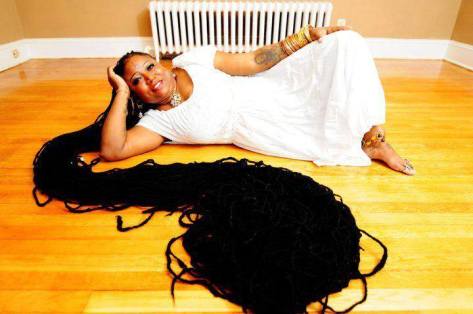
Asha Mandela, widely recognized as “The Black Rapunzel,” has captivated the world with her extraordinary crown—locs that measure over 110 feet long. As the Guinness World Record holder for the longest dreadlocks on a living person, her story is not merely about length but about patience, pride, and the spiritual and cultural journey of Black womanhood. In a world where Black hair has often been politicized, exoticized, or misunderstood, Asha Mandela’s story reclaims agency, celebrates heritage, and offers insight into the sacred beauty of natural hair care. This essay explores Mandela’s biography, hair routine, the science of Black hair growth, societal views on Afro-textured hair, and the rising global fascination—particularly in Asia—with natural Black hairstyles.
Asha Mandela: A Biography of Beauty and Resilience
Born in Trinidad and Tobago and raised in the Caribbean before relocating to the United States, Asha Mandela began her loc journey in her early 20s, over 40 years ago. At the time, she was experiencing serious health issues and believed that growing her locs was part of a spiritual calling—a holistic lifestyle decision meant to connect her to her roots and protect her energy. She credits her locs not only as a beauty statement but as an extension of her identity and strength.
According to the Guinness World Records (2021), her longest lock measures over 110 feet (33.5 meters)—longer than a London double-decker bus. Maintaining and growing her hair to such incredible lengths has been a labor of love, discipline, and faith.
The Art and Ritual of Hair Care
Asha Mandela’s hair is styled in traditional locs, a natural hairstyle created by allowing textured hair to mat and lock over time. She has stated in interviews that caring for her hair can take up to two full days, especially during washing and drying. She uses homemade essential oil blends, nutrient-rich shampoos, and organic treatments. Because of the weight and length of her locs, which can exceed 25 pounds when wet, she sleeps with them wrapped and often carries them in a scarf or pouch to avoid strain on her spine.
Mandela emphasizes that growing hair to such lengths requires spiritual intention, patience, and internal harmony. “It’s a part of me,” she says. “They’re my life force and my connection to the universe” (Essence Magazine, 2014).
Understanding Black Women’s Hair: Texture, Growth, and Myths
Black women’s hair is genetically diverse and uniquely structured. Afro-textured hair typically falls under the Type 3 (curly) and Type 4 (coily/kinky) hair classification. These strands grow in tight spirals or coils, giving the appearance of less length due to shrinkage, even though the hair continues to grow like any other hair type.
Contrary to stereotypes, Black hair grows at the same average rate—about 0.5 inches per month—as other ethnicities, but its coily nature and fragility make length retention more difficult. Frequent breakage, excessive manipulation, or chemical treatments can hinder growth. However, with protective styling, moisture-rich routines, and low-manipulation methods such as locs or braids, Black hair can grow very long, as demonstrated by Asha Mandela.
The World’s Gaze: Black Hair in Global Culture
Historically, Black hair has been burdened by social stigma. In many Western societies, Afro-textured hair has been labeled “unprofessional” or “unkempt,” leading to discriminatory practices in schools and workplaces (Byrd & Tharps, 2014). Yet simultaneously, Black hair has also become a site of global fascination and cultural admiration.
In recent years, a trend known as the “Fro Craze” has taken root in parts of Asia, particularly Japan and South Korea. Young people in these countries have embraced Afro wigs, dreadlocks, and cornrows as symbols of rebellion or high fashion. Some even undergo perms to create the look of a natural Afro. While some view this as cultural appreciation, others critique it as cultural appropriation—enjoying the aesthetics of Blackness without the lived realities that come with it.
Nonetheless, the interest reveals a broader shift: Black hair is no longer being hidden—it is being celebrated globally as a symbol of boldness, authenticity, and ancestral pride.
Public Reactions to Asha Mandela’s Hair
Public responses to Mandela’s hair are as layered as her locs themselves. Many see her as a living legend and a symbol of natural beauty. Others question the practicality or even the health of such extreme hair lengths. Some have unfairly labeled her hair “unclean” or “eccentric,” which speaks more to societal discomfort with Black hair that does not conform.
Yet Mandela remains unfazed. “My hair has never been a burden to me,” she said. “It’s been a blessing. It’s who I am.” (Guinness World Records, 2021).
Spirituality and Black Hair
For many women of African descent, hair is not merely fashion—it is spiritual. In African cosmologies, hair is considered a conduit for divine energy. In the Bible, Samson’s strength was in his hair (Judges 16:17), and many Rastafarians, like Mandela, view dreadlocks as a holy connection to Jah (God), resisting Babylon (oppression).
Conclusion
Asha Mandela’s record-breaking locs symbolize far more than a Guinness certificate. Her hair tells a story of resilience, cultural pride, self-acceptance, and sacred beauty. In a world where Black hair has been misunderstood, criminalized, or commodified, Mandela offers a bold reminder that natural hair is a crown—not to be tamed, but to be revered. Her journey also invites a deeper understanding of Black women’s hair, its science, cultural depth, and global influence. Ultimately, Asha Mandela’s story is a testament to the power of patience, pride, and authenticity in a society that often demands conformity.
References
- Byrd, A., & Tharps, L. (2014). Hair Story: Untangling the Roots of Black Hair in America (2nd ed.). St. Martin’s Press.
- Guinness World Records. (2021). Longest dreadlocks (female). Retrieved from https://www.guinnessworldrecords.com/world-records/longest-dreadlocks
- Essence Magazine. (2014). Asha Mandela’s Journey to Hair Royalty. Retrieved from https://www.essence.com
- Bae, H. (2018). Afro Hair Craze in Korea: Style or Stereotype? Journal of East Asian Pop Culture Studies, 6(2), 78–91.
- American Academy of Dermatology. (2020). Black hair care tips. Retrieved from https://www.aad.org/public/everyday-care/hair-scalp-care/hair-care/black-hair-care
 THE BROWN GIRL DILEMMA