
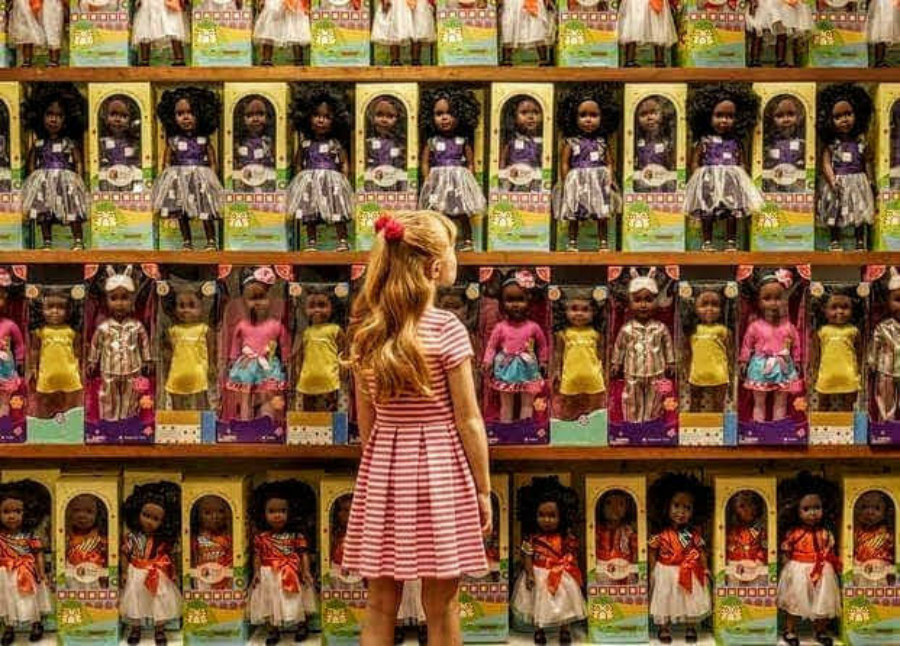
The Black Doll Experiment was a landmark psychological study conducted in the 1940s by husband-and-wife psychologists Dr. Kenneth Clark and Dr. Mamie Clark. It aimed to investigate how segregation and systemic racism affected the self-perception and identity of Black children in the United States. Using simple tools—dolls of different skin colors—the Clarks revealed profound truths about the psychological damage inflicted by racism and white supremacy.
In the experiment, Black children aged three to seven were shown four dolls: two with white skin and two with Black skin. The children were asked a series of questions such as: “Which doll is the nice doll?” “Which doll is the bad doll?” “Which doll looks like you?” The overwhelming majority of children preferred the white dolls, attributing positive traits like “good” and “pretty” to them, while associating the Black dolls with “bad” and “ugly.” Even when asked to identify the doll that looked like them, many Black children reluctantly pointed to the Black doll, often with visible discomfort or sadness (Clark & Clark, 1947).
The lesson learned was painfully clear: segregation and systemic racism had instilled in Black children a sense of inferiority and self-rejection. The study demonstrated how social structures, media, and education reinforced the idea that whiteness was superior and Blackness undesirable. This internalized racism was not innate but learned—a result of constant exposure to discriminatory norms, limited representation, and exclusion from full citizenship in America.
The message behind the experiment was that segregation harmed not only material opportunities for Black people but also their very sense of self-worth and identity. By showing the psychological scars of racism on the youngest and most innocent members of society, the Clarks challenged the moral legitimacy of Jim Crow laws.
The outcome of the Black Doll Experiment was historic. It was used as evidence in the landmark 1954 Supreme Court case Brown v. Board of Education, which declared racial segregation in public schools unconstitutional. Chief Justice Earl Warren cited the Clarks’ research to show that segregation created “a sense of inferiority” that affected Black children’s motivation to learn. Thus, the experiment played a direct role in dismantling legalized segregation in education and advancing the Civil Rights Movement.
Those involved included Dr. Kenneth Clark, who later became the first Black president of the American Psychological Association (APA), and Dr. Mamie Clark, who was instrumental in both designing the methodology and analyzing the psychological meaning of the children’s responses. Together, they bridged psychology and social justice, showing how science could serve as a tool of liberation.
The results underscored the deep psychological wounds racism inflicted on Black children, highlighting the urgent need for systemic reform. While the dolls revealed self-hatred, the greater solution lay in dismantling segregation, challenging racist stereotypes, and affirming Black identity through representation, culture, and education.
The solution proposed—then and now—was not only to desegregate schools but also to affirm the beauty, intelligence, and worth of Black children. This includes strengthening cultural pride, promoting positive Black imagery, and dismantling systemic barriers that reinforce inferiority complexes. In the words of Psalm 139:14 (KJV), “I will praise thee; for I am fearfully and wonderfully made.” The Clarks’ experiment was thus both a warning and a call to action: the liberation of Black people requires not just political freedom but also psychological healing.
References
- Clark, K. B., & Clark, M. P. (1947). Racial identification and preference in Negro children. In E. L. Hartley (Ed.), Readings in Social Psychology (pp. 169–178). New York: Holt.
- Brown v. Board of Education, 347 U.S. 483 (1954).
- Russell, K. K., Wilson, M., & Hall, R. (1992). The Color Complex: The Politics of Skin Color Among African Americans. Anchor.
- KJV Bible, Psalm 139:14.
 THE BROWN GIRL DILEMMA