
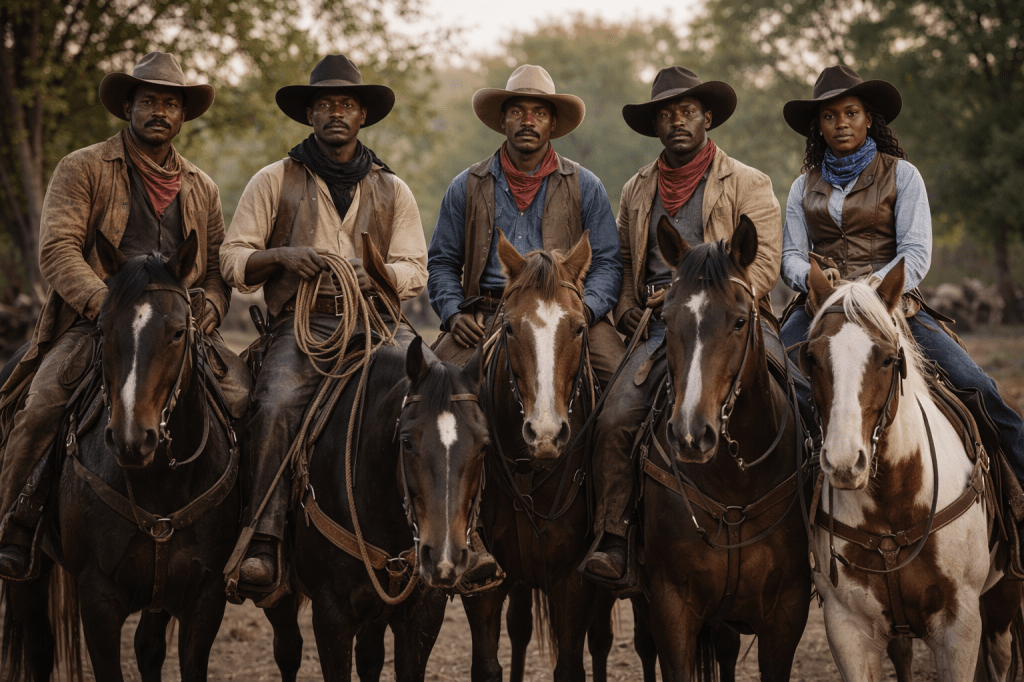
The history of Black cowboys and cowgirls is one of the most overlooked yet foundational narratives in American history. Although popular culture often portrays the cowboy as a white, rugged frontiersman, historical scholarship estimates that one in four cowboys in the American West was Black, alongside many Indigenous and Mexican vaqueros. Black cowboys emerged primarily in the post–Civil War era, when formerly enslaved Africans sought employment and freedom in the cattle industry, finding opportunities as ranch hands, wranglers, trail riders, and rodeo performers.
The roots of Black cowboys begin with slavery itself. Enslaved Africans in the southern United States were already skilled in animal husbandry, horseback riding, and land management. Many plantations relied on enslaved Black men to manage livestock, making them natural candidates for cowboy labor after emancipation. When slavery ended in 1865, thousands of freedmen entered the expanding cattle industry in Texas, Oklahoma, Kansas, and the Great Plains.
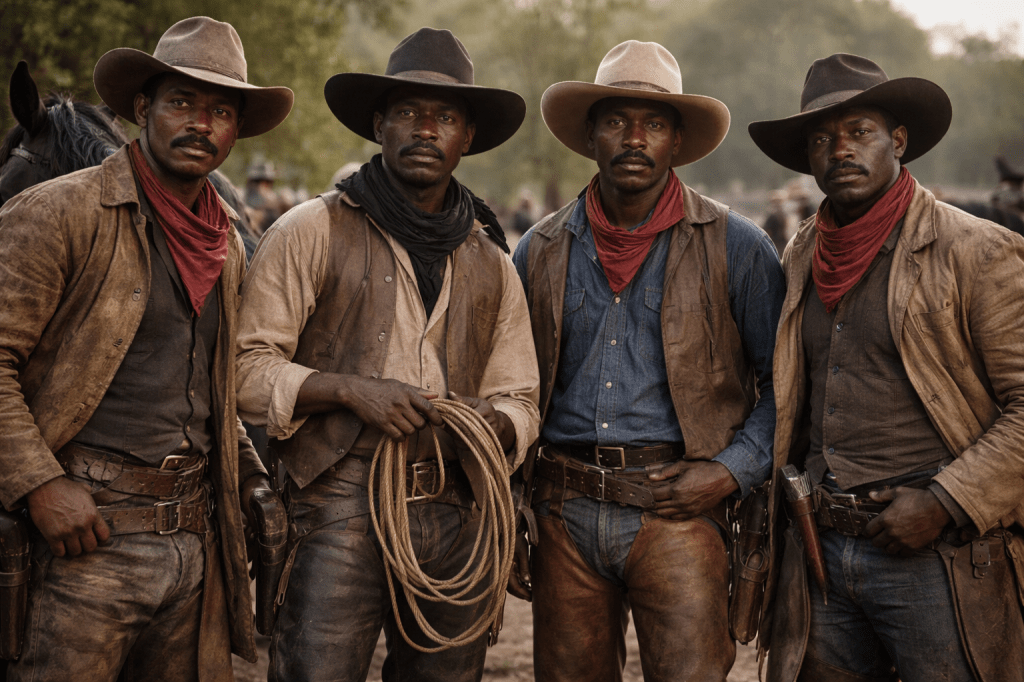
Black cowboys were often called “cowboys,” “trail riders,” “wranglers,” or “buffalo soldiers” (if they served in the military), while women were known as cowgirls or sometimes “rodeo queens.” Despite their central role, Black cowboys were rarely credited in mainstream narratives, largely due to systemic racism and the whitewashing of Western mythology through Hollywood films and dime novels.
One of the most famous Black cowboys was Nat Love, also known as Deadwood Dick. Born into slavery in Tennessee, Love became a legendary cattle driver and rodeo champion in the late 19th century. He won multiple roping and riding competitions and documented his life in his autobiography The Life and Adventures of Nat Love (1907), which remains one of the most important firsthand accounts of Black cowboy life.
Another major figure was Bill Pickett, a Black rodeo innovator credited with inventing bulldogging (steer wrestling)—a technique where the rider jumps from a horse onto a steer and wrestles it to the ground. Pickett became one of the most famous rodeo performers of the early 20th century and was posthumously inducted into the National Rodeo Hall of Fame and the Pro Rodeo Hall of Fame.
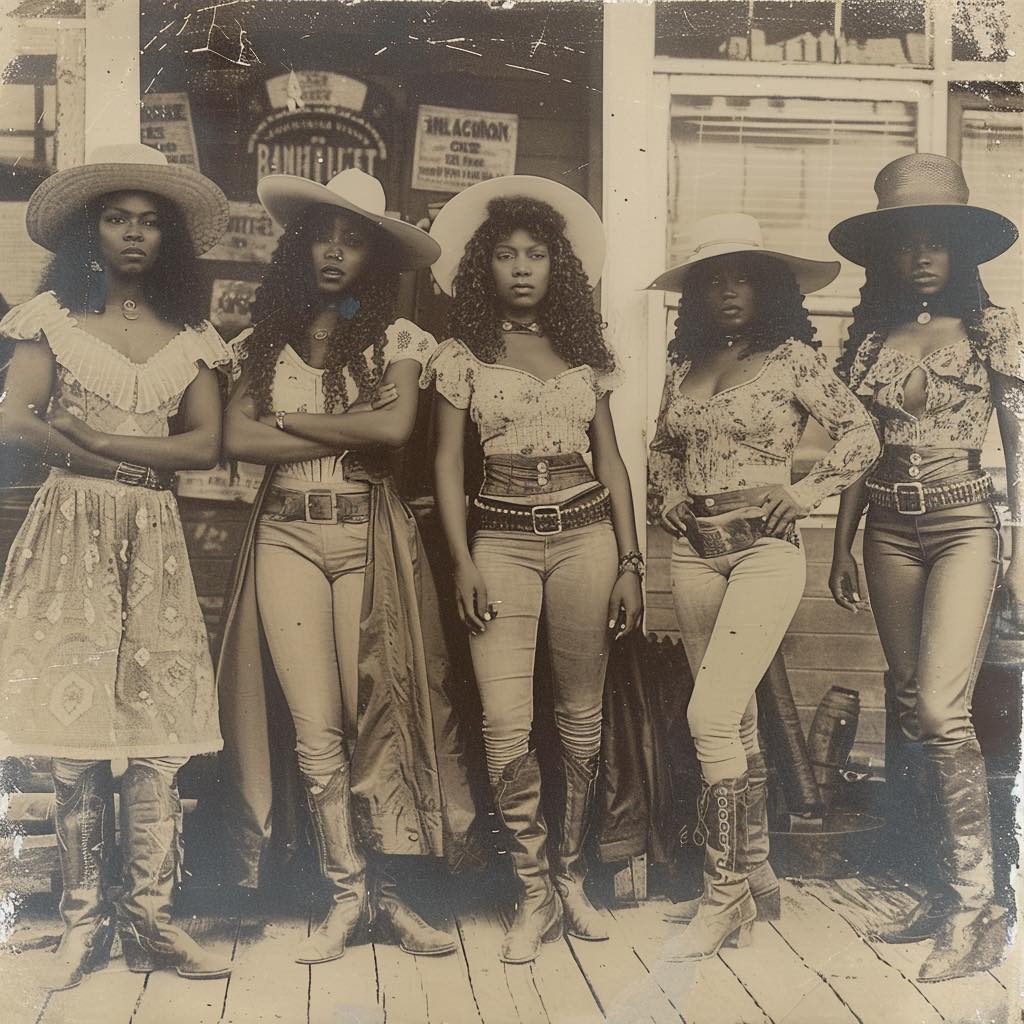
Black cowgirls also played a significant role, although their stories are even more marginalized. Mary Fields, also known as Stagecoach Mary, worked as a mail carrier and ranch hand in Montana and was known for her strength, independence, and marksmanship. Jesse Stahl, another notable Black cowgirl, was a world-renowned trick rider who performed across the United States in Wild West shows.
Racism shaped every aspect of Black cowboy life. Although Black cowboys often worked alongside white cowboys and performed the same labor, they were frequently paid less, denied leadership positions, and excluded from many professional rodeos. Segregation forced Black cowboys to create their own circuits, including the Bill Pickett Invitational Rodeo, which remains the longest-running African American rodeo in the United States.
Hollywood played a major role in erasing Black cowboys from public memory. Early Western films almost exclusively portrayed white cowboys, reinforcing the myth that the American frontier was racially homogenous. This cultural erasure contributed to the widespread belief that Black people had little involvement in shaping the West, despite overwhelming historical evidence to the contrary.
In reality, Black cowboys were instrumental in building the cattle economy that helped industrialize America. They drove cattle across thousands of miles, supplied beef to eastern cities, and helped establish rail-based commerce. Without their labor, the famous cattle drives from Texas to Kansas and Wyoming would not have been possible.
Black cowboys also contributed to American culture through music, language, and fashion. Many cowboy expressions, riding techniques, and musical traditions, such as early country blues and work songs, trace their roots to African American culture. The cowboy hat, boots, and rodeo rituals were influenced by Black, Indigenous, and Mexican practices long before they became national symbols.
In terms of awards and recognition, modern institutions have begun to honor Black cowboys more visibly. Bill Pickett’s induction into major rodeo halls marked a turning point, and figures like Fred Whitfield, a contemporary Black rodeo champion, have won multiple PRCA World Championships in calf roping. Whitfield is one of the highest-earning Black cowboys in modern rodeo history.
The term “Buffalo Soldier” is also closely linked to Black cowboy identity. These were Black U.S. Army regiments formed after the Civil War who protected settlers, built infrastructure, and managed frontier territories. Many buffalo soldiers later became ranchers and cowboys, blending military discipline with frontier survival skills.
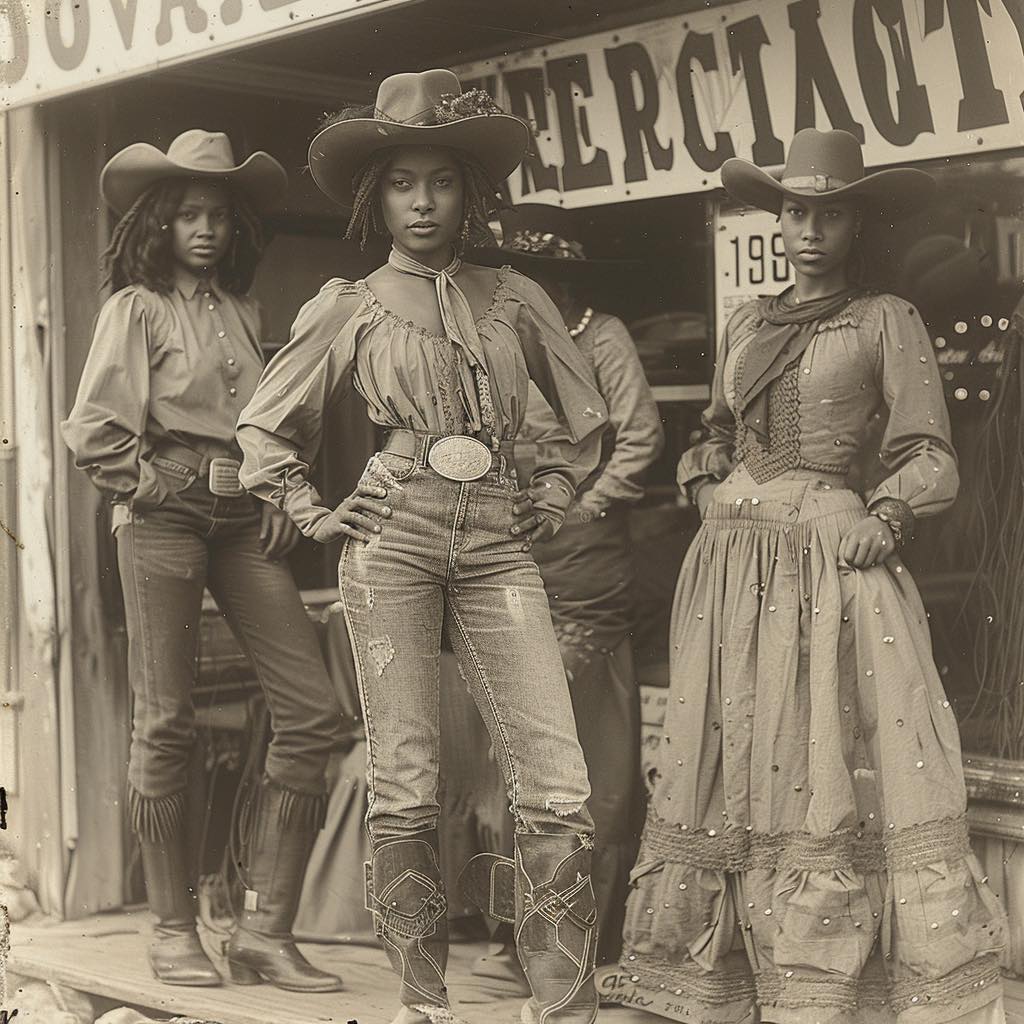
Black cowboys lived primarily during the late 1800s through the early 1900s, known as the Golden Age of the American West. However, Black cowboys continue to exist today, particularly in Texas, Oklahoma, California, and Georgia, where Black rodeo associations preserve the tradition and mentor younger generations.
In the present day, organizations such as the National Multicultural Western Heritage Museum and the Black Cowboy Museum in Texas work to document and preserve this history. Social media and documentary films have also helped revive interest in Black cowboy culture, challenging decades of historical erasure.
Black cowboys represent more than just a profession; they symbolize resistance, resilience, and self-determination. At a time when Black Americans were denied political rights, land ownership, and safety, the cowboy life offered a rare space for autonomy, skill recognition, and economic mobility.
Their legacy also challenges stereotypes about Black masculinity and femininity. Black cowboys and cowgirls embodied discipline, courage, leadership, and technical expertise—traits rarely associated with Black people in dominant American media narratives.
From a sociological perspective, the erasure of Black cowboys reflects what scholars call historical silencing, where dominant groups control national memory. The myth of the white cowboy served ideological purposes, reinforcing white supremacy and minimizing Black contributions to nation-building.
The revival of Black cowboy history also connects to broader movements of Afrofuturism, Afrocentric education, and cultural reclamation, where Black communities seek to restore forgotten legacies and reshape historical consciousness.
Spiritually and symbolically, Black cowboys reflect a biblical pattern of the marginalized becoming central to divine and historical narratives. Much like shepherds in the Bible—who were considered low-status yet chosen by God—Black cowboys were essential laborers whose stories were hidden despite their foundational role.
In conclusion, Black cowboys and cowgirls were not side characters in American history; they were architects of the West. Their contributions to agriculture, commerce, culture, and national identity remain undeniable. Recognizing their legacy is not merely about representation—it is about correcting historical truth and honoring a people whose labor helped build modern America.
Their story stands as a powerful reminder that Black history is not separate from American history—it is American history.
References
Love, N. (1907). The life and adventures of Nat Love, better known in the cattle country as “Deadwood Dick.” University of Nebraska Press.
Katz, W. L. (2012). The Black West: A documentary and pictorial history of the African American role in the Westward expansion of the United States. Simon & Schuster.
Pickett, B., & Smith, S. (2009). Bill Pickett: Bulldogger. University of Oklahoma Press.
Savage, W. S. (1997). Blacks in the West. Greenwood Press.
Taylor, Q. (2018). In search of the racial frontier: African Americans in the American West, 1528–1990. W. W. Norton & Company.
National Park Service. (2021). African American cowboys and the American West. U.S. Department of the Interior.
Smithsonian National Museum of African American History and Culture. (2020). The Black cowboy: Myth and reality. Smithsonian Institution.
Whitfield, F. (2015). Cowboy of color: Rodeo, race, and identity in modern America. Pro Rodeo Historical Society.
Bill Pickett Invitational Rodeo. (2023). History of African American rodeo culture. BPI Rodeo Archives.
 THE BROWN GIRL DILEMMA