
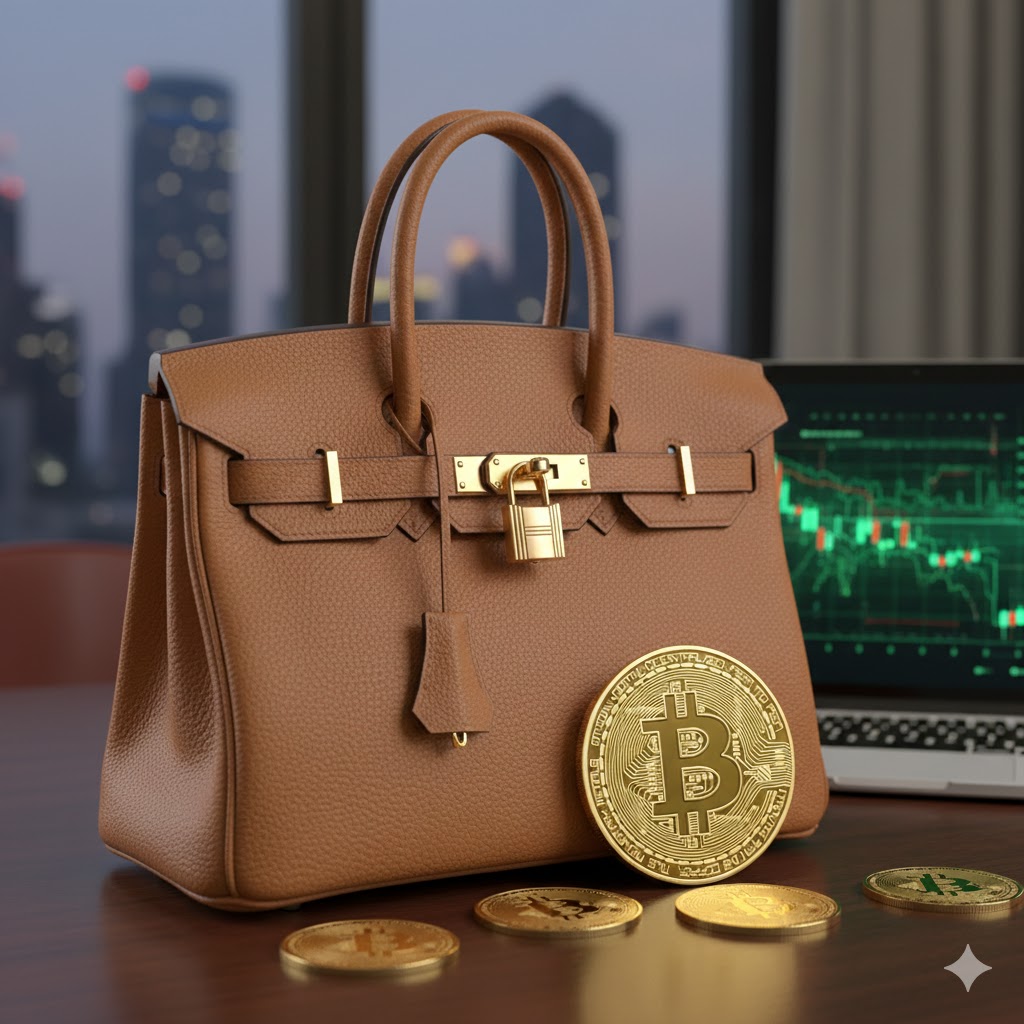
Investing has always been a balancing act between risk and reward, but today, investors are increasingly confronted with unconventional options. Two seemingly disparate assets—Hermès Birkin bags and Bitcoin—have captured the attention of collectors, speculators, and wealth strategists alike. Each represents a different approach to wealth: one grounded in tangible luxury, the other in digital innovation. Understanding their value, risks, and potential returns is crucial for anyone seeking to diversify or preserve capital.
1. Birkin Bags (Luxury Collectibles)
Pros:
- Scarcity & Exclusivity: Hermes Birkins are produced in extremely limited numbers. Certain colors, materials, and rare editions can appreciate significantly over time.
- Tangible Asset: Physical item you can hold, store, and insure.
- Cultural Status & Demand: Strong desirability among collectors; often considered a “blue-chip” luxury collectible.
- Stable Value in Niche Market: Prices can outperform inflation, especially for rare or vintage pieces. For example, some Birkin bags have historically appreciated 500–600% over 10–15 years.
Cons:
- High Entry Cost: Prices start around $12k–$15k and can go well above $500k for rare editions.
- Liquidity Issues: Selling can be slow; you need the right buyer/market.
- Storage & Maintenance: Requires careful storage and sometimes professional upkeep.
- Market Risk: Tastes can change, and fashion trends fluctuate.
2. Bitcoin (Cryptocurrency)
Pros:
- High Growth Potential: Has made millionaires in short periods; extremely high upside potential.
- Liquidity: Can be bought/sold 24/7 on exchanges.
- Decentralized: Not tied to any government or physical asset.
- Ease of Transfer: Can be moved globally almost instantly.
Cons:
- Extreme Volatility: Price swings can be 10–30% in a single day. Losses can be dramatic.
- Regulatory Risk: Governments may regulate or ban crypto at any time.
- No Tangible Value: Value is purely speculative; depends on adoption and market sentiment.
- Security Risk: Hacking, forgotten keys, or scams can result in total loss.
3. Comparison Summary
| Factor | Birkin Bag | Bitcoin |
|---|---|---|
| Initial Cost | High ($12k–$500k+) | Low ($20+ per coin, fractional possible) |
| Volatility | Low | High |
| Liquidity | Low | High |
| Historical ROI | 10–15% annually for rare pieces | Highly variable; 100%+ in bull markets, huge losses in bear markets |
| Tangible vs Digital | Tangible | Digital |
| Cultural/Status Value | Very high | Mostly speculative, social value varies |
4. Strategic Approach
- Birkin: Treat it as a luxury collectible with the bonus of potential appreciation. Best for wealth preservation and status.
- Bitcoin: Treat as a high-risk/high-reward asset for potential growth. Suitable for risk-tolerant investors.
Bottom Line:
- If you want status, tangibility, and slower, steady appreciation, go Birkins.
- If you want high-risk, high-reward digital speculation, go Bitcoin.
Some savvy investors do both: Birkins as a hedge against volatility, Bitcoin for speculative upside.
Hermès Birkins, named after the actress and singer Jane Birkin, are the epitome of luxury fashion. Produced in limited quantities, these handbags are handcrafted in France and priced from approximately $12,000 to over $500,000, depending on size, material, and rarity. Their scarcity, combined with cultural desirability, has historically allowed Birkins to appreciate over time, sometimes outperforming traditional financial instruments.
Bitcoin, in contrast, is a decentralized cryptocurrency launched in 2009. It is purely digital, exists outside the traditional banking system, and relies on blockchain technology to maintain security and scarcity. Unlike tangible assets, Bitcoin’s value is speculative, dependent on adoption, market sentiment, and broader regulatory developments.
One of the key advantages of Birkins is their relative stability. While prices fluctuate based on market demand and fashion trends, the growth has historically been steady. Research has shown that rare Birkins have increased in value by an average of 10–15% annually over the past two decades. This makes them a reliable option for collectors and investors seeking to preserve wealth.
Bitcoin, on the other hand, is highly volatile. Its price has experienced dramatic swings, sometimes increasing by hundreds of percent within months or losing significant value just as quickly. This volatility offers opportunities for high returns but comes with equally high risks. Investors must be prepared for sudden price drops.
Liquidity is another important consideration. Bitcoin can be traded 24/7 on numerous exchanges worldwide, allowing investors to access cash relatively quickly. Birkins, however, require finding the right buyer, often through auctions or specialized resale markets. While the market for Birkins is robust, it is far less liquid than digital assets.
Cultural and status value further distinguishes Birkins. Owning a Birkin is a statement of wealth, taste, and social positioning. In some cases, this social capital can indirectly enhance the asset’s monetary value. Bitcoin, while increasingly mainstream, does not confer the same tangible prestige, though it signals financial acumen and early adoption of technology.
Storage and maintenance are practical factors that impact Birkins’ value. These handbags must be preserved carefully to maintain condition. Environmental factors, handling, and insurance all contribute to the overall cost of ownership. Bitcoin, conversely, requires secure digital storage, such as hardware wallets, but lacks the physical maintenance costs associated with luxury goods.
Risk profiles also differ. Birkins are exposed to fashion cycles and counterfeit markets but are largely insulated from regulatory intervention. Bitcoin faces regulatory scrutiny, cyber threats, and the potential for systemic market shocks. Investors must assess their tolerance for these different types of risk when deciding where to allocate capital.
Investment horizons further illustrate the distinction. Birkins are generally long-term assets; their appreciation occurs over years or decades. Bitcoin can generate substantial short-term gains, but timing and market conditions are critical. Each asset class therefore serves different investor objectives.
Accessibility is a practical consideration. While fractional ownership of Bitcoin allows almost anyone to invest with minimal capital, Birkins require substantial upfront investment. This high entry barrier limits Birkins to wealthy investors or dedicated collectors.
Diversification potential also differs. Birkins provide a hedge against inflation and traditional financial market volatility, while Bitcoin offers exposure to an emerging technological ecosystem with global reach. Combining both can create a complementary portfolio balance of tangible and digital assets.
Market data indicates that rare Birkins have outperformed gold and the S&P 500 in some periods. Bitcoin, while outperforming nearly every traditional asset class in its early years, exhibits much higher variability. Both require careful timing and market understanding to maximize returns.
Psychological factors influence investor behavior. Luxury goods like Birkins appeal to those seeking security and status, whereas Bitcoin attracts speculative traders and tech-savvy investors. These behavioral dynamics can impact market demand and price trajectories.
Global trends further influence both assets. Rising wealth in emerging markets has fueled Birkin demand, particularly in Asia and the Middle East. Bitcoin adoption, meanwhile, is expanding worldwide, with institutional investment and corporate acceptance driving legitimacy and price growth.
Inflation protection is another consideration. Birkins maintain value through scarcity and desirability, while Bitcoin’s fixed supply is designed to act as a hedge against currency devaluation. Both strategies offer ways to preserve purchasing power in uncertain economic environments.
Investment strategies vary accordingly. A conservative approach may favor Birkins for wealth preservation, while aggressive investors might allocate a portion of their portfolio to Bitcoin for speculative growth. Combining both can mitigate risk while capturing diverse opportunities.
Historical performance provides insight but not certainty. Past appreciation of Birkins suggests steady growth, yet fashion trends can change. Bitcoin’s history demonstrates massive gains alongside significant drawdowns, emphasizing the importance of risk management and timing.
Both assets challenge traditional notions of investment. Birkins blur the line between consumable luxury and financial instrument, while Bitcoin challenges conventional currency and banking systems. Investors must weigh personal goals, risk tolerance, and market understanding before committing capital.
Ultimately, Birkins and Bitcoin represent two very different investment philosophies: one rooted in tangible, culturally valued goods; the other in speculative, decentralized digital innovation. The “best” choice depends on individual priorities, financial goals, and appetite for risk.
For those seeking stability, status, and tangible luxury, Birkins are a compelling option. For those seeking high-risk, high-reward opportunities in a rapidly evolving digital landscape, Bitcoin offers unmatched potential. Combining both may provide the optimal balance between tradition and innovation, security and growth.
References
- D’Angelo, J. (2022). The investment value of luxury handbags: A case study on Hermès Birkins. Journal of Fashion Marketing and Management, 26(4), 543–559. https://doi.org/10.1108/JFMM-08-2021-0150
- Hull, J., & White, M. (2021). Bitcoin and cryptocurrency: Risk, regulation, and investment performance. Financial Analysts Journal, 77(3), 45–60. https://doi.org/10.1080/0015198X.2021.1900234
- Knight Frank. (2023). The wealth report 2023: Luxury investments. Knight Frank Research. https://www.knightfrank.com/research
- Peltz, L. (2022). Hermès Birkin bags: A blue-chip luxury investment. Forbes. https://www.forbes.com/sites/lapeltz/2022/05/03/hermes-birkin-investment-value
- Yermack, D. (2019). Is Bitcoin a real currency? An economic analysis. Journal of Financial Economics, 134(3), 499–516. https://doi.org/10.1016/j.jfineco.2019.05.004
 THE BROWN GIRL DILEMMA