
Introduction
In the annals of ancient history, few names conjure images of beauty and regality like Queen Nefertiti. Revered as the wife of Pharaoh Akhenaten and a powerful co-regent of Egypt’s 18th Dynasty, Nefertiti’s legacy endures not only through her political and religious influence but through the iconic limestone bust that has become a global symbol of feminine perfection. From Hitler’s obsession with her image to the racial politics surrounding her physical depiction, Nefertiti’s story is deeply intertwined with power, race, and Western fascination with Black beauty. This essay explores her biography, the cultural impact of her visage, and the lasting influence she had on her kingdom—and beyond.
Etymology and Identity: “The Beautiful One Has Come”
The name Nefertiti means “the beautiful one has come”, derived from the Egyptian Nefer (beauty) and iti (has come). Her name alone attests to the reverence she commanded in her time, not just for her appearance but for the spiritual and political harmony she represented in the court of Akhenaten (Tyldesley, 1998).
Biography: Life, Royalty, and Rule
Nefertiti lived during the 14th century BCE, flourishing in the period of the New Kingdom, specifically Egypt’s 18th Dynasty. While her origins are debated, many scholars believe she may have been of noble Egyptian or possibly Mitanni (Syrian) descent. She married Pharaoh Akhenaten, a revolutionary ruler who broke from traditional polytheism to promote the monotheistic worship of Aten, the sun disk.
Together, Nefertiti and Akhenaten ruled from Amarna, the new capital city built to honor Aten. Nefertiti was not a mere consort—reliefs depict her wearing the blue crown of pharaohs, smiting enemies and engaging in diplomacy, suggesting her co-regency and immense influence. The couple had six daughters and likely no sons, though some speculate she may have ruled under another name—possibly Neferneferuaten—after Akhenaten’s death (Reeves, 2004).
Nefertiti’s Kingdom and Influence
Nefertiti’s reign coincided with one of Egypt’s most radical transformations: the shift to monotheism under the Atenist revolution. As queen, she supported her husband in eliminating the powerful priesthood of Amun and redirecting worship to Aten. This act undermined centuries of religious tradition and centralized power in the royal family, particularly the queen. Nefertiti was not only a religious figure but likely also a diplomatic and military leader, overseeing a time of relative peace and artistic flourishing (Robins, 1993).
The Bust of Nefertiti: Beauty and Eurocentric Alterations
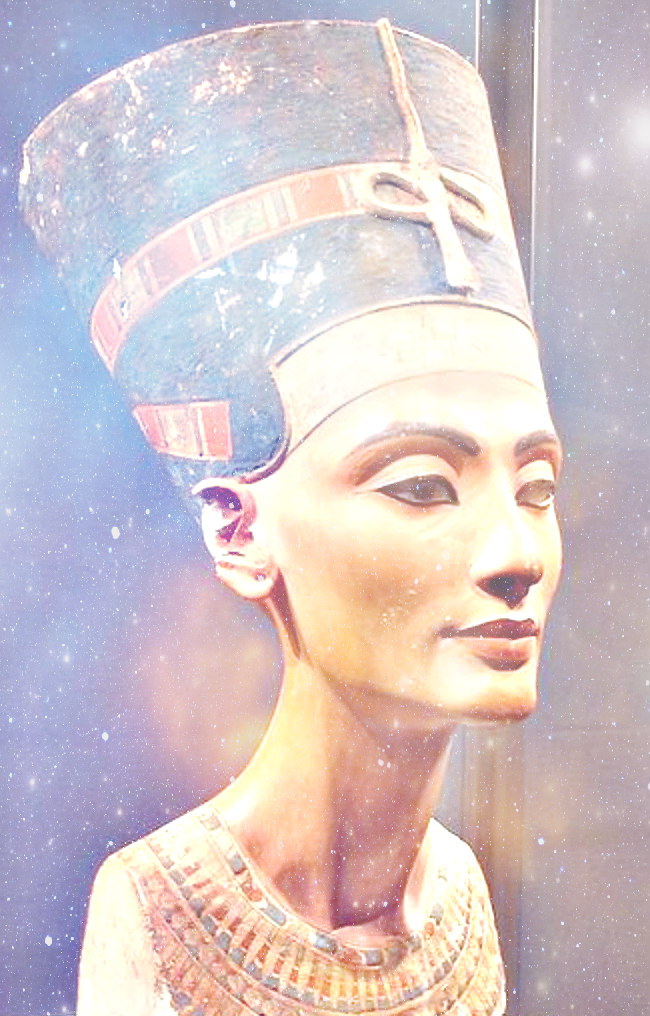
Discovered in 1912 by German archaeologist Ludwig Borchardt at Tell el-Amarna, the limestone and stucco bust of Nefertiti became one of the most iconic symbols of ancient beauty. It currently resides at the Neues Museum in Berlin.
The bust features high cheekbones, almond-shaped eyes, a straight nose, and full lips. Many scholars and Afrocentrists argue that the original features may have been altered to reflect Eurocentric ideals of beauty, especially during its restoration. The bust was never meant for public display—it was likely a sculptor’s model—and Borchardt’s notes suggest a desire to emphasize symmetry and refinement (Fisher, 2010). A CT scan conducted in the 2000s revealed an inner limestone layer with a wider nose and more defined cheekbones, indicating that the outer stucco layer softened African features, potentially aligning with white supremacist aesthetic ideals.
Beauty and Symbolism: “A Perfect 10”
Nefertiti has often been described as “a perfect 10” in terms of beauty. Her symmetrical face became the gold standard in facial harmony studies. German Egyptologist Ludwig Borchardt reportedly wrote upon seeing the bust:
“Description is useless; must be seen.”
Others have likened her to goddesses and mythic beauties. Art historian Bettany Hughes once said:
“Nefertiti is the Mona Lisa of the ancient world—enigmatic, powerful, and timeless.”
Her beauty is not merely physical; it carries with it symbolic power—Black, feminine, and royal.
Comparison to Cleopatra and Helen of Troy
While Cleopatra VII was known for her intellect and political savvy, her beauty was often exaggerated or politicized by Roman propaganda. Nefertiti, in contrast, is immortalized in stone as the embodiment of grace. Cleopatra’s coinage shows her with a hooked nose and sharp features—far from the Elizabeth Taylor depiction. Meanwhile, Helen of Troy, possibly mythical, is credited as the “face that launched a thousand ships.” Yet unlike Nefertiti, Helen’s image is tied more to war and male desire than sovereignty and artistry.
Nefertiti’s beauty represents command, serenity, and sacred divinity—not merely lust or scandal.
Hitler and the Politics of Possession
Adolf Hitler had a fascination with art, antiquity, and Aryan superiority. When Egypt demanded the return of the Nefertiti bust, Hitler refused, calling it “a treasure of German culture” and expressing a desire to place it at the center of his grand museum in Linz. Hitler reportedly called the bust:
“The most precious possession of the German people.”
Despite his racist ideology, Hitler paradoxically admired the beauty of a woman likely of African descent—highlighting the hypocrisy of white supremacy, which often appropriates and deifies Black beauty while simultaneously denigrating Black people.
As for his views on Black people, Hitler’s regime classified them as racially inferior, and Afro-Germans were sterilized, persecuted, and excluded from society. His praise of Nefertiti’s image was rooted in aesthetic objectification, not respect for African heritage.
Fascination with Black Beauty and Modern Parallels
The enduring appeal of Nefertiti reflects a global fascination with Black women’s beauty, often filtered through white-controlled lenses. Today, figures like Naomi Campbell, Beyoncé, and Lupita Nyong’o inherit the symbolic space that Nefertiti occupied—Black women celebrated yet scrutinized, desired yet dehumanized.
Modern beauty trends—like the BBL (Brazilian Butt Lift)—further commodify features that were once mocked in Black women: full lips, wide hips, and curvaceous figures. Nefertiti’s bust can be viewed as a historical anchor in this legacy, where Black beauty is imitated but rarely honored.
Conclusion
Queen Nefertiti was more than a face; she was a visionary queen, religious reformer, and symbol of African dignity. Her beauty, while immortalized in art, also became a battleground for colonial appropriation, racial politics, and gender dynamics. From ancient Amarna to 20th-century Nazi Germany to modern pop culture, her image has been used, misused, and revered—but always powerful.
Her legacy calls us to reclaim Black beauty, authority, and history from the margins and return them to the center of global consciousness—where Nefertiti, truly, belongs.
References
- Fisher, M. (2010). What Lies Beneath Nefertiti’s Beauty: The Politics of Restoration. Journal of Egyptian Antiquity, 47(2), 91–109.
- Robins, G. (1993). Women in Ancient Egypt. Harvard University Press.
- Reeves, N. (2004). Akhenaten: Egypt’s False Prophet. Thames & Hudson.
- Tyldesley, J. (1998). Nefertiti: Egypt’s Sun Queen. Viking Press.
- Hughes, B. (2009). The Hem of His Garment: Gender and Power in Ancient Egypt. BBC History.
- Berman, P. (1992). The Rise of the Modern Fascist Art Movement. Historical Journal of Fascism, 34(1), 23–47.
 THE BROWN GIRL DILEMMA