
Introduction
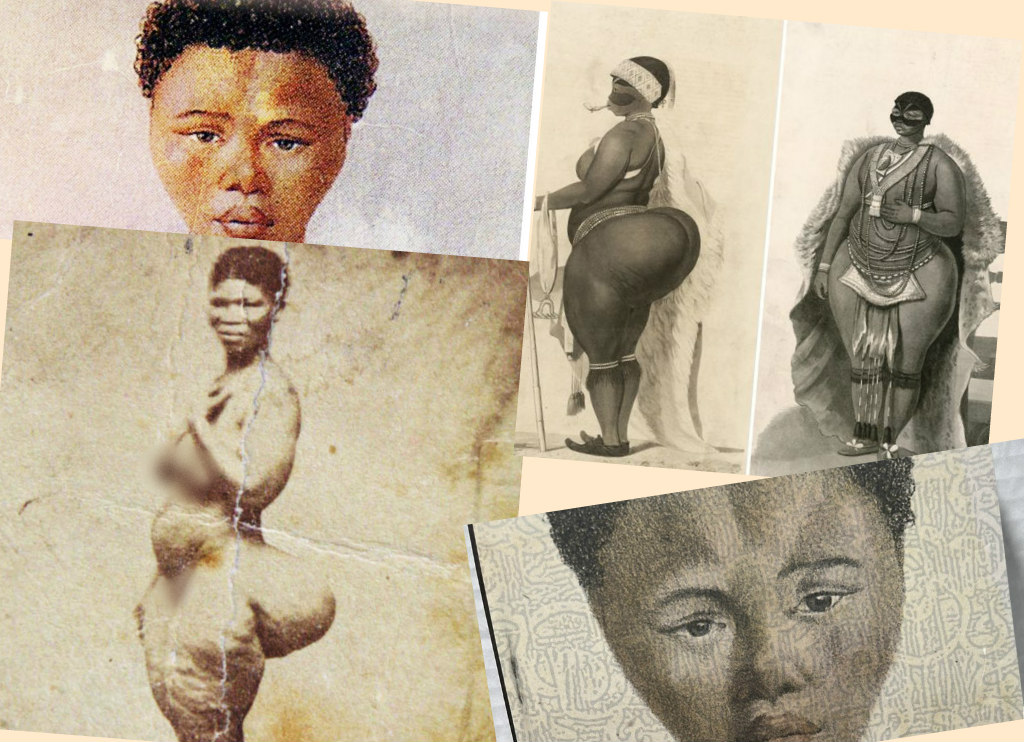
Sarah Baartman, widely known by the derogatory nickname “The Hottentot Venus,” was a South African Khoikhoi woman who became one of the most exploited and objectified figures in colonial history. Her life is emblematic of the intersection between racism, colonialism, misogyny, and pseudoscience. Displayed as a curiosity in 19th-century Europe, Baartman’s body was fetishized and dehumanized, even in death. Her story foreshadows the modern commodification of Black women’s bodies and raises critical questions about beauty standards, cultural appropriation, and racialized misogyny.
Early Life and Origins
Sarah Baartman was born around 1789 in the Gamtoos Valley of the Eastern Cape of South Africa. She belonged to the Khoikhoi people, an indigenous group known pejoratively as “Hottentots” by European colonists. Little is known about her early family life, but historical accounts suggest she was orphaned at a young age during colonial conflicts between the Dutch settlers and native Africans. She later became a domestic servant and was exposed to European culture and oppression early in life (Fausto-Sterling, 1995).
Her Exploitation and Display in Europe
In 1810, Sarah was taken to England by a British military surgeon, William Dunlop, under the pretense that she would gain wealth by exhibiting her body. She was soon placed on public display in London and later in Paris, exhibited nearly naked in circuses, saloons, and theaters. Advertised as the “Hottentot Venus,” her steatopygia—a natural genetic feature of prominent buttocks common among Khoisan women—became the central focus of her public spectacle.
European audiences viewed her body as both exotic and grotesque, sexualized and ridiculed. Scientists like Georges Cuvier subjected her to invasive examinations, believing she was proof of the “missing link” between animals and humans. Baartman became a living subject for racist pseudoscience that sought to validate white supremacy through physical anthropology (Gould, 1981).
Why Her Beauty Was Under Scrutiny
Baartman’s physical features—broad hips, dark skin, full lips, and pronounced buttocks—stood in stark contrast to Eurocentric ideals of beauty. Rather than being celebrated, her natural body became a site of scorn, desire, and “scientific” scrutiny. In essence, her Black femininity was hypersexualized and pathologized. Her beauty was never seen as worthy of admiration; instead, it was dissected to reinforce the colonial gaze and racist theories of human difference (Collins, 2000).
Her Death and Posthumous Humiliation
Sarah Baartman died on December 29, 1815, at just 26 years old, likely from pneumonia or syphilis, in Paris. Even in death, she was denied dignity. Her body was dissected by Cuvier, and her skeleton, genitals, and brain were preserved and displayed at the Musée de l’Homme in Paris for over 150 years.
Her remains were finally returned to South Africa in 2002, after a long legal and diplomatic battle. Then-President Nelson Mandela had requested their return as a matter of national and cultural healing. Sarah Baartman was buried on August 9, 2002, in the Eastern Cape, and her story became a symbol of the abuse of Black women under colonial regimes (Qureshi, 2004).
Personal Life: Family, Children, and Survival
Historical documentation does not confirm whether Sarah Baartman had a husband or children. Her personal agency during her time in Europe remains a matter of debate. Some accounts suggest she may have engaged in sex work out of economic desperation and lack of options. Her descent into prostitution, if it occurred, must be understood within the context of extreme exploitation, racism, and the absence of human rights for women of color in Europe.
Scientific Racism and Her Genetic Body Makeup
Baartman’s body became a site for scientific racism. European naturalists used her as a specimen to support racial hierarchies, claiming her physique was evidence of primitiveness. Her steatopygia, which is genetically normal among Khoisan women, was falsely framed as an aberration. The grotesque display of her genitalia by scientists such as Cuvier reinforced colonial myths about African sexuality and physiology (Gilman, 1985).
Modern Reflections: The BBL Craze and Baartman’s Legacy
Today, the Brazilian Butt Lift (BBL) craze—especially among women of all racial backgrounds—ironically mirrors the very body type for which Sarah Baartman was ridiculed. Her natural curves are now commodified, celebrated, and monetized in fashion, social media, and cosmetic surgery industries. Figures like Kim Kardashian, Nicki Minaj, and Cardi B have become modern icons of curvaceous beauty, appropriating features once vilified in Black women.
Yet, this popularity does not signal racial progress. Black women with natural bodies like Baartman’s still face colorism, fatphobia, and hypersexualization. The paradox remains: the Black body is envied, mimicked, and monetized, yet often despised and marginalized in its authentic form.
Why Some Women Use Their Bodies for Fame and Fortune
In a society that frequently commodifies women—especially Black women—many are compelled to capitalize on their physical appearance as a survival strategy. This is not new. Sarah Baartman’s coerced exhibitionism finds echoes in the lives of modern women who use their bodies in music, entertainment, and social media. The global beauty economy profits from features long stigmatized in Black women, reinforcing the painful legacy of objectification and exploitation.
Contemporary Symbolism and Social Commentary
Sarah Baartman represents both historical trauma and modern relevance. Her legacy forces a reckoning with how Black women’s bodies have been treated—as property, as curiosities, as sexual objects—and how they are still commercialized today.
While there are no precise contemporary equivalents, the symbolism of Sarah Baartman can be found in debates around beauty standards, the body positivity movement, and critiques of cultural appropriation. Figures like Serena Williams, Lizzo, and Megan Thee Stallion—who boldly embrace their bodies and identities—offer both resistance and reclamation in a world still shaped by the gaze that dehumanized Baartman.
Conclusion
Sarah Baartman’s life and death tell a harrowing story of racism, exploitation, and the violent colonial gaze. Yet, her story is not just one of suffering—it is also a story of endurance and symbolism. Her legacy compels us to confront uncomfortable truths about how Black femininity is perceived, appropriated, and controlled. From the grotesque science of the 19th century to the filtered perfection of social media today, Baartman’s body still haunts the Western imagination. We owe it to her and to all women like her to remember, reckon, and restore dignity to bodies once denied it.
- In the 1990s, after the fall of apartheid and the establishment of a democratic government in South Africa, Nelson Mandela, as President (1994–1999), called for the return of Sarah Baartman’s remains as part of a broader effort to restore dignity to the victims of colonialism and racism.
- Her remains, including her skeleton, brain, and genitalia, had been on display at the Muséum national d’Histoire naturelle in Paris for over 150 years following her death in 1815.
- In 1994, shortly after Mandela became President, the South African government made an official request to the French government for the return of her remains.
- The process faced legal and bureaucratic hurdles in France, where some institutions initially resisted the request, claiming her remains were part of the national scientific collection.
- It was not until January 2002, after years of negotiation, that France passed special legislation allowing the return of Baartman’s remains to South Africa.
- Her remains were repatriated on May 3, 2002, and she was finally laid to rest on August 9, 2002, in Hankey, Eastern Cape, near the area of her birth.
- The burial date was symbolic—it coincided with South Africa’s National Women’s Day, commemorating the 1956 anti-pass laws march by women, making it a national tribute to Baartman as a historical symbol of the abuse and dignity of Black women.
While Nelson Mandela did not personally oversee the return (he had left the presidency by 1999), he was instrumental in beginning the political and moral campaign for her repatriation. His government’s efforts, supported by later administrations, ensured that Sarah Baartman could finally return home and be buried with the honor and humanity she had been denied in life.
Her story remains a profound symbol of the colonial exploitation of Black women and a call to honor those who suffered under imperial systems.
References
- Collins, P. H. (2000). Black Feminist Thought: Knowledge, Consciousness, and the Politics of Empowerment. Routledge.
- Fausto-Sterling, A. (1995). Myths of Gender: Biological Theories about Women and Men. Basic Books.
- Gilman, S. L. (1985). Difference and Pathology: Stereotypes of Sexuality, Race, and Madness. Cornell University Press.
- Gould, S. J. (1981). The Mismeasure of Man. W.W. Norton.
- Qureshi, S. (2004). Displaying Sara Baartman, the ‘Hottentot Venus’. History of Science, 42(2), 233–257.
- Scully, P. (2015). Sara Baartman and the Hottentot Venus: A Ghost Story and a Biography. Princeton University Press.
 THE BROWN GIRL DILEMMA