
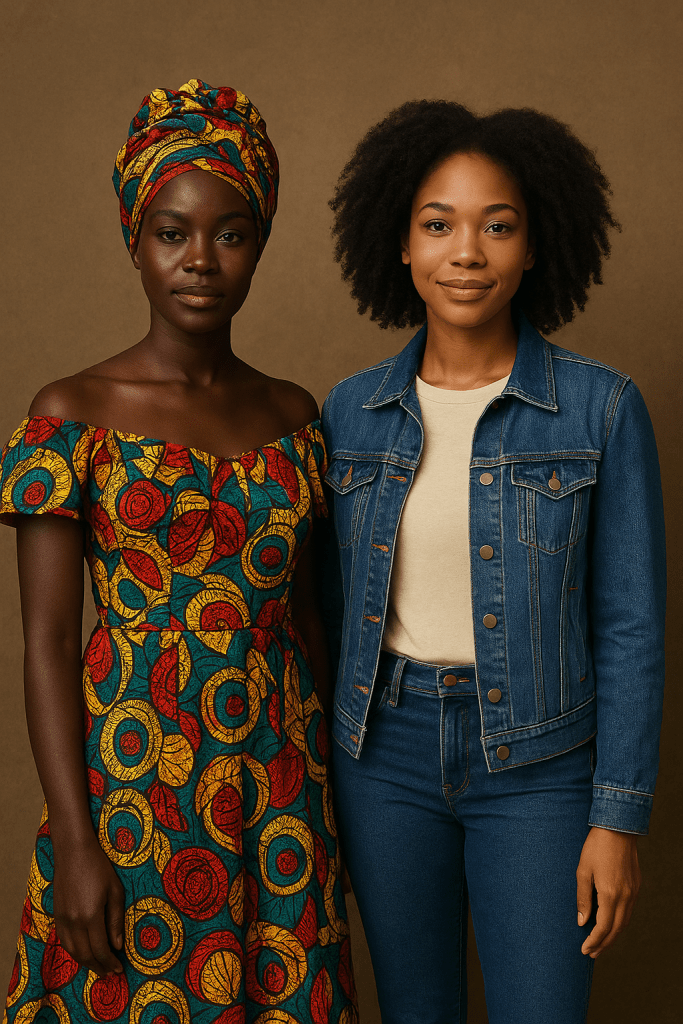
The relationship between African and African American women is complex, layered with shared ancestry yet shaped by divergent histories and sociocultural experiences. Both groups embody resilience and strength, yet their lived realities reflect different responses to history, colonization, and displacement. Understanding the distinctions between African and African American women requires an exploration of culture, traditions, gender roles, spirituality, and identity formation within historical and modern contexts.
African women are deeply rooted in ancestral traditions that emphasize community, kinship, and continuity. Their roles are often defined through lineage, extended family systems, and tribal customs. In many African societies, womanhood is tied to motherhood, hospitality, and participation in rituals that sustain the social order (Amadiume, 1997). Their identities are shaped by ethnic belonging—such as Yoruba, Zulu, Akan, or Igbo—and by collective rather than individualistic frameworks of living.
African American women, in contrast, are descendants of enslaved Africans who were forcibly removed from their native lands and stripped of their languages, spiritual systems, and kinship ties. Their womanhood evolved within the context of systemic racism, patriarchy, and survival in a hostile society. African American women have had to reconstruct their cultural identity, blending remnants of African heritage with new social realities in America (Collins, 2000).
One of the most striking differences lies in the preservation of tradition. African women often maintain cultural practices such as traditional attire, native languages, ancestral naming systems, and rites of passage. In contrast, African American women have had to rediscover or reinvent these elements through Afrocentric movements, Black nationalism, and Pan-Africanism. This reconstruction has created a hybrid culture—neither fully African nor Western, but uniquely diasporic (Asante, 2003).
In terms of social structure, African societies historically emphasize collectivism. Women play vital roles in market economies, agriculture, and family leadership. The extended family and community elders serve as support systems in raising children and resolving conflicts. African American women, on the other hand, have historically faced fragmentation of the family structure due to slavery, systemic poverty, and incarceration. This has necessitated a strong tradition of matriarchal resilience—women taking on leadership roles in families, churches, and movements for justice (Higginbotham, 1993).
Marriage and gender roles also reveal cultural contrasts. In traditional African contexts, marriage is often a communal affair, involving families, elders, and sometimes arranged unions that ensure social stability. Bride price or dowry systems still exist as cultural customs, symbolizing respect and family alliance. African American women, influenced by Western notions of romantic love and individual freedom, often view marriage as a personal choice rather than a family contract (Sudarkasa, 1986).
Motherhood holds sacred value in both contexts but manifests differently. African women view motherhood as an honored calling tied to continuity and lineage, often supported by extended family. African American women, however, have navigated motherhood as a site of resistance and survival. During slavery, their reproductive autonomy was denied, and yet motherhood became a means of transmitting hope, strength, and cultural memory (White, 1999).
Religious traditions further mark significant distinctions. African women continue to practice indigenous spiritual systems—such as Yoruba Ifá, Akan ancestral veneration, or Zulu cosmology—alongside Christianity and Islam. Their spirituality often integrates rituals, dance, and ancestral communication. African American women, shaped by the Black Church and later by Afrocentric revivalism, combine Christianity with African spiritual elements like ancestor remembrance and liberation theology (Cone, 1970).
Beauty standards and cultural aesthetics also differ across the diaspora. African women often embrace natural hairstyles, traditional clothing such as kente, Ankara, and gele, and view beauty through communal and spiritual lenses. In contrast, African American women have historically faced Eurocentric beauty ideals, leading to internal conflicts regarding hair texture, skin tone, and body image. However, movements like “Black is Beautiful” and the natural hair revolution have reconnected African American women to their African roots (Mercer, 1994).
Economic participation reveals both parallels and disparities. African women constitute a significant portion of the labor force in agriculture, trade, and small-scale entrepreneurship. Many African societies recognize women as economic backbones of their households. African American women, similarly industrious, have long been active in the American workforce, from domestic labor during slavery to leadership in education, healthcare, and activism. Yet, they face intersectional barriers of race and gender in capitalist structures (King, 1988).
Education serves as a bridge between the two worlds. African women, in many regions, continue to struggle against patriarchal and economic barriers to education. In contrast, African American women have achieved high levels of academic advancement, becoming one of the most educated demographic groups in the United States (National Center for Education Statistics, 2021). This achievement reflects both a legacy of struggle and the valuing of education as liberation.
Feminism also manifests differently. African feminism often focuses on complementarity, emphasizing harmony between men and women within cultural contexts rather than Western individualism. African American feminism, however, emerged from experiences of racial and gender oppression, advocating for intersectional justice and liberation (Ogundipe-Leslie, 1994; Collins, 2000). Both movements share the goal of empowerment but differ in philosophical grounding and expression.
Language remains a powerful marker of identity. African women maintain indigenous languages that connect them to their heritage and ancestors. African American women, descendants of those whose tongues were forcibly silenced, developed African American Vernacular English (AAVE)—a linguistic legacy of survival, creativity, and cultural memory (Smitherman, 2000). Through language, both groups assert cultural pride and identity.
Cultural rites of passage further distinguish the two. African women often undergo coming-of-age rituals marking puberty, fertility, or marriage, rooted in centuries-old tribal customs. African American women, separated from such rites through slavery, have developed alternative initiations through church ceremonies, debutante events, and sorority culture, reflecting adaptation and resilience (Nwando, 2011).
In terms of dress and adornment, African women’s attire is both symbolic and ceremonial, often reflecting tribal identity, marital status, and community pride. African American women, influenced by Western fashion and hip-hop culture, express identity through style as a form of resistance, creativity, and affirmation of Blackness. Both use adornment as cultural language (Blay, 2011).
Despite differences, a spiritual and cultural bond persists. African and African American women share an unspoken recognition of shared ancestry and pain—the scars of colonization, slavery, and patriarchal oppression. Yet, reconnecting across continents often reveals misunderstandings born of colonial narratives and Western stereotypes. African women may view African American women as overly liberal or disconnected from traditional values, while African American women may perceive Africans as patriarchal or uncritical of oppressive customs (Makalani, 2010).
The transatlantic slave trade remains the historical rupture that defines their separation. Yet it also serves as the bridge calling for reconnection. In recent decades, cultural exchange between African and African American women has grown through Pan-African organizations, social media, and travel. The “Back to Africa” movement, Afrobeat music, and global diasporic conferences have reignited dialogue and cultural healing.
This reconnection is not without challenges. Colorism, class differences, and cultural misunderstandings sometimes hinder unity. However, shared spirituality, music, and activism—seen in collaborations across art, academia, and politics—offer hope for transcontinental sisterhood. The success of African and African American women in global leadership, from Ngozi Okonjo-Iweala to Michelle Obama, symbolizes this convergence of strength and heritage.
Both groups have also led resistance movements in their respective contexts. African women have championed anti-colonial struggles and modern reforms, while African American women led civil rights, Black Lives Matter, and feminist movements. Their activism demonstrates that, though separated by geography, their spirits are united in a global pursuit of justice (Giddings, 1984).
Modern globalization continues to blur distinctions. Migration, intermarriage, and digital communication have fostered greater cross-cultural understanding. Younger generations of African and African American women increasingly identify with Pan-Africanism, embracing a collective identity rooted in pride, heritage, and empowerment.
Ultimately, African women embody the preservation of ancestral memory, while African American women represent cultural rebirth from historical disruption. One carries the flame of tradition; the other reignites it through rediscovery. Both together form a continuum of Black womanhood that transcends borders and time.
Understanding the differences between African and African American women is not to divide but to illuminate the diverse expressions of shared origin. Through dialogue, empathy, and education, these women can continue to heal historical wounds and strengthen global Black unity. Their stories, though written on different continents, form one collective narrative of endurance, dignity, and divine resilience.
References (APA Style)
Amadiume, I. (1997). Re-inventing Africa: Matriarchy, Religion and Culture. Zed Books.
Asante, M. K. (2003). Afrocentricity: The Theory of Social Change. African World Press.
Blay, Y. (2011). (1)ne Drop: Shifting the Lens on Race. Black Classic Press.
Collins, P. H. (2000). Black Feminist Thought: Knowledge, Consciousness, and the Politics of Empowerment. Routledge.
Cone, J. H. (1970). A Black Theology of Liberation. Orbis Books.
Giddings, P. (1984). When and Where I Enter: The Impact of Black Women on Race and Sex in America. William Morrow.
Higginbotham, E. (1993). Righteous Discontent: The Women’s Movement in the Black Baptist Church, 1880–1920. Harvard University Press.
King, D. K. (1988). Multiple jeopardy, multiple consciousness: The context of a Black feminist ideology. Signs, 14(1), 42–72.
Makalani, M. (2010). In the Cause of Freedom: Radical Black Internationalism from Harlem to London, 1917–1939. University of North Carolina Press.
Mercer, K. (1994). Welcome to the Jungle: New Positions in Black Cultural Studies. Routledge.
National Center for Education Statistics. (2021). Condition of Education 2021. U.S. Department of Education.
Nwando, A. (2011). African Women: A Historical Overview. Cambridge University Press.
Ogundipe-Leslie, M. (1994). Re-creating Ourselves: African Women and Critical Transformations. Africa World Press.
Puri, J. (2016). Woman, Body, Desire in Post-Colonial Contexts. Routledge.
Smitherman, G. (2000). Talkin and Testifyin: The Language of Black America. Wayne State University Press.
Sudarkasa, N. (1986). The status of women in indigenous African societies. Feminist Studies, 12(1), 91–103.
White, D. G. (1999). Ar’n’t I a Woman? Female Slaves in the Plantation South. W.W. Norton.
 THE BROWN GIRL DILEMMA