
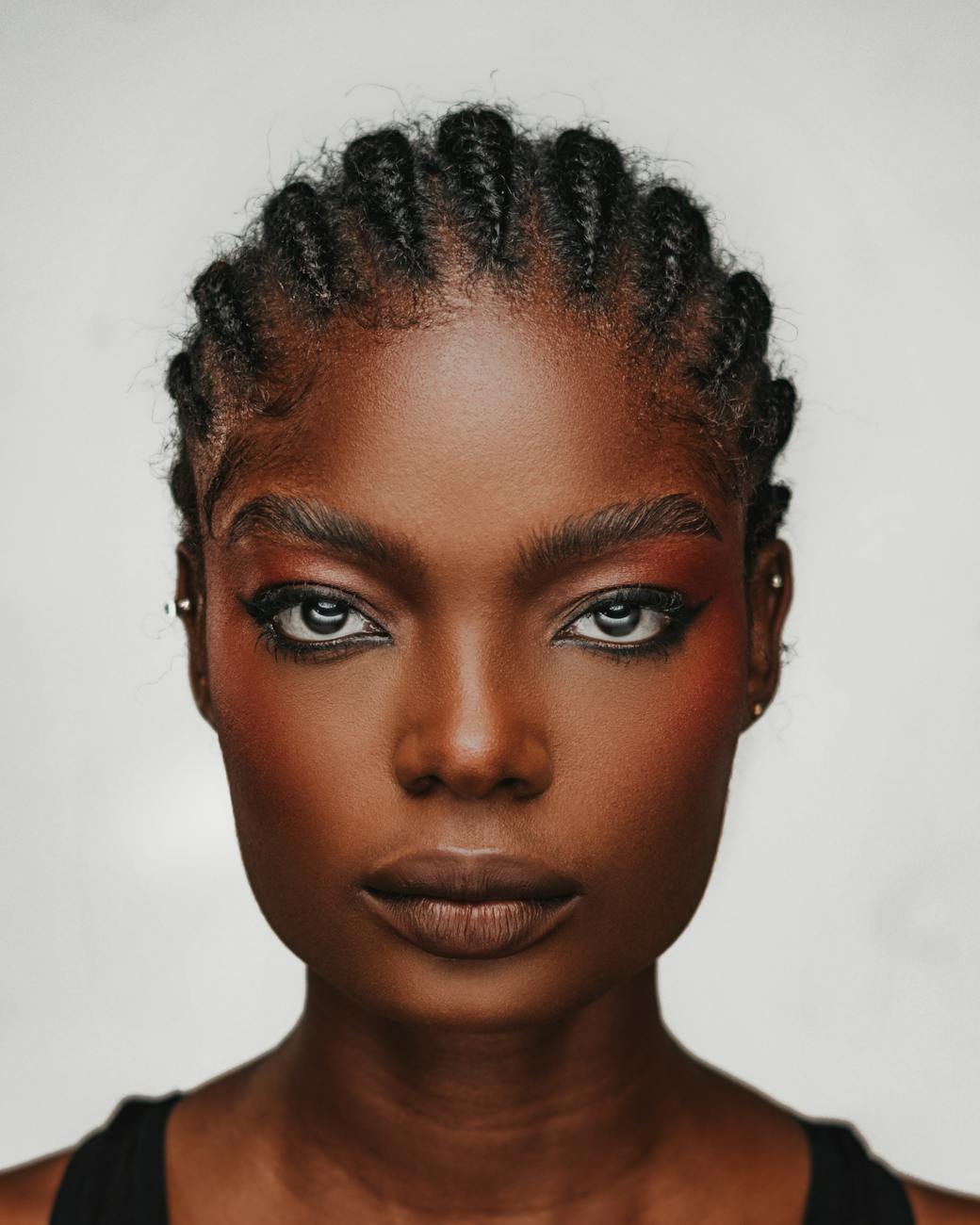
Black beauty is a concept far deeper than surface appearance. It is the convergence of science, history, and spirit, revealing how genetics, cultural expression, and aesthetic principles work together to create radiance. To speak of the “golden ratio of melanin” is to acknowledge that Black beauty embodies symmetry, biological adaptation, and cultural meaning. This essay explores the anatomy of Black beauty through genetics, symmetry, cultural aesthetics, and identity, uncovering the scientific and symbolic foundations of its radiance.
Evolutionary Foundations of Black Beauty
The human body is a record of adaptation, and African-descended peoples carry evolutionary traits that reflect millennia of survival in diverse climates. Deeply pigmented skin, rich in eumelanin, developed as protection against ultraviolet radiation, safeguarding folate and reproductive health while allowing adequate vitamin D synthesis (Jablonski & Chaplin, 2010). This evolutionary brilliance demonstrates that beauty is inseparable from function and survival.
The Science of Melanin
Melanin, the pigment responsible for skin, hair, and eye color, holds both biological and symbolic power. Biologically, it provides a shield against UV damage and oxidative stress. Symbolically, it has become a marker of identity and pride, as phrases such as “melanin magic” reclaim the beauty once devalued by colonial systems. The “golden ratio of melanin” metaphorically expresses the balance between biological adaptation and aesthetic radiance embedded in Black bodies.
Facial Symmetry and Aesthetics
Scientific studies show that facial symmetry often influences perceptions of beauty (Little et al., 2011). Yet Black beauty complicates this narrative. While symmetry is biologically associated with health and reproductive fitness, the diversity of African facial structures—from high cheekbones to broad noses—illustrates that beauty cannot be reduced to symmetry alone. The unique harmony of features within African-descended populations reflects both genetic depth and aesthetic variety beyond Eurocentric measures.
Genetics and Diversity
Africa is the most genetically diverse continent, containing the origins of humanity itself (Tishkoff et al., 2009). This genetic variation produces an extraordinary range of phenotypes: skin tones from deep ebony to golden bronze, hair textures from tightly coiled to wavy, and eye colors that include rare shades of amber or green. Such diversity underscores that Black beauty is not singular but multifaceted, shaped by genetic inheritance and expressed across continents and diasporas.
The Psychology of Black Beauty
The psychology of beauty is inseparable from systems of power. For centuries, Eurocentric ideals defined beauty in ways that excluded African features, leading to internalized racism and colorism within Black communities (Hunter, 2007). Yet psychological resilience emerged through cultural movements that reframed beauty. From the “Black is Beautiful” movement to today’s natural hair renaissance, psychology demonstrates that Black beauty is not merely seen but also consciously reclaimed as self-affirmation.
The Cultural Expression of Beauty
Culture shapes how beauty is performed and perceived. Hairstyles, adornment, and fashion within African and diasporic traditions are more than aesthetic—they are carriers of memory, resistance, and identity. Cornrows, locs, and Afro hairstyles, once stigmatized, now stand as global fashion statements while retaining cultural significance (Byrd & Tharps, 2014). Thus, Black beauty is not static but evolves with cultural shifts, asserting both individuality and community.
Historical Erasure and Resistance
Colonialism and slavery systematically devalued Black beauty, portraying African features as inferior while elevating Eurocentric standards. Enslaved Africans were stripped of adornments yet found ways to preserve identity, such as braiding hair with hidden codes for survival. This history demonstrates that beauty was never trivial but a form of cultural survival and resistance against dehumanization.
Representation and Media
Representation in media profoundly influences global perceptions of beauty. For much of history, darker skin and African features were either excluded or caricatured. Yet figures like Cicely Tyson, Naomi Campbell, and Lupita Nyong’o have redefined representation, bringing diverse expressions of Black beauty to global platforms (Craig, 2006). Rihanna’s Fenty Beauty further revolutionized the cosmetics industry by centering inclusivity, making darker shades visible and celebrated in ways previously unseen.
The Aesthetics of Proportion
The “golden ratio,” a mathematical principle often associated with ideal beauty, raises questions about universal aesthetics. While some studies suggest that facial proportions linked to the golden ratio are perceived as attractive, such measures often privilege European features (Pallett et al., 2010). Black beauty challenges and expands this framework, demonstrating that harmony and proportion can be expressed in multiple ways that transcend narrow mathematical formulas.
Identity and Self-Perception
Beauty is inseparable from identity. For Black people, affirming beauty has long been an act of self-definition against imposed inferiority. Identity formation involves embracing melanin, natural features, and cultural aesthetics as sources of pride rather than shame. This reclamation is both personal and collective, as communities cultivate beauty standards that reflect African heritage rather than colonial imposition.
Spiritual Dimensions of Beauty
Scripture affirms that true beauty is rooted in spirit rather than external adornment: “Whose adorning let it not be that outward adorning… but the hidden man of the heart” (1 Peter 3:3–4, KJV). For Black communities, whose external beauty was historically denied, spiritual beauty became a foundation of dignity and resilience. Thus, Black beauty radiates not only through skin and hair but through faith, endurance, and inner strength.
Global Influence of Black Aesthetics
Today, Black aesthetics shape global culture in profound ways. From hip-hop fashion to Afrocentric hairstyles on runways, African-descended styles influence mainstream trends worldwide. Yet appropriation remains a challenge, as Black cultural expression is often commodified without honoring its origins (Patton, 2006). Despite this, the global admiration of Black beauty underscores its undeniable power to shape aesthetics on a universal scale.
Resilience as Radiance
At its core, Black beauty is radiant because it has endured. It has survived slavery, colonialism, and systemic erasure, yet continues to redefine standards on its own terms. This resilience transforms beauty from mere appearance into testimony. Black beauty is not fragile—it is forged in fire, radiant because it resisted dehumanization and emerged with power intact.
Conclusion
The anatomy of Black beauty encompasses genetics, symmetry, and identity, but extends beyond science into culture, psychology, and spirit. It is the golden ratio of melanin: a perfect balance of biological brilliance, cultural resistance, and aesthetic radiance. To study the science of Black beauty is to affirm that it is foundational to humanity, diverse in expression, and sacred in meaning. Black beauty is not just seen—it is lived, survived, and celebrated as resilience made radiant.
References
- Byrd, A., & Tharps, L. (2014). Hair story: Untangling the roots of Black hair in America. St. Martin’s Press.
- Craig, M. L. (2006). Race, beauty, and the tangled knot of a guilty pleasure. Feminist Theory, 7(2), 159–177.
- Hunter, M. (2007). The persistent problem of colorism: Skin tone, status, and inequality. Sociology Compass, 1(1), 237–254.
- Jablonski, N. G., & Chaplin, G. (2010). Human skin pigmentation as an adaptation to UV radiation. Proceedings of the National Academy of Sciences, 107(Suppl 2), 8962–8968.
- Little, A. C., Jones, B. C., & DeBruine, L. M. (2011). Facial attractiveness: Evolutionary based research. Philosophical Transactions of the Royal Society B: Biological Sciences, 366(1571), 1638–1659.
- Pallett, P. M., Link, S., & Lee, K. (2010). New “golden” ratios for facial beauty. Vision Research, 50(2), 149–154.
- Patton, T. O. (2006). Hey girl, am I more than my hair? African American women and their struggles with beauty, body image, and hair. NWSA Journal, 18(2), 24–51.
- Robins, A. H. (2009). Biological perspectives on human pigmentation. Cambridge University Press.
- Tishkoff, S. A., et al. (2009). The genetic structure and history of Africans and African Americans. Science, 324(5930), 1035–1044.
 THE BROWN GIRL DILEMMA