
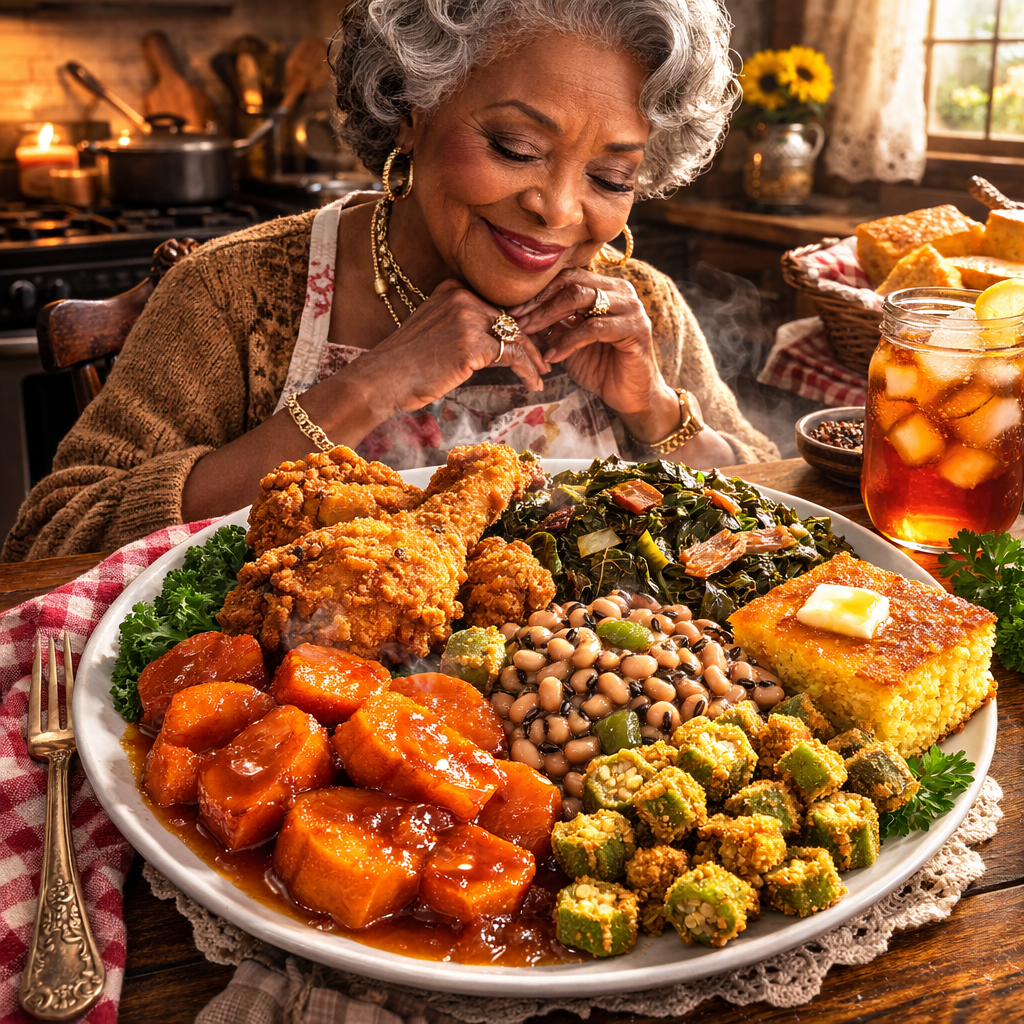
Soul food is far more than a collection of dishes; it is a living historical record of resistance, survival, ingenuity, and cultural pride for African Americans (Britannica Editors, 2026). Its origins are deeply rooted in the history of slavery, the adaptation of African culinary traditions, and the remaking of limited resources into food that sustains both body and community.
The roots of soul food stretch back to the era of slavery in the Southern United States. Enslaved Africans brought with them culinary knowledge from West and Central Africa, including cooking methods and flavor profiles that would later be foundational to the cuisine (Wikipedia, 2026). These skills—shaping flavor, stewing greens, and combining ingredients into nourishing meals—were essential for sustaining life in brutal, undernourishing conditions.
During slavery, African Americans were typically given meager rations consisting of cornmeal and scraps of pork or other discarded animal parts. Slave owners kept prime cuts for themselves, leaving enslaved people with offal, bones, and less desirable cuts of meat (Wikipedia, 2026). Rather than waste, these ingredients became opportunities for creative cooking that ultimately formed the backbone of soul food.
Enslaved cooks adapted traditional West African techniques to combine these limited foodstuffs with local ingredients. They melded their ancestral knowledge with Indigenous American and European cooking methods, creating new dishes that were both resourceful and flavorful. In this way, soul food is a hybrid cuisine reflecting the intersecting histories of Africans, Native Americans, and Europeans in the South (Wikipedia, 2026).
Because of the harsh conditions on plantations, enslaved people often supplemented their diets through hunting, fishing, and gardening. Small private gardens became sources of okra, greens, and other vegetables that remained central to soul food after emancipation (Wikipedia, 2026). These foods were combined with what was available from rations or the landscape to create hearty, high‑calorie meals necessary for laboring bodies.
The term “soul food” itself didn’t emerge until the 1960s and 1970s, during the Black Power and Black Pride movements, when “soul” became a broader cultural expression of identity and resistance. During this era, African Americans began to reclaim and celebrate their culinary traditions as symbols of cultural pride rather than shame (The Soul Food Pot, 2026).
Before the term was popularized, these dishes were often called “down‑home food,” “country cooking,” or “real good cooking.” They were the meals families prepared for Sunday dinners, communal gatherings, and everyday survival (Chicago Crusader, 2026). These communicative food traditions connected generations and helped maintain cultural memory.
After emancipation and especially during the Great Migration, African Americans brought this culinary tradition north and west to urban centers. Soul food restaurants began to appear in cities with significant Black populations, transforming regional rural cooking into a national cuisine associated with African American culture (Britannica Editors, 2026).
At its core, soul food reflects adaptability in the face of oppression. Greens such as collards, mustard, and turnips became staples because these crops could be grown in small gardens and were rich in nutrients. Beans, black‑eyed peas, and okra similarly became key components of the repertoire, often stewed with smoked meat for additional flavor (Afro.com, 2026).
Dishes we now think of as quintessential soul food—gumbos, stews, and rice dishes—trace back to West African foodways. For example, gumbo is closely linked to West African stews, thickened with okra or filé powder and seasoned with local spices, reflecting the blend of cultures in the South (The DO, 2026).
Pork played a significant role because it was widely available in the antebellum South. Ham hocks, jowls, and other parts of the hog that slave owners discarded were transformed into flavor bases for greens, beans, and stews. The use of pork fat also enhanced flavor and calories in otherwise lean vegetable dishes (Wikipedia, 2026).
Fried chicken—one of the most iconic soul food dishes—exemplifies the cuisine’s blended heritage. While frying chicken was practiced in some West African cultures, the technique was reinforced in the American South by enslaved cooks and adapted alongside European frying methods. Over time, African Americans perfected the seasoning, frying style, and presentation that distinguished it as soul food (Mercer University, 2026).
Despite its cultural richness, the association of fried chicken with Black Americans has also been shaped by racist stereotyping. As soul food historian Adrian Miller notes, African Americans who sold fried chicken or cooked it under oppression were later depicted in derogatory media imagery that trafficked in harmful tropes (Eater, 2018).
This duality—celebration and stereotype—highlights how soul food occupies both pride and pain within the broader American imagination. The food that sustained families through hardship has also been used to demean the very people who created it (Eater, 2018).
While traditional soul food involved pork heavily, modern adaptations often substitute smoked turkey, chicken, or vegetarian proteins to make the cuisine healthier or to accommodate dietary restrictions without losing the essence of the dishes (AA Registry, 2026).
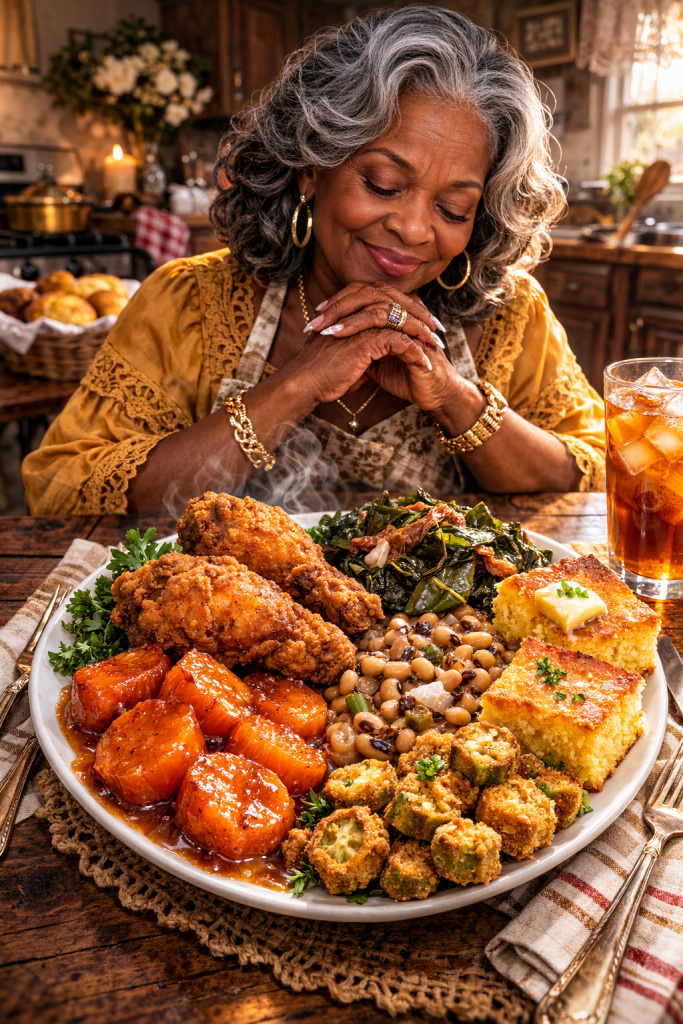
A traditional soul food plate without pork might include fried chicken or baked chicken, stewed collard greens seasoned with smoked turkey, black‑eyed peas, cornbread, candied yams, and okra. Each element reflects the historical journey of an ingredient—whether cultivated, foraged, or inherited from ancestral cooking traditions (Afro.com, 2026).
Soul food has endured because it is cultural memory on a plate. It functions as an edible archive of survival, community, and identity—passed down through families, celebrated at gatherings, and shared across generations as a testament to resilience (Chicago Crusader, 2026).
KFC: The History of Kentucky Fried Chicken
Kentucky Fried Chicken, commonly known as KFC, was founded by Harland David “Colonel” Sanders in 1952 in Salt Lake City, Utah, though Sanders had been cooking and selling fried chicken in Kentucky decades earlier (Wall Street Journal, 2023). His original recipe, featuring 11 secret herbs and spices, became the foundation for one of the world’s most recognized fast-food brands.
Sanders first operated a small roadside restaurant during the Great Depression, catering to travelers with fried chicken and other home-cooked Southern meals. In the 1930s and 1940s, he experimented with pressure-frying, a method that reduced cooking time while keeping chicken crispy—a key innovation that helped KFC expand nationwide.
By the 1960s, KFC began franchising aggressively, spreading across the U.S. and then internationally. Today, KFC operates in over 150 countries, with a unique global footprint where the menu is adapted to local tastes, such as spicy fried chicken in Asia, halal options in the Middle East, and rice-based sides in Latin America.
KFC’s cultural significance lies not only in its branding but also in its role in popularizing fried chicken as fast food worldwide, bridging Southern American culinary traditions with global consumption.
Fried Chicken in Asia: Origins and Popularity
Fried chicken was not invented in Asia, but certain Asian countries adopted and adapted the dish to their own culinary traditions centuries ago. For example:
- China: Historical records suggest that frying chicken in oil has existed since the Tang dynasty (618–907 CE). Chinese cooks used light coatings of flour or starch and seasonings for fried poultry, predating widespread Western fried chicken. (Asia Society, 2020)
- Japan: Fried chicken became popular with karaage, a Japanese cooking method where bite-sized pieces of chicken are marinated in soy sauce, ginger, and garlic, then coated lightly in starch and fried. This style was influenced by Chinese techniques but adapted to local flavors. (Japan Times, 2021)
- Korea: Korean fried chicken, or “chikin”, emerged in the 1960s–70s and became widely popular through fried chicken chains. Unlike Western fried chicken, Korean fried chicken is often double-fried for extreme crispiness and coated with spicy or sweet sauces. It is now a staple in Korean cuisine and social culture. (Korea Herald, 2022)
In essence, while fried chicken as we know it in KFC form originates from Southern U.S. cooking traditions, many Asian countries have parallel fried chicken traditions that predate modern fast-food chains. Today, these countries have also influenced global fried chicken flavors, including the sweet, spicy, or soy-based styles now sold in KFC outlets worldwide.
Its evolution from necessity to pride underscores how African Americans reclaimed what was once a symbol of marginalization and transformed it into one of cultural affirmation. Soul food remains one of the most beloved and influential contributions African Americans have made to the broader landscape of American cuisine (Britannica Editors, 2026).
References
Afro.com. (2026). Soul food: African culture embedded in American cuisine. Retrieved from https://afro.com/soul-food-african-culture-embedded-in-american-cuisine/?utm_source=chatgpt.com
AA Registry. (2026). Soul food: A brief history. Retrieved from https://aaregistry.org/story/soul-food-a-brief-history/?utm_source=chatgpt.com
Britannica Editors. (2026). Soul food. In Encyclopedia Britannica. Retrieved from https://www.britannica.com/topic/soul-food-cuisine?utm_source=chatgpt.com
Chicago Crusader. (2026). The Black plate: Soul food’s long march to freedom. Retrieved from https://chicagocrusader.com/the-black-plate-soul-foods-long-march-to-freedom/?utm_source=chatgpt.com
Eater. (2018, October 3). Fried chicken is common ground: The history and stereotypes. Retrieved from https://www.eater.com/2018/10/3/17926424/fried-chicken-is-common-ground?utm_source=chatgpt.com
Mercer University. (2026). Southern food and African-American culinary traditions. Retrieved from https://faculty.mercer.edu/davis_da/southernfood/blog.html?utm_source=chatgpt.com
The DO. (2026). Food from the soul: A history of African-American culture and nutrition. Retrieved from https://thedo.osteopathic.org/columns/food-from-the-soul-a-history-of-african-american-culture-and-nutrition/?utm_source=chatgpt.com
The Soul Food Pot. (2026). Soul food history. Retrieved from https://thesoulfoodpot.com/soul-food-history/?utm_source=chatgpt.com
Wikipedia. (2026). Soul food. Retrieved from https://en.wikipedia.org/wiki/Soul_food?utm_source=chatgpt.com
 THE BROWN GIRL DILEMMA