Category Archives: Shades

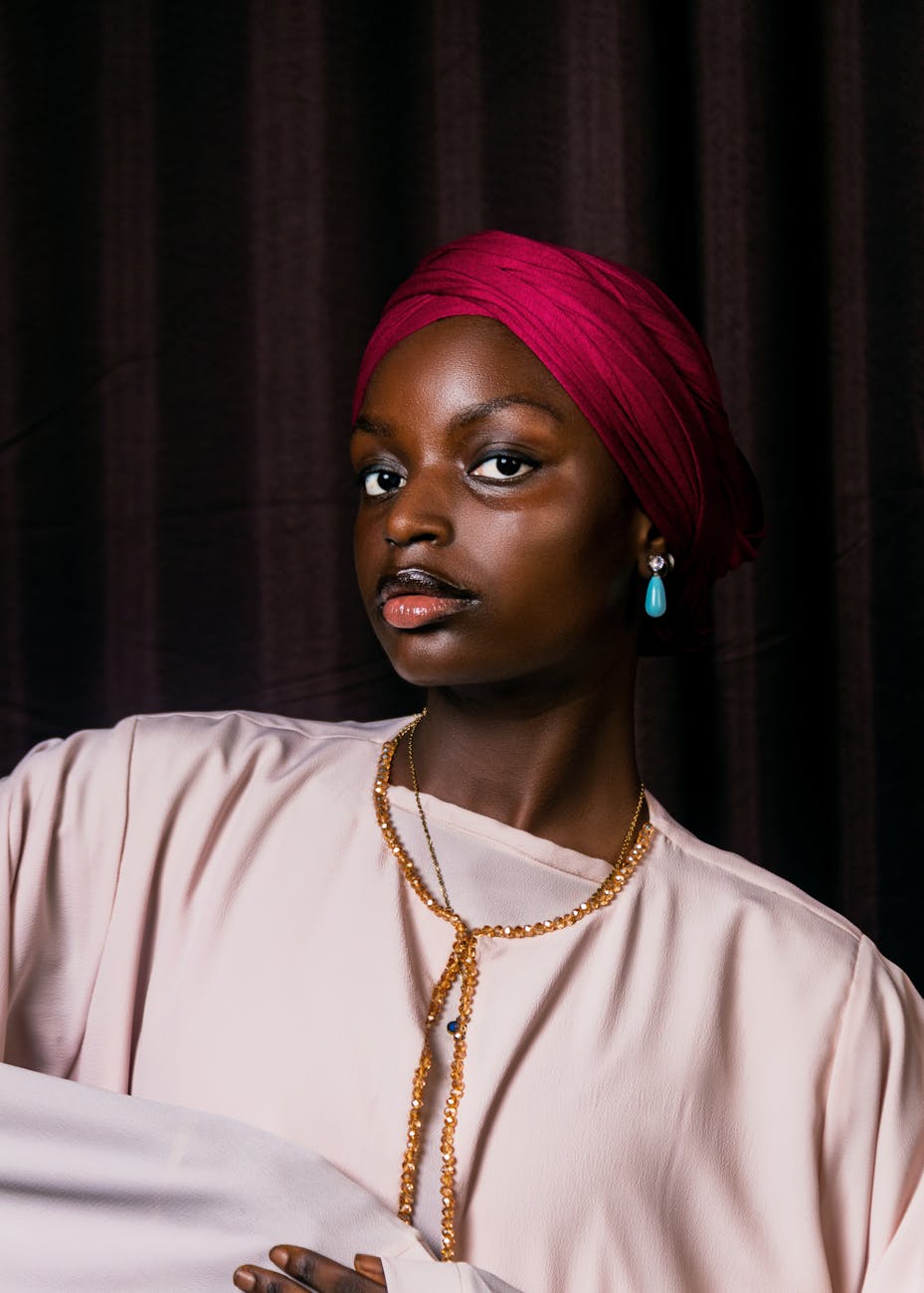
Ode to the shades of Brown

Oh, the shades of brown, rich as the earth,
From the deepest mahogany to the honeyed warmth of birth.
You tell stories of ancestry, of kings and queens,
Of rivers crossed and lands unseen.

Your skin, a tapestry woven by God’s own hand,
A palette divine, too vast to understand.
Every tone a hymn, every hue a song,
A testament of resilience, proud and strong.

In sunlight, you shimmer like burnished gold,
A brilliance no lens nor mirror can hold.
In shadow, you speak of depth and grace,
Of sacred histories, time cannot erase.

Oh, chestnut, cocoa, and espresso hues,
Each a reflection of ancient truths.
Each freckle, each mole, a jewel to behold,
A story of courage, of valor untold.

Caramel whispers of warmth and light,
Mocha radiates quiet power in sight.
Amber gleams with a gentle fire,
Chestnut glows with ancestral desire.

The shades of brown, both subtle and bold,
Carry legacies neither bought nor sold.
From slave cabins to palaces, from fields to streets,
Your beauty defies oppression, never retreats.

KJV Truth sings in your radiant skin:
Psalm 139:14 – “I am fearfully and wonderfully made.”
Every shade, every tone, every nuance,
A reflection of God’s artistry, perfect and true.

Celebrate your brown, in all its delight,
From dawn’s soft glow to the velvet of night.
No pigment dictates your worth or your place,
Your brown is divine, imbued with God’s grace.

Oh, the shades of brown, a spectrum so vast,
From subtle taupe to the boldest cast.
You are power, beauty, endurance, and art,
A masterpiece woven straight from God’s heart.

So rise, brown daughters, with pride in your skin,
Let no world’s bias define what’s within.
Your shade is a crown, your hue is a song,
In the orchestra of creation, you alone belong.

The phrase “shades of brown” reflects more than just physical variation in skin tone—it represents a complex social reality shaped by history, power, and perception. Across the African diaspora and other communities of color, differences in skin tone have been given meaning within systems that rank and assign value to people based on how light or dark they appear. This phenomenon, known as Colorism, continues to influence identity, opportunity, and self-perception.

Colorism has deep roots in the history of slavery and colonialism. During the transatlantic slave trade, lighter-skinned enslaved individuals—many of whom were of mixed ancestry—were sometimes given preferential treatment, such as working in the house rather than in the fields. These divisions were not accidental; they reinforced a hierarchy that placed whiteness, and proximity to it, at the top. Over time, these patterns became internalized within communities, creating lasting divisions based on complexion.

The legacy of these practices can still be seen today. Lighter skin is often associated with beauty, success, and desirability, while darker skin is unfairly stigmatized. This bias is reinforced through media representation, where lighter-skinned individuals are frequently overrepresented in leading roles, advertisements, and positions of influence. As a result, societal standards of beauty often reflect a narrow range of features tied to Eurocentric ideals.

From a sociological perspective, colorism operates as a learned norm within Sociology, passed down through generations and reinforced by institutions such as media, education, and family structures. Individuals absorb these messages early in life, shaping how they view themselves and others. Children, for example, may begin to associate lighter skin with positive traits and darker skin with negative ones, even without explicit instruction.

The psychological impact of colorism is significant. Studies have shown that individuals with darker skin tones may experience lower self-esteem, higher levels of discrimination, and reduced access to opportunities in areas such as employment and education. This aligns with Social Identity Theory, which explains how people derive part of their self-worth from how their group is perceived in society. When darker skin is devalued, it can negatively affect individual identity and confidence.

In addition to its psychological effects, colorism also has economic consequences. Research suggests that lighter-skinned individuals, on average, earn higher incomes and are more likely to be perceived as professional or trustworthy. These disparities highlight how deeply embedded color bias is within social and institutional structures.

The concept of “shades of brown” also intersects with ideas of mixed race and racial ambiguity. Individuals with lighter or racially ambiguous features are often treated differently, sometimes receiving privileges not afforded to darker-skinned individuals. However, this can also come with its own challenges, including questions about identity and belonging.

The Media continues to play a central role in reinforcing color hierarchies. Through film, television, and social media, certain looks are elevated while others are marginalized. The lack of diverse representation contributes to a limited understanding of beauty and perpetuates harmful stereotypes.

At the same time, there has been a growing movement to challenge colorism and celebrate darker skin tones. Campaigns promoting inclusivity and representation have begun to shift public perception, encouraging a broader and more authentic definition of beauty. Social media, while part of the problem, has also become a platform for advocacy and empowerment.

Education and awareness are key to addressing colorism. By understanding its historical roots and recognizing its modern impact, individuals and communities can begin to dismantle these biases. Conversations about colorism help to bring attention to an issue that is often overlooked but deeply felt.

Ultimately, the “shades of brown” are a testament to human diversity, not a hierarchy of value. Skin tone variation is a natural result of genetic adaptation and ancestry, not a measure of worth. Challenging colorism requires both individual reflection and collective action to redefine standards and promote equity.

The journey toward dismantling colorism is ongoing, but it begins with recognizing that all shades carry equal beauty, dignity, and significance. By confronting these biases, society can move closer to a more inclusive and just understanding of identity.


References

Hunter, M. (2007). The persistent problem of colorism: Skin tone, status, and inequality. Sociology Compass, 1(1), 237–254.

Keith, V. M., & Herring, C. (1991). Skin tone and stratification in the Black community. American Journal of Sociology, 97(3), 760–778.

Monk, E. P. (2015). The cost of color: Skin color, discrimination, and health among African Americans. American Journal of Sociology, 121(2), 396–444.

Dixon, T. L., & Telles, E. E. (2017). Skin color and colorism: Global research, concepts, and measurement. Annual Review of Sociology, 43, 405–424.

Hall, R. E. (2018). The Bleaching Syndrome: African Americans’ Response to Cultural Domination. Springer.
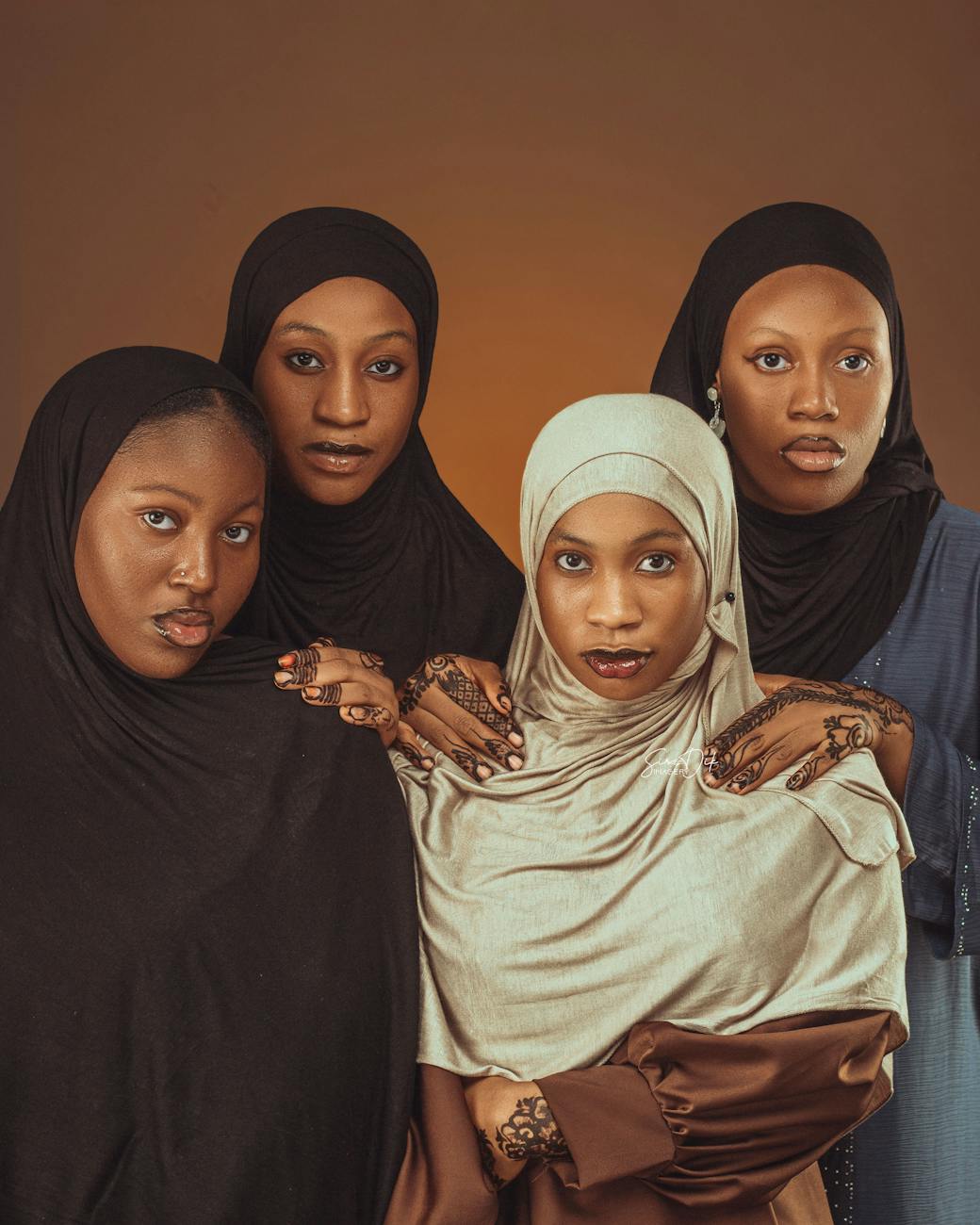
Pretty Privilege Series: Beyond the Complexion — Redefining Worth for Every Shade.

Photo by sirdik Imagery on Pexels.com

Colorism has left wounds that run deep within our communities, shaping perceptions of beauty, identity, and worth. For too long, shade has been used as a measuring stick for acceptance, desirability, and opportunity. To move forward, we must redefine worth for every shade, lifting the veil on “pretty privilege” and affirming the divine value of Blackness in all its richness.

Skin Deep Wounds — Healing the Hidden Scars of Colorism

The wounds of colorism are not only external but internal. Skin tone bias is not simply about how the world perceives us; it is about how we learn to perceive ourselves. Words like “too dark” or “light but not bright” cut into the soul, shaping childhood self-image in ways that echo into adulthood. Proverbs 18:21 (KJV) reminds us, “Death and life are in the power of the tongue.” When words diminish God’s creation, they leave hidden scars.

These scars are visible in the struggles of young Black girls who avoid the sun to keep their skin light, or young boys teased for being “too dark.” The trauma festers silently, becoming insecurities that limit confidence and self-expression. Healing begins with honesty—acknowledging that colorism has been a battleground for many of our souls.

The healing process requires dismantling internalized lies. Psalm 139:14 (KJV) declares, “I will praise thee; for I am fearfully and wonderfully made.” Every shade of melanin carries God’s fingerprint, a mark of intentional design. To heal from colorism is to return to this truth, replacing shame with sacred affirmation.

Shattered Reflections — When Beauty Becomes a Battleground

The beauty industry has long profited from fractured reflections, perpetuating the idea that lighter skin is superior. From skin-lightening creams in Jamaica to casting choices in Hollywood, darker shades are often treated as obstacles rather than assets (Charles, 2003). This battle over beauty has forced many women into comparison wars, where worth is tied to shade rather than substance.

Consider how media representations reinforce these divisions. Lighter-skinned women often receive leading roles or are marketed as universal beauties, while darker-skinned women are typecast as strong but rarely romantic leads. This reinforces a dangerous hierarchy that fractures self-worth and perpetuates insecurity.

But beauty should never be a battlefield. Ecclesiastes 3:11 (KJV) reminds us, “He hath made every thing beautiful in his time.” God’s design leaves no shade excluded, no complexion unworthy. The real battle is against lies that seek to limit the spectrum of Black beauty.

Examples of Worthy Black Women in All Shades of Color

Across history and culture, Black women of every shade have embodied brilliance, resilience, and beauty. Their lives demonstrate that worth is not confined to complexion but rooted in character and calling.

Lupita Nyong’o, a dark-skinned actress and activist, has become a global voice for self-love and natural beauty. Her 2014 Oscar speech about embracing her skin inspired countless young women to reject colorist lies.

Viola Davis, another darker-skinned icon, has broken barriers in Hollywood, becoming the first Black woman to win an Emmy, Tony, and Oscar. Her success proves that talent, not tone, defines greatness.

Zendaya, of a lighter complexion, uses her platform to challenge the privileges afforded to her shade. She consistently advocates for darker-skinned representation in film and fashion, showing that lighter-skinned women can use their privilege responsibly to uplift others.

Beyoncé, with her golden-brown complexion, has redefined global pop culture. Yet she also openly addresses her Blackness in works like Lemonade, highlighting the beauty and struggles of being a Black woman in all shades.

Michelle Obama, of a rich brown hue, served as First Lady of the United States with grace, intellect, and strength. She became a living reminder that leadership, class, and beauty transcend skin tone.

Serena and Venus Williams, both deep brown-toned athletes, dominated tennis, a sport historically closed to Black women. Their resilience against racism and colorism within sports symbolizes how power and melanin coexist unapologetically.

Each of these women stands as proof that every shade holds worth. Their legacies dismantle the myths of colorism and expand the spectrum of representation.

Redefining Worth for Every Shade

Redefining worth means moving beyond complexion as a qualifier. It is choosing to affirm that Black beauty is not conditional but universal. John 8:32 (KJV) assures, “And ye shall know the truth, and the truth shall make you free.” The truth is that worth is God-given, not man-defined.

Communities must intentionally affirm children across shades, teaching them that their melanin is not a burden but a blessing. Schools, churches, and families must create spaces where darker and lighter-skinned children see themselves equally celebrated.

Media industries must diversify representation, rejecting tokenism in favor of authentic inclusivity. This means casting darker-skinned women in roles of love and softness, not just strength, and celebrating lighter-skinned women without placing them on pedestals of exclusivity.

Spiritually, churches must reject shade-based biases. The gospel is clear: “Of a truth I perceive that God is no respecter of persons” (Acts 10:34, KJV). If heaven is filled with every shade, then earth should reflect that same truth.

Ultimately, the battle of complexion is not about beauty but about identity. When Black people stop fighting one another over melanin and begin celebrating the divine artistry of every hue, the chains of colorism will break.

The healing of these hidden scars requires both personal and collective action. Individually, it means reclaiming self-love. Collectively, it means dismantling systems and mindsets that perpetuate shade hierarchies. Together, we can move beyond complexion to redefine worth for every shade.


References

  • Charles, C. A. D. (2003). Skin bleachers’ representations of skin color in Jamaica. Journal of Black Studies, 33(6), 711–728.
  • Hunter, M. (2007). The persistent problem of colorism: Skin tone, status, and inequality. Sociology Compass, 1(1), 237–254.
  • Keith, V. M., & Herring, C. (1991). Skin tone and stratification in the Black community. American Journal of Sociology, 97(3), 760–778.
  • Russell, K., Wilson, M., & Hall, R. (1992). The Color Complex: The Politics of Skin Color Among African Americans. Anchor Books.
  • The Holy Bible, King James Version.

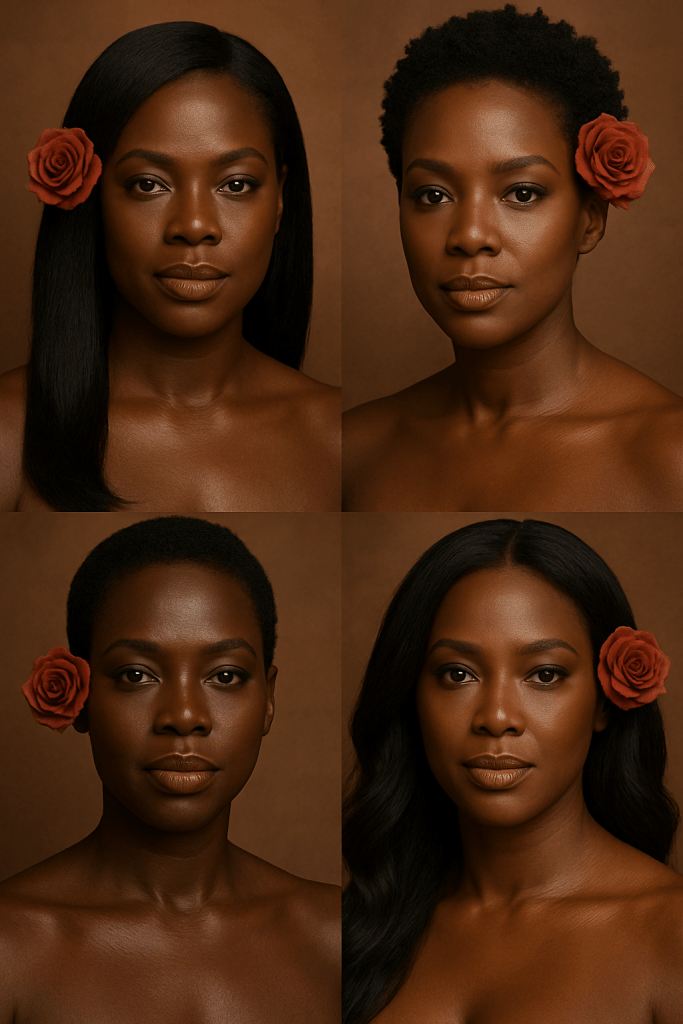
Pretty Privilege Series: Faces of the Sun — Celebrating the Deepest Shades of Us.

Beauty has always been both a mirror and a weapon—reflecting societal values while often wounding those who fall outside its narrow definitions. The phenomenon known as pretty privilege reveals how beauty grants unspoken advantages, yet historically, this privilege has excluded darker-skinned individuals, especially within the Black community. In this installment, “Faces of the Sun,” we turn toward the light that has too often been dimmed—celebrating the deepest, richest complexions as the living embodiment of radiance, history, and divine artistry.

The term “Faces of the Sun” symbolizes more than melanin; it signifies resilience, warmth, and illumination born from struggle. The sun does not discriminate—it shines equally, yet some societies have long taught people to seek its opposite. In many cultures, including those shaped by colonial influence, dark skin was unjustly stigmatized while lightness became the aesthetic ideal (Hunter, 2007). This bias—rooted in colorism—still permeates beauty industries, employment opportunities, and social hierarchies today.

For centuries, enslaved Africans and their descendants were taught that proximity to whiteness equated to superiority. Light skin was rewarded; darker complexions were marginalized. This internalized system of value manipulation fractured collective identity (Russell, Wilson, & Hall, 2013). Yet, against all odds, the darkest hues endured, retaining the ancestral glow of the first people—the original faces of the sun.

To understand the beauty of dark skin, one must first unlearn Eurocentric paradigms of beauty that prioritize symmetry and fairness as universal standards. In truth, African beauty has always been multidimensional—defined by strength, spirit, and natural brilliance. Anthropologists note that the deep pigmentation found in African populations is an evolutionary masterpiece, perfectly adapted to protect against ultraviolet radiation (Jablonski & Chaplin, 2000). The melanin that once symbolized “less than” is, scientifically, a shield of life.

This scientific truth carries profound cultural and spiritual implications. The same melanin that protects the body also metaphorically protects identity, grounding it in ancestry and divinity. Within many African cosmologies, the sun is a sacred source of life. To call dark-skinned people “faces of the sun” is to affirm that their complexions are celestial—not accidental. It is to remind them that they carry within them the warmth, depth, and eternal glow of creation itself.

Modern media, however, continues to struggle with accurate representation. While there has been progress—through figures like Lupita Nyong’o, Viola Davis, and Duckie Thot—dark-skinned women and men still face underrepresentation or tokenization. Nyong’o (2014) once described her journey to self-acceptance as a process of “learning to see beauty where it had not been taught.” Her words echo a broader cultural awakening that beauty is not defined by the dominant gaze but reclaimed by those once unseen.

Social media has been instrumental in reshaping beauty narratives. Movements like #MelaninPoppin and #BlackGirlMagic have become affirmations of identity and resistance. These digital spaces serve as modern-day salons of empowerment, where dark-skinned individuals can finally see themselves reflected with dignity and admiration (Hobson, 2018).

Yet, the celebration of melanin must not merely be a trend; it must be an enduring cultural correction. Too often, society commodifies Black beauty while ignoring Black pain. It sells the “aesthetic” but not the struggle. The Faces of the Sun series challenges this hypocrisy by centering the full humanity behind the beauty—the intellect, spirituality, and power embedded in every deep shade.

For men, the experience of colorism is often overlooked but equally profound. Dark-skinned Black men are sometimes fetishized as symbols of masculinity and virility while simultaneously criminalized in social perception (Monk, 2014). This duality reveals how colorism not only shapes attraction but also social justice outcomes, influencing employment, sentencing, and media portrayals. The path to healing requires both genders to unlearn these destructive binaries.

Psychologically, internalized colorism affects self-esteem, dating preferences, and even family dynamics. Studies show that darker-skinned individuals report higher instances of discrimination from both white and nonwhite peers (Keith & Herring, 1991). Healing begins with naming these experiences and dismantling the shame attached to skin tone. The mind must be decolonized before the mirror can truly reflect beauty.

Spiritually, celebrating the deepest shades is an act of restoration. In scripture, the Song of Solomon proclaims, “I am black, but comely” (Song of Solomon 1:5, KJV)—a poetic affirmation of divine beauty long before Western constructs defined worth. The “but” in that verse was not an apology; it was a declaration of mystery and majesty, a proclamation that darkness is as sacred as light.

Artists and photographers who celebrate deep skin tones are participating in a form of cultural reclamation. Through careful lighting and composition, they capture how dark skin interacts with illumination—absorbing and reflecting it with unmatched depth. This interplay of light and shadow becomes a metaphor for resilience: the darker the hue, the more it thrives in the brilliance of the sun.

Cinematically, we are witnessing a renaissance in the portrayal of deep-toned characters. Films like Black Panther (2018) and The Woman King (2022) have redefined representation, highlighting beauty, power, and leadership within African diasporic narratives. These works not only entertain but reeducate the collective imagination about what heroism and beauty look like when liberated from whitewashed ideals.

Fashion, too, has begun to embrace the richness of melanin. Designers like Hanifa, Pyer Moss, and LaQuan Smith intentionally feature models with deeper complexions, challenging industries long dominated by Eurocentric aesthetics. This rebalancing is not simply inclusion—it is justice in fabric form.

Still, the work is far from done. Representation cannot end on runways or screens; it must reach classrooms, boardrooms, and pulpits. The next generation must grow up seeing dark skin as divine design, not deviation. Education and media literacy are vital tools in dismantling colorist conditioning and restoring collective dignity.

The celebration of deep shades also invites global unity. Across the diaspora—from Sudan to Jamaica to Atlanta—our varied tones tell stories of migration, resilience, and rebirth. Each hue is a historical archive, holding ancestral wisdom that no bleaching cream or algorithm can erase.

By honoring “faces of the sun,” we acknowledge that beauty was never lost—it was merely unrecognized. When dark skin is illuminated correctly, the world witnesses the art of survival and the poetry of existence written in human form. This illumination is both literal and symbolic: a reminder that true radiance comes from embracing one’s God-given tone, not conforming to someone else’s lens.

In celebrating the deepest shades among us, we resist erasure and affirm life itself. Every melanin-rich face carries the memory of the beginning, when humanity first emerged under African skies. To be dark is not to be shadowed—it is to be kissed by the origin of light. The sun does not apologize for shining, and neither should we.

Ultimately, Pretty Privilege: Faces of the Sun is not just a visual or cultural movement; it is a theological and psychological restoration. It reclaims what colonization and capitalism once devalued—the inherent holiness of Blackness. It reminds us that we are not merely beautiful because we are seen, but because we are of the sun.


References

  • Hobson, J. (2018). The Black body in Hollywood: Visual culture and race politics. Routledge.
  • Hunter, M. L. (2007). The persistent problem of colorism: Skin tone, status, and inequality. Sociology Compass, 1(1), 237–254.
  • Jablonski, N. G., & Chaplin, G. (2000). The evolution of human skin coloration. Journal of Human Evolution, 39(1), 57–106.
  • Keith, V. M., & Herring, C. (1991). Skin tone and stratification in the Black community. American Journal of Sociology, 97(3), 760–778.
  • Monk, E. P. (2014). Skin tone stratification among Black Americans, 2001–2003. Social Forces, 92(4), 1313–1337.
  • Nyong’o, L. (2014). Essence Magazine Interview: Lupita Nyong’o on embracing her beauty. Essence.
  • Russell, K., Wilson, M., & Hall, R. (2013). The color complex: The politics of skin color among African Americans. Anchor Books.

The Psychology of Shade: Self-Worth in the Brown Girl Journey. #thebrowngirldilemma

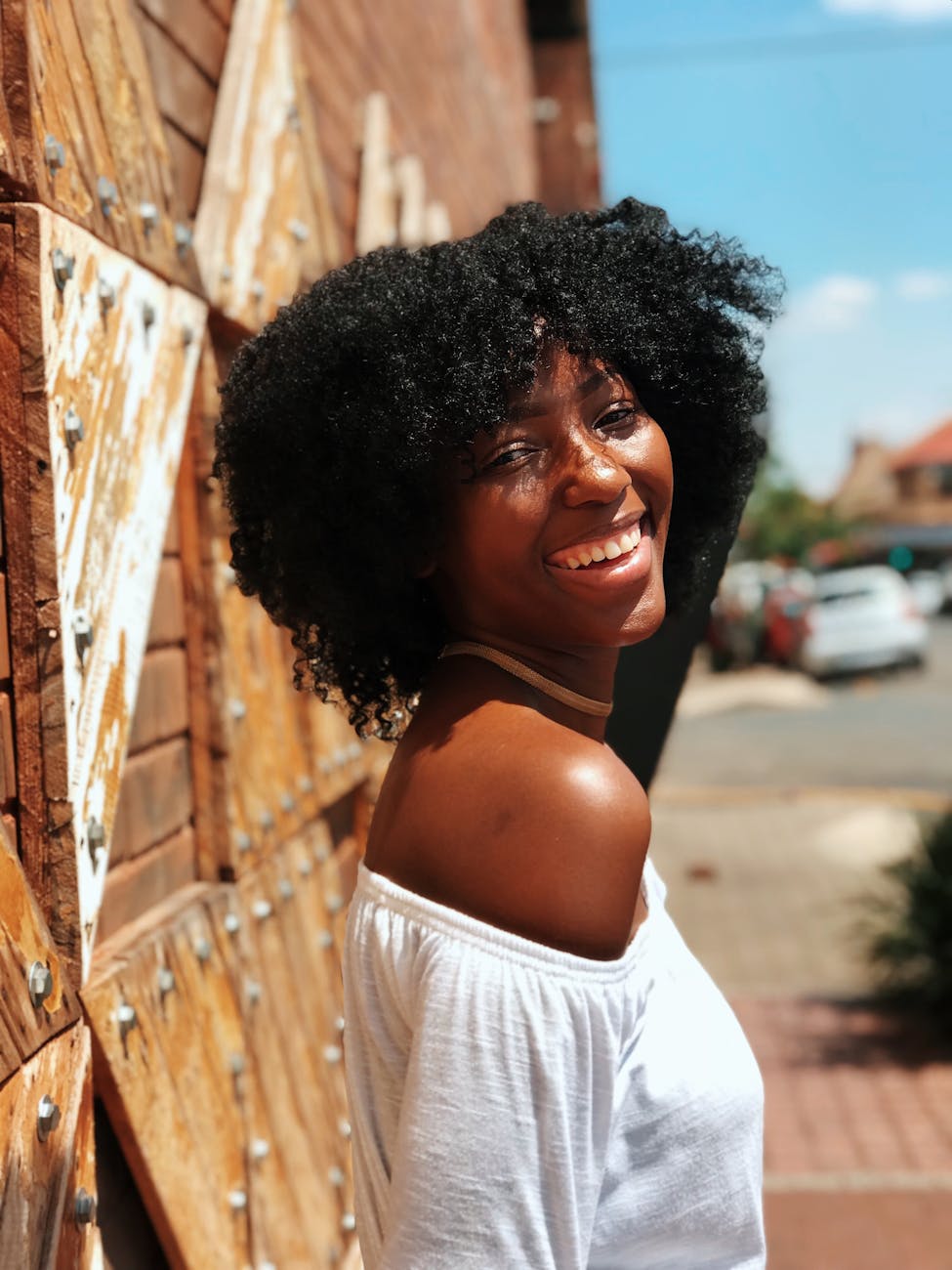
Photo by Anchau on Pexels.com

Shade is more than a color on the spectrum of skin—it is a lived experience that shapes identity, opportunity, and self-worth. For the brown girl, navigating her journey often means negotiating the psychological weight of how her shade is read by the world. Colorism, both within and outside of the Black community, functions as a hierarchy of value, where lighter shades are privileged and darker shades are dismissed or devalued (Hunter, 2007). This creates a paradox of belonging: the brown girl is simultaneously celebrated for her uniqueness yet pressured to alter or deny her shade to gain acceptance.

Psychologically, this manifests in what scholars call internalized colorism, where individuals measure their self-worth against Eurocentric standards of beauty and success (Keith & Herring, 1991). Brown girls may wrestle with questions of desirability—Am I too dark to be beautiful? Too brown to be chosen?—echoing wounds that stem from centuries of colonial trauma. Such questions erode self-esteem, linking complexion to perceived social status and opportunity. This is evident in studies showing that darker-skinned women often earn less, face higher discrimination in dating markets, and experience greater stigmatization in professional spaces (Hersch, 2008).

Yet, the psychology of shade is not solely one of burden. It is also one of resilience. Brown girls develop what psychologists call racial socialization—strategies passed down through family and community that affirm their identity, instill cultural pride, and resist internalized oppression (Hughes et al., 2006). For example, Black mothers often teach their daughters affirmations of melanin beauty, linking shade to cultural strength and divine uniqueness. This nurtures resilience, allowing brown girls to push back against narratives of inferiority.

Faith also plays a crucial role in shaping the psychology of shade. The biblical reminder that “I am fearfully and wonderfully made” (Psalm 139:14, KJV) serves as a spiritual antidote to colorist lies. In the Song of Solomon, the Shulamite woman boldly declares, “I am black, but comely” (Song of Solomon 1:5, KJV), a verse that directly challenges the stigma attached to darker complexion. By rooting self-worth in divine creation rather than societal validation, the brown girl journey becomes one of liberation rather than limitation.

Media representation also influences the psychology of shade. Historically, darker-skinned women were cast in roles that reinforced stereotypes of servitude, aggression, or invisibility. Today, increasing visibility of brown-skinned actresses, models, and influencers signals a shift in cultural narratives. When Lupita Nyong’o won an Academy Award, she used her platform to speak directly to young girls with darker skin, affirming their beauty and worth. Such moments have a profound psychological impact, expanding the mirror of possibility for future generations.

Still, the scars of colorism persist. In global contexts, from South Asia to Latin America, skin-lightening creams remain billion-dollar industries (Tate, 2016), underscoring how shade continues to dictate perceived value. For the brown girl, resisting this global obsession with lightness is a radical act of self-love. It is choosing to see her shade not as a deficit but as a divine inheritance.

Ultimately, the psychology of shade reveals both the wounds and the wisdom of the brown girl journey. The struggle with self-worth is real, shaped by centuries of systemic bias. Yet, through faith, cultural pride, and resistance, brown girls transform shade from a site of shame into a source of strength. In embracing her skin, the brown girl affirms not only herself but also generations before her who were told to hide their brilliance.

Her journey declares that shade is not something to overcome but something to honor. The psychology of shade, therefore, becomes a psychology of sovereignty—choosing to define beauty, worth, and identity on her own terms.


References

  • Hersch, J. (2008). Profiling the new immigrant worker: The effects of skin color and height. Journal of Labor Economics, 26(2), 345–386.
  • Hughes, D., Rodriguez, J., Smith, E. P., Johnson, D. J., Stevenson, H. C., & Spicer, P. (2006). Parents’ ethnic-racial socialization practices: A review of research and directions for future study. Developmental Psychology, 42(5), 747–770.
  • Hunter, M. (2007). The persistent problem of colorism: Skin tone, status, and inequality. Sociology Compass, 1(1), 237–254.
  • Keith, V. M., & Herring, C. (1991). Skin tone and stratification in the Black community. American Journal of Sociology, 97(3), 760–778.
  • Tate, S. (2016). Skin Bleaching in Black and Brown Communities: Connected to Colorism and Colonialism. Palgrave Macmillan.
  • The Holy Bible, King James Version.

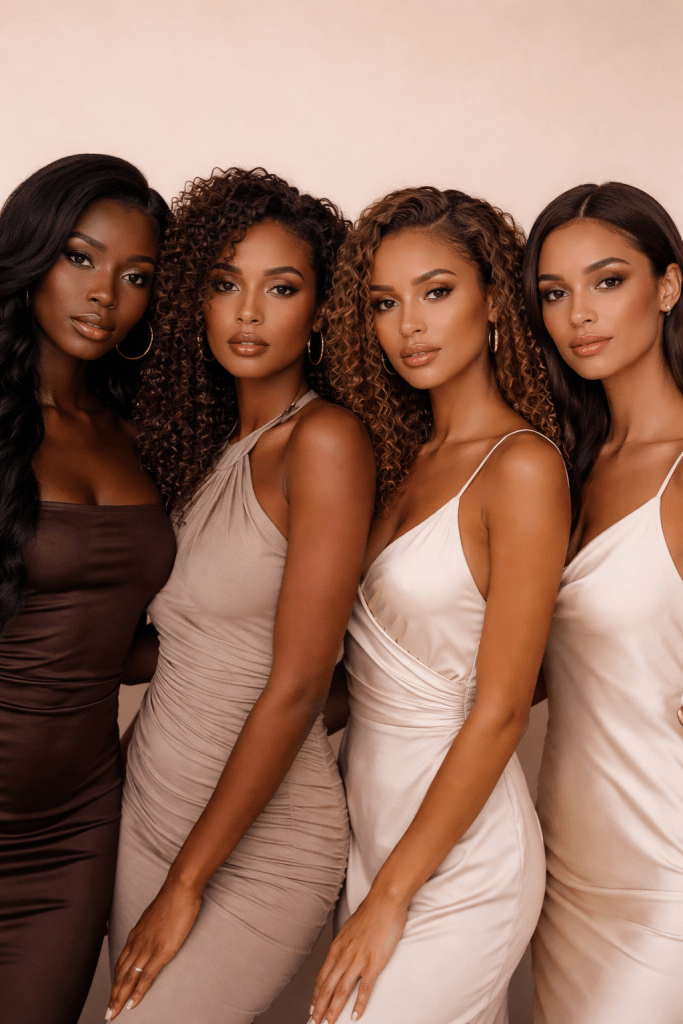
Hashtags and Shades: Online Movements Celebrating Melanin.

Photo by Sam Qeja on Pexels.com

In the digital age, social media has become a powerful tool for celebrating identity, challenging beauty standards, and amplifying voices historically marginalized. Among these movements, online campaigns highlighting melanin-rich skin have gained global traction. Through hashtags, challenges, and storytelling, communities are reclaiming beauty, fostering self-love, and redefining cultural narratives.

The Power of Hashtags

Hashtags like #MelaninPoppin, #DarkSkinIsBeautiful, #BrownSkinGirl, and #BlackGirlMagic serve as more than trends—they are declarations. These digital markers create spaces for visibility, connection, and affirmation, allowing people to celebrate skin tones that mainstream media has historically undervalued. Psychologically, the collective validation provided by such hashtags can enhance self-esteem, reduce internalized colorism, and promote a sense of belonging (Hunter, 2007).

Social Media as a Platform for Representation

Platforms like Instagram, TikTok, and Twitter provide direct access to communities and influencers embracing melanin-rich skin. Influencers such as Nyma Tang, Jackie Aina, and Rashida Strober use these spaces to educate audiences, challenge colorism, and celebrate diverse shades. Their content emphasizes authenticity, beauty diversity, and empowerment, creating a ripple effect that normalizes and honors all skin tones.

Hashtags and Shades: Celebrating Melanin Online

1. #MelaninPoppin

  • Focus: Celebrates dark and deep brown skin tones.
  • Impact: Empowers individuals to embrace natural beauty; fosters global visibility.
  • Influencers: Nyma Tang, Jackie Aina
  • Visual Idea: Showcase selfies of diverse skin tones with glowing melanin highlights.

2. #BrownSkinGirl

  • Focus: Celebrates medium brown and caramel skin shades.
  • Impact: Promotes self-love and pride among women of the African diaspora.
  • Influencers: Rashida Strober, Michaela Coel
  • Visual Idea: Include quotes from influencers about confidence and heritage.

3. #DarkSkinIsBeautiful

  • Focus: Reclaims deep skin tones from societal bias.
  • Impact: Challenges colorism; affirms beauty in shades historically marginalized.
  • Influencers: Lupita Nyong’o, Viola Davis
  • Visual Idea: Side-by-side before-and-after empowerment campaigns emphasizing melanin.

4. #BlackGirlMagic

  • Focus: Celebrates achievements, beauty, and brilliance of Black women.
  • Impact: Combines recognition of talent with melanin appreciation; builds community.
  • Influencers: Issa Rae, Yara Shahidi
  • Visual Idea: Include snapshots of career achievements paired with skin tone celebration.

5. #ShowYourShade

  • Focus: Encourages participants to share selfies, affirming all shades of brown and black skin.
  • Impact: Fosters inclusion, representation, and personal pride.
  • Influencers: Social media users worldwide
  • Visual Idea: Collage of community selfies reflecting a spectrum of melanin-rich tones.

Movements and Challenges

Online campaigns often go beyond hashtags. Challenges like “#ShowYourShade” encourage participants to share selfies or stories celebrating their melanin. Viral initiatives like Fenty Beauty’s foundation inclusivity campaign highlight the demand for representation in cosmetics and media. These movements validate melanin as powerful, beautiful, and worthy of recognition, shifting cultural perceptions globally.

Psychological and Cultural Impact

Celebrating melanin online has measurable effects on self-perception and community identity. By sharing and engaging with positive imagery and stories, individuals counteract societal bias and internalized colorism. Furthermore, these movements educate broader audiences about the beauty, history, and resilience associated with melanin-rich skin. Collectively, they foster pride, confidence, and cultural affirmation.

The Future of Digital Empowerment

The rise of online melanin movements underscores the importance of digital activism in shaping beauty narratives. As communities continue to use hashtags, viral campaigns, and influencer-led initiatives, the visibility of diverse skin tones grows, creating cultural shifts that extend beyond social media. Digital spaces are transforming from platforms of passive consumption into arenas for empowerment, education, and celebration.

Conclusion

Hashtags and shades are more than online trends—they are catalysts for empowerment. Through digital storytelling, visibility, and collective affirmation, melanin-rich communities are reclaiming beauty, reshaping cultural narratives, and fostering pride. Celebrating melanin online not only empowers individuals but also challenges societal bias, proving that identity, heritage, and color are powerful forces of beauty.


References

  • Hunter, M. (2007). The Persistent Problem of Colorism: Skin Tone, Status, and Inequality. Sociology Compass, 1(1), 237–254.
  • The Holy Bible, King James Version. (1611). Song of Solomon 1:5.