

Category Archives: remote work

How to write the Perfect Resume

A résumé is a professional narrative that translates an individual’s skills, experience, and potential into a concise document designed for evaluation. In contemporary hiring practices, résumés function not merely as summaries of employment history but as strategic marketing tools that align a candidate’s profile with organizational needs.

The first principle of writing an effective résumé is clarity of purpose. A résumé should be tailored to the specific job or industry, reflecting the competencies, language, and qualifications most relevant to the role. Generic résumés are often filtered out early in the screening process, particularly by applicant tracking systems.

Structure is essential to résumé effectiveness. Employers typically expect a clear hierarchy that includes contact information, a professional summary, work experience, education, and relevant skills. Logical organization enables recruiters to quickly identify qualifications without cognitive overload.

The professional summary, often placed at the top, serves as a brief introduction to the candidate. This section should articulate career identity, years of experience, and core strengths in two to four concise sentences. Objective statements focused on what the applicant wants are increasingly replaced by summaries focused on what the applicant offers.

Work experience is the most heavily weighted section of most résumés. Entries should emphasize achievements rather than responsibilities, using action-oriented language and quantifiable outcomes. Employers respond more favorably to evidence of impact than to task descriptions alone.

Education should be presented clearly and honestly, listing degrees earned, institutions attended, and relevant certifications. For early-career applicants, education may appear before work experience, while seasoned professionals typically place it afterward. Including honors or relevant coursework can be beneficial when directly related to the role.

Skills sections should balance technical and transferable competencies. Hard skills such as software proficiency, data analysis, or industry-specific tools should be listed alongside soft skills like leadership, communication, and problem-solving, though the latter should also be demonstrated within experience descriptions.

Certain elements should be avoided in a professional résumé. Personal information such as age, marital status, photographs, or religious affiliation is generally discouraged in U.S. hiring contexts due to anti-discrimination standards. Including such information may unintentionally bias evaluators or violate employer policies.

Length is a critical consideration in résumé design. For most candidates, one page is ideal, particularly for those with fewer than ten years of experience. Two-page résumés are acceptable for senior professionals or academics with extensive credentials, but unnecessary detail should always be eliminated.

Formatting choices significantly affect readability. Clean fonts, consistent spacing, and restrained use of bold or italics enhance professional appearance. Overly decorative designs may distract from content and confuse automated screening systems.

The inclusion of a cover letter remains an important strategic decision. While not always required, a well-written cover letter allows applicants to contextualize their experience, express motivation, and demonstrate alignment with organizational values. When optional, submitting one can signal professionalism and initiative.

A strong cover letter complements the résumé rather than repeating it. It should expand on key qualifications, explain career transitions if necessary, and articulate why the candidate is a strong fit for the specific role and company. Personalization is particularly influential in competitive hiring environments.

Providing an example résumé can clarify best practices. A simplified professional résumé might include a header with name and contact details, a brief summary highlighting expertise, bullet-pointed work achievements with measurable results, a concise education section, and a targeted skills list aligned with the job description.

Concluding the résumé effectively involves leaving the reader with a clear sense of readiness and value. Final sections, such as certifications, professional affiliations, or volunteer experience, can reinforce competence and character when relevant to the role.

Beyond document preparation, understanding hiring psychology improves outcomes. Recruiters often spend only seconds on an initial résumé review, making keyword alignment and visual clarity essential for passing early screening stages.

Following up after submission can demonstrate professionalism when done appropriately. A brief email checking on application status after one to two weeks is generally acceptable and may help keep a candidate visible without appearing intrusive.

Networking remains one of the most effective complements to résumé submission. Internal referrals significantly increase interview likelihood, as résumés accompanied by personal recommendations often bypass initial automated filters.

Applicants should also consider tailoring résumés for different roles within the same industry. Slight adjustments to language, skill emphasis, and experience framing can significantly enhance alignment with diverse job descriptions.

Ethical accuracy is fundamental in résumé writing. Exaggeration or misrepresentation may result in termination if discovered later. Authenticity paired with strategic presentation builds long-term credibility and trust.

In an evolving labor market shaped by technology and globalization, résumés continue to adapt. Digital portfolios, LinkedIn integration, and skill-based hiring models increasingly influence how résumés are evaluated.

Ultimately, the perfect résumé is not universal but contextual. It reflects self-awareness, market understanding, and intentional communication, positioning the applicant not merely as qualified but as valuable.

EXAMPLE OF RESUME

Jane Doe
Email: jane.doe@email.com | Phone: (555) 123-4567 | LinkedIn: linkedin.com/in/janedoe | Location: New York, NY


Professional Summary
Detail-oriented marketing professional with 5+ years of experience in digital campaigns, content strategy, and brand management. Skilled at increasing audience engagement and driving measurable results. Seeking a position in a dynamic marketing team to leverage creativity and data-driven strategies.


Professional Experience

Marketing Specialist – Bright Media Agency, New York, NY
June 2020 – Present

  • Developed and executed social media campaigns that increased follower engagement by 35% in 6 months.
  • Managed email marketing initiatives that resulted in a 20% increase in open rates.
  • Collaborated with cross-functional teams to launch 10+ product campaigns on time and within budget.

Marketing Coordinator – Creative Solutions, Brooklyn, NY
January 2018 – May 2020

  • Produced content calendars and coordinated multi-channel marketing campaigns.
  • Conducted market research to inform strategy, contributing to a 15% increase in lead generation.
  • Monitored KPIs and presented monthly performance reports to senior management.

Education

Bachelor of Arts in Marketing – New York University, NY
Graduated: 2017

  • Relevant coursework: Digital Marketing, Consumer Behavior, Brand Strategy

Skills

  • Digital Marketing Tools: Google Analytics, HubSpot, Hootsuite
  • Content Creation & Copywriting
  • Social Media Strategy
  • Data Analysis & Reporting
  • Project Management

Certifications

  • Google Analytics Certified (2022)
  • HubSpot Content Marketing Certification (2021)

Optional Sections

  • Volunteer Experience: Marketing Volunteer – Nonprofit Organization (2020 – Present)
  • Professional Affiliations: Member of American Marketing Association (AMA)

Tips Demonstrated in This Structure:

  • Contact Info at the top for easy reference.
  • Professional Summary highlights experience, skills, and goals.
  • Work Experience emphasizes achievements with measurable results.
  • Education is concise and relevant.
  • Skills & Certifications showcase technical competencies.
  • Optional sections can add depth without cluttering the résumé.

References

Brown, C., & Hesketh, A. (2004). The mismanagement of talent: Employability and jobs in the knowledge economy. Oxford University Press.

CareerOneStop. (2023). Resume guide. U.S. Department of Labor.

Khurana, R. (2002). Searching for a corporate savior: The irrational quest for charismatic CEOs. Princeton University Press.

Lent, R. W., & Brown, S. D. (2013). Social cognitive model of career self-management. Journal of Counseling Psychology, 60(4), 557–568.

National Association of Colleges and Employers. (2022). Job outlook and hiring practices. NACE.

Roth, P. L., Bobko, P., Van Iddekinge, C. H., & Thatcher, J. B. (2016). Social media in employee-selection-related decisions. Journal of Management, 42(1), 269–298.

U.S. Equal Employment Opportunity Commission. (2021). Prohibited employment policies and practices. EEOC.

Leveraging Skills for Remote Work and Freelancing.

Photo by Anna Nekrashevich on Pexels.com

In today’s global economy, remote work and freelancing have transitioned from fringe opportunities to mainstream career pathways. The digital revolution, accelerated by technological advancements and the COVID-19 pandemic, has created a flexible labor market that values skills, adaptability, and innovation over geographic location. For professionals seeking autonomy, income diversification, and better work–life balance, developing strategies to leverage personal skills in the remote economy is essential.

Identifying Marketable Skills

The first step in remote work success is recognizing skills that can be monetized. Fields such as writing, graphic design, software development, digital marketing, customer service, and consulting dominate freelancing platforms. Transferable skills like communication, problem-solving, and project management also remain highly marketable. Self-assessment tools and career inventories can help individuals identify unique talents that align with remote opportunities.

Building a Digital Presence

A strong online presence is vital in freelancing. Portfolios, professional websites, and active LinkedIn profiles communicate credibility to potential clients. Platforms such as Upwork, Fiverr, and Freelancer.com allow individuals to showcase their expertise and build reputations through reviews. For creatives, visual portfolios on platforms like Behance or Dribbble are powerful assets. The digital marketplace thrives on visibility and branding, making self-presentation a cornerstone of success.

🌍 Top 10 Remote Work Sites for Black Women: Building Freedom, Flexibility, and Equity

In today’s digital economy, remote work and freelancing are reshaping career possibilities, particularly for Black women who often face barriers in traditional workplaces such as discrimination, microaggressions, and unequal pay (Hewlett, 2014; Wingfield, 2019). By leveraging global platforms, Black women can bypass geographic, racial, and gender barriers, while creating sustainable income streams. Below are the top 10 sites for remote work and freelancing, with insights into why they matter for women of color.


1. FlexJobs

A curated platform with thoroughly vetted remote jobs across industries. Known for its commitment to eliminating scams and underpaying gigs, it offers a safer entry point for professionals.
Why it matters: Helps Black women avoid exploitative roles and focus on meaningful, flexible work.


2. Upwork

One of the largest freelancing marketplaces for writing, design, marketing, and technology. Its rating system rewards consistency and quality.
Why it matters: Allows Black women to build strong professional brands and client networks beyond geographical bias.


3. Fiverr

Gig-based platform where freelancers set up “services” starting at $5, with the ability to scale into high-value packages.
Why it matters: Excellent for creatives—writers, coaches, designers—who want autonomy and visibility without gatekeepers.


4. We Work Remotely

One of the biggest boards for fully remote positions in tech, marketing, and customer service.
Why it matters: Known for higher-paying roles and companies that support diverse, global hiring.


5. LinkedIn

Not only a networking hub but also a growing marketplace for remote and freelance opportunities.
Why it matters: Black women can build thought leadership, join communities like Blacks in Tech, and gain direct recruiter access.


6. Toptal

An exclusive network for the top 3% of freelancers in software, finance, and design.
Why it matters: Though competitive, it pushes back against the underestimation of Black women’s technical skills in global markets.


7. Remotive

Community-driven remote job board with tech and digital opportunities.
Why it matters: Offers support through peer groups, which can be healing for Black women often isolated in corporate spaces.


8. AngelList Talent (Wellfound)

A hub for remote startup jobs, many of which welcome unconventional backgrounds.
Why it matters: Startups often seek innovation over pedigree, opening doors for Black women with creativity and resilience.


9. ProBlogger Job Board

Specifically for writers, bloggers, and content strategists.
Why it matters: Black women storytellers and content creators can monetize their voices while pushing cultural narratives forward.


10. PeoplePerHour

Freelancing site that connects clients to professionals in writing, design, and web development.
Why it matters: Offers flexibility and diverse opportunities, allowing Black women to curate projects that align with their skills.


✨ Why Remote Work is Essential for Black Women

  • Freedom from Bias: Remote work reduces exposure to office-based discrimination and microaggressions (Roberts & Mayo, 2019).
  • Global Pay Opportunities: Expands access to international clients who value talent, not stereotypes.
  • Work-Life Balance: Flexible schedules help balance family responsibilities while building financial independence.
  • Community & Representation: Online spaces create solidarity networks that affirm cultural identity and professional excellence.

🔑 Final Thoughts

For Black women, remote work is more than convenience—it is empowerment, agency, and liberation from systemic barriers. Platforms like FlexJobs, Upwork, and LinkedIn offer professional stability, while spaces like Fiverr and ProBlogger allow creativity to flourish. As Proverbs 31 reminds us, the virtuous woman is industrious, wise, and resourceful—traits reflected in Black women navigating and excelling in the digital economy.


General Remote Job Boards

  1. FlexJobs – Curated, scam-free listings for remote, hybrid, and freelance jobs across industries.
  2. Remote.co – Wide range of fully remote positions, from entry-level to executive.
  3. We Work Remotely – One of the largest remote-only job boards (tech, marketing, customer support, design).
  4. JustRemote – Remote jobs in sales, development, design, and project management.
  5. Working Nomads – Sends curated lists of remote jobs (mostly tech and digital).

💻 Freelancing Platforms

  1. Upwork – The largest freelancing marketplace for writing, design, marketing, programming, and more.
  2. Fiverr – Gig-based platform for services starting at $5 (great for creatives and consultants).
  3. Freelancer.com – Global freelancing platform with projects in many industries.
  4. PeoplePerHour – Good for freelance professionals in design, writing, web, and marketing.
  5. Toptal – Exclusive network for top 3% of freelancers (software, design, finance).

🎨 Creative and Design-Focused

  1. Behance – Showcases portfolios and connects creatives with freelance gigs.
  2. Dribbble Jobs – Focused on designers, illustrators, and creatives.
  3. 99designs – Freelancing platform specifically for graphic design competitions and projects.

👩🏽‍💼 Professional and Niche Remote Work

  1. LinkedIn – Use filters to find remote/freelance jobs and network directly with recruiters.
  2. AngelList Talent (Wellfound) – Best for remote startup jobs.
  3. Outsourcely – Connects startups with remote workers for long-term positions.
  4. Remotive – Remote job board plus a strong online community.
  5. SkipTheDrive – Easy-to-navigate site for remote roles in IT, project management, and customer service.

📝 Writing & Content-Specific

  1. ProBlogger Job Board – Great for freelance blogging jobs.
  2. Contently – Matches writers with companies seeking content creators.
  3. ClearVoice – Freelance writing platform where you set your own rates.

Pro tip: For higher-paying, long-term remote jobs, platforms like FlexJobs, Toptal, and LinkedIn work best. For building a freelance portfolio, Upwork, Fiverr, and Freelancer are strong starting points.

Continuous Learning and Upskilling

Remote work markets are competitive, requiring constant upskilling. Online education platforms like Coursera, Udemy, and LinkedIn Learning provide affordable training in technical, creative, and business-related skills. Freelancers who embrace lifelong learning gain an edge by adapting to changing industry demands, such as artificial intelligence integration, search engine optimization (SEO), and social media strategies.

Time Management and Productivity Tools

Working remotely demands discipline. Without the structure of a traditional office, freelancers must develop systems to stay productive. Tools like Trello, Asana, and Notion assist in task management, while apps like RescueTime and Toggl track productivity. Creating dedicated workspaces and setting boundaries between personal and professional life are key strategies for maintaining balance and efficiency.

Networking and Relationship Building

Even in digital workspaces, relationships remain critical. Freelancers benefit from joining professional communities on Slack, Discord, or niche forums, where collaboration and knowledge sharing occur. Networking not only leads to new clients but also fosters mentorship and accountability. Cultivating long-term client relationships through clear communication, reliability, and delivering quality work ensures sustainability in freelancing.

Financial Literacy and Business Mindset

Freelancers are essentially entrepreneurs. Managing invoices, contracts, taxes, and savings requires financial literacy. Using accounting software such as QuickBooks or FreshBooks helps streamline finances. Developing a business mindset—treating freelancing as a professional enterprise rather than side work—builds credibility and long-term success. This includes setting fair rates, negotiating confidently, and protecting intellectual property.

Cultural and Global Awareness

Since remote work transcends borders, freelancers must navigate cultural differences in communication styles, time zones, and expectations. Developing cross-cultural competence enhances collaboration and builds trust in global markets. Sensitivity to diversity, inclusivity, and respect for different professional practices strengthens client relationships across continents.

Conclusion: Thriving in the Remote Economy

Remote work and freelancing offer opportunities for independence, creativity, and financial stability. Success depends not only on technical skills but also on adaptability, branding, networking, and self-discipline. By identifying marketable talents, building a professional presence, investing in lifelong learning, and cultivating strong client relationships, individuals can thrive in the evolving digital economy. The key lies in viewing remote work not as a temporary solution but as a sustainable career pathway aligned with modern global trends.


References

  • Friedman, G. (2014). Workers without employers: Shadow corporations and the rise of the gig economy. Review of Keynesian Economics, 2(2), 171–188.
  • Kuhn, K. M., & Maleki, A. (2017). Micro-entrepreneurs, dependent contractors, and instaserfs: Understanding online labor platform workforces. Academy of Management Perspectives, 31(3), 183–200.
  • Mould, O., Vorley, T., & Liu, K. (2014). Invisible creativity? Highlighting the hidden impact of freelancing in London’s creative industries. European Planning Studies, 22(12), 2436–2455.
  • Vallas, S., & Schor, J. B. (2020). What do platforms do? Understanding the gig economy. Annual Review of Sociology, 46, 273–294.
  • Wood, A. J., Graham, M., Lehdonvirta, V., & Hjorth, I. (2019). Good gig, bad gig: Autonomy and algorithmic control in the global gig economy. Work, Employment and Society, 33(1), 56–75.
  • Hewlett, S. A. (2014). Executive presence: The missing link between merit and success. Harper Business.
  • Roberts, L. M., & Mayo, A. J. (2019). Race, work, and leadership: New perspectives on the Black experience. Harvard Business Press.
  • Wingfield, A. H. (2019). Flatlining: Race, work, and health care in the new economy. University of California Press.
  • Pew Research Center. (2021). Racial and gender disparities in the workplace. Pew Social Trends.
  • World Economic Forum. (2020). The future of jobs report.

Affiliate Marketing 101: Strategies, Tips, and Tools to Earn Online.

Affiliate marketing is a performance-based marketing strategy where you promote someone else’s products or services and earn a commission for each sale or action generated through your unique referral link. Essentially, you act as a middleman connecting the product with the customer.

It benefits three parties:

  1. The Merchant: Gains more sales or leads without upfront marketing costs.
  2. The Affiliate (You): Earns a commission for driving traffic or sales.
  3. The Customer: Finds products through trusted recommendations.

In today’s digital world, affiliate marketing has emerged as one of the most popular ways to earn income online. At its core, affiliate marketing is a performance-based strategy where individuals, known as affiliates, promote products or services and earn a commission for every sale, click, or action generated through their unique referral links. It creates a win-win scenario: merchants increase their sales without upfront costs, affiliates earn money by promoting products, and customers gain access to trusted recommendations. For those looking to build a sustainable online income, understanding the fundamentals of affiliate marketing is essential.

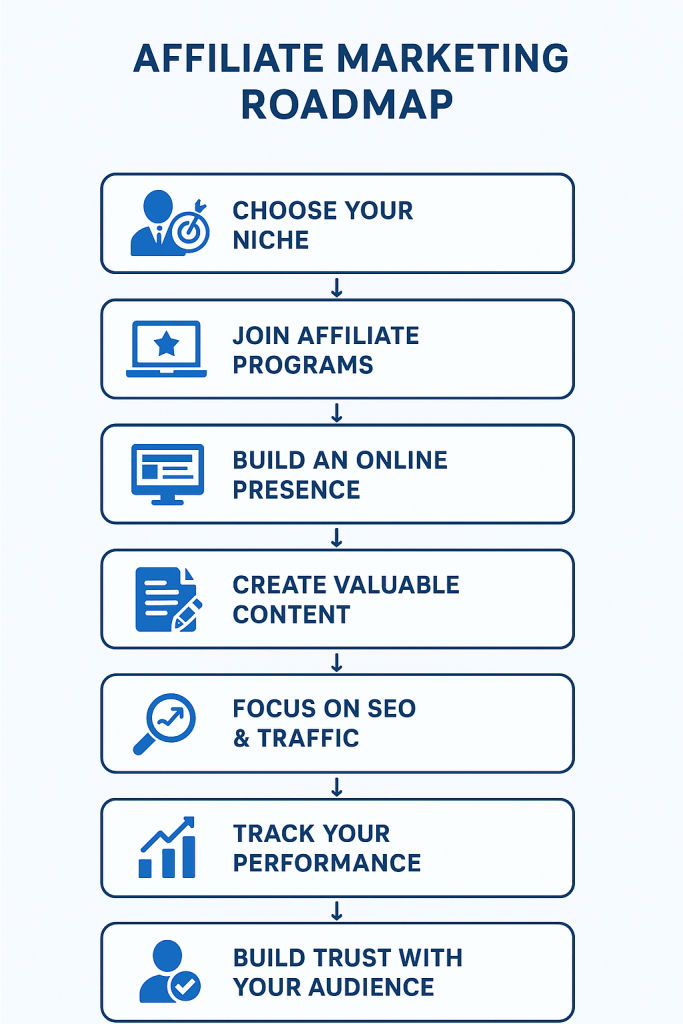
The first step to getting started in affiliate marketing is choosing a niche. A niche is a specific area of interest or industry, such as beauty, fitness, technology, travel, or personal finance. By focusing on a niche, affiliates can build authority and trust with their audience, ensuring that promotions resonate effectively. Once a niche is selected, the next step is to join reputable affiliate programs. Popular networks include Amazon Associates, ShareASale, CJ Affiliate, ClickBank, and Rakuten Marketing. Each platform offers unique benefits, from a wide variety of products to higher commission rates on digital goods, making it possible for affiliates to choose programs that align with their niche and audience.

Choose Your Niche:
Focus on a specific industry or topic you are passionate about, such as beauty, fitness, finance, tech, or travel. A clear niche builds trust and authority with your audience.

Select Affiliate Programs/Companies:
Start with reputable companies and networks. Popular options include:

  • Amazon Associates – Easy to join; wide range of products.
  • ShareASale – Thousands of merchants in various niches.
  • CJ Affiliate (Commission Junction) – High-quality brands and reliable tracking.
  • ClickBank – Digital products, often higher commissions.
  • Rakuten Marketing – Big brands and global reach.

Build an Online Presence:
You’ll need a platform to promote products:

  • Blog or Website: SEO content drives organic traffic.
  • Social Media: Instagram, TikTok, or Pinterest for visual promotions.
  • YouTube: Tutorials and reviews can be highly effective.
  • Email Marketing: Build a subscriber list for recurring promotions.

Affiliate Marketing Tips & Tricks: Quick-Start Guide

1. Choose Your Niche Wisely

  • Pick a topic you are passionate about.
  • Focus on a specific audience to build authority.

2. Join Reputable Affiliate Programs

  • Amazon Associates – Wide variety of products.
  • ClickBank – High commissions on digital products.
  • ShareASale / CJ Affiliate / Rakuten – Access to quality brands.

3. Build an Online Presence

  • Start a blog, YouTube channel, or social media profile.
  • Use email lists to reach your audience directly.

4. Create Valuable Content

  • Tutorials, reviews, comparison guides, and “how-to” articles.
  • Incorporate affiliate links naturally—don’t force them.

5. Focus on SEO & Traffic

  • Optimize your website for search engines to attract organic visitors.
  • Use paid ads strategically for faster results.

6. Track Your Performance

  • Use analytics to monitor clicks, conversions, and top-performing products.
  • Adjust strategies based on what works best.

7. Build Trust with Your Audience

  • Be honest about affiliate links.
  • Share genuine experiences and product recommendations.

8. Diversify & Scale

  • Join multiple affiliate programs to avoid relying on one source.
  • Reinvent and expand your content to reach more audiences.

9. Be Patient & Consistent

  • Earnings grow over time with effort, testing, and optimization.
  • Focus on quality and value rather than quick profits.

10. Learn from Successful Affiliates

  • Follow top affiliates in your niche.
  • Study strategies that consistently convert traffic into sales.

Building a strong online presence is crucial for affiliate marketing success. Affiliates can leverage blogs, websites, social media platforms, YouTube channels, and email marketing to reach potential customers. Content marketing, such as product reviews, tutorials, comparison guides, and “how-to” articles, allows affiliates to provide value while naturally integrating affiliate links. Search engine optimization (SEO) further amplifies reach by attracting organic traffic, while paid advertisements on Google, Facebook, or Instagram can target highly specific audiences to increase conversions. Trust is key; affiliates who provide genuine recommendations and showcase real experiences often see higher engagement and sales.

Content Marketing: Create valuable content like product reviews, “how-to” guides, and comparison articles.

SEO Optimization: Rank your content in search engines to attract free organic traffic.

Paid Ads: Facebook Ads, Google Ads, or influencer partnerships to drive targeted traffic.

Email Campaigns: Promote products to a dedicated audience with newsletters and promotions.

Social Proof & Trust: Use testimonials, case studies, and real experiences to boost credibility.

Successful affiliate marketers employ a combination of strategies to maximize earnings. Tracking performance through analytics enables affiliates to determine which products and promotional methods yield the best results. Diversifying income streams by joining multiple programs and promoting various products reduces risk and increases potential revenue. Email marketing campaigns to a loyal subscriber list can generate recurring income, and integrating social proof—such as testimonials, case studies, or user-generated content—helps establish credibility. Affiliates who prioritize quality over quantity and remain transparent about affiliate links build long-term relationships with their audience.

Pick products you personally trust and align with your audience.

Focus on quality over quantity; promote fewer, high-value products.

Track your performance with analytics to see what converts.

Diversify income streams with multiple affiliate programs.

Always disclose affiliate links; honesty builds trust with your audience.

The earning potential in affiliate marketing varies widely based on niche, traffic, and conversion rates. Beginners might earn between $50 and $500 per month, intermediate affiliates can generate $500–$5,000 monthly, and experienced marketers with multiple platforms and email lists can earn upwards of $50,000 per month. Physical products typically offer lower commissions (1%–10%), while digital products can provide higher rates (30%–75%). The key to success lies in patience, consistency, and reinvesting earnings to scale one’s efforts gradually.

  • Commissions vary by product and program:
    • Physical products: ~1%–10% per sale (Amazon).
    • Digital products: ~30%–75% per sale (ClickBank).
  • Income depends on traffic, conversion rates, and niche:
    • Beginners: $50–$500/month
    • Intermediate: $500–$5,000/month
    • Advanced: $5,000–$50,000+/month (top affiliates often scale with multiple websites and email lists)

Tip: Start small, reinvest earnings, and scale gradually for sustainable income.

In conclusion, affiliate marketing offers a flexible and potentially lucrative way to earn online, provided one approaches it with strategy, integrity, and dedication. By selecting the right niche, collaborating with reputable programs, establishing a robust online presence, and implementing targeted marketing strategies, aspiring affiliates can establish a sustainable source of income. With continuous learning, testing, and adaptation, affiliate marketing not only provides financial opportunities but also allows individuals to share valuable products and services with audiences around the world.

👉 These REFERENCES provide both academic depth and real-world industry insights.

Books & Academic Sources

  • Chaffey, D., & Ellis-Chadwick, F. (2019). Digital Marketing (7th ed.). Pearson.
  • Evans, D. S., & Schmalensee, R. (2016). Matchmakers: The New Economics of Multisided Platforms. Harvard Business Review Press.
  • Strauss, J., & Frost, R. (2016). E-Marketing (7th ed.). Routledge.

Industry & Professional Sources

Statistics & Earnings Potential

  • Statista. (2023). Affiliate Marketing – Statistics & Facts. Retrieved from https://www.statista.com
  • Business Insider Intelligence. (2021). The Affiliate Marketing Report.

👉 These references provide both academic depth and real-world industry insights.