Category Archives: Dark Skinned Women

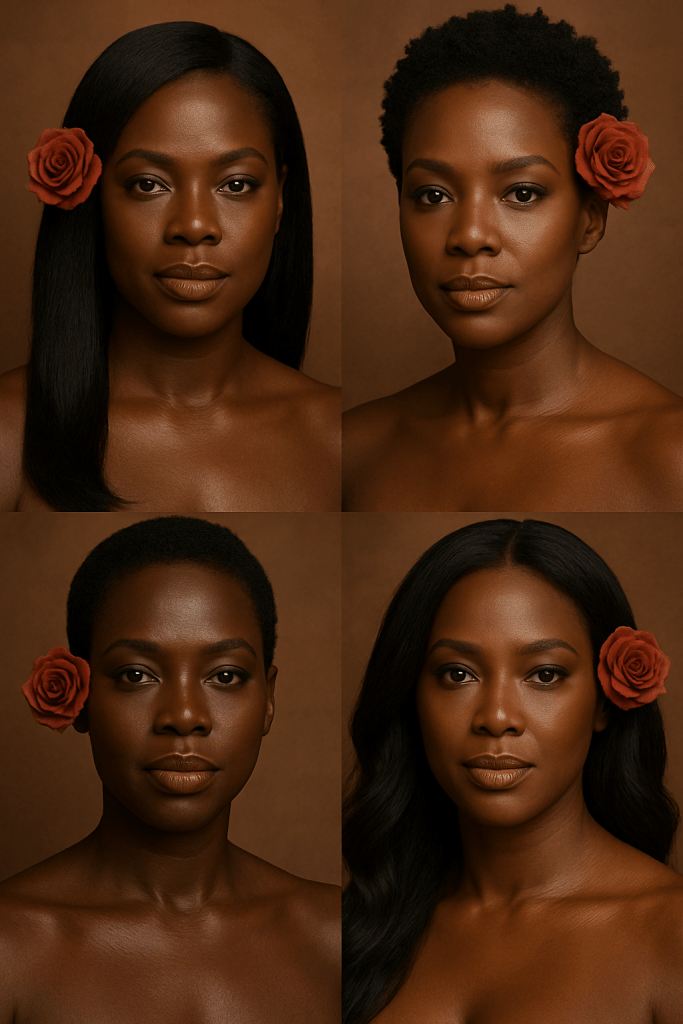
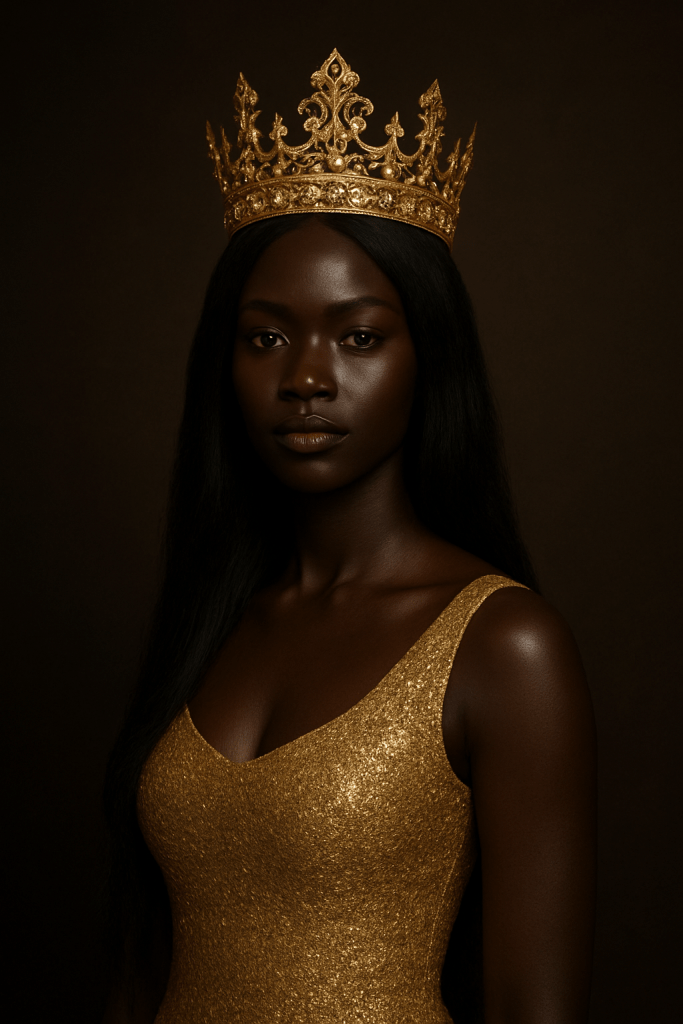
The Dark-Skinned Queens: Restoring the Crown to Melanin’s Deep Majesty.

The Dark-Skinned Queen stands as a living monument to ancestral glory—her skin a sacred archive of history, divinity, and resilience. Yet the world has not always treated her as such. For centuries, she has been positioned at the bottom of a racialized beauty hierarchy, burdened by the shadows of colonialism, anti-Blackness, and internal color prejudice. But the truth remains unshaken: her beauty is ancient, sovereign, and cosmic. She is not emerging—she has always been, and the world is finally remembering what was never lost.

Historically, deep melanin was revered across civilizations. In ancient Kemet, Nubia, and Kush, dark-skinned queens were worshipped as embodiments of divinity, fertility, royalty, and cosmic order. Stone carvings and temple art bear witness—deep brown skin was not merely beautiful; it was sacred. Civilization began in melanin-rich lands, and thus, the Dark-Skinned Goddess represents origin and power, not deviation or rarity.

Colonialism sought to rewrite this truth, weaponizing beauty to fracture identity. European expansion brought a violent inversion of values, casting darker skin as undesirable, uncivilized, or inferior. These lies were institutionalized through enslavement, missionary propaganda, and global media. The goal was psychological domination: if the world could be convinced that the darkest skin was the least valuable, then the original people could be controlled. Beauty became a battlefield.

Through history, dark-skinned women bore double violence—racism and colorism. Their labor was exploited, their beauty ignored or mocked, and their femininity questioned. Those wounds still echo today when darker-skinned girls struggle with visibility, self-esteem, and belonging. Yet even in oppression, the Dark-Skinned Goddess remained unbroken. Her existence is resistance. Her radiance survived the lie.

In modern media, her representation remains limited, though rising. When women like Lupita Nyong’o, Viola Davis, Khoudia Diop, and Nia Long appear, they disrupt centuries of curated beauty narratives. Their presence is not simply aesthetic—it is political. Their faces tell new stories and correct historical distortions. Their visibility is cultural restoration, not a trend.

Socially, the Dark-Skinned Goddess is often underestimated before she is known. People assume toughness, attitude, or aggression before recognizing grace, intelligence, softness, or elegance. Stereotypes cling to her not because she lacks depth, but because the world fears her power. Mischaracterization is the weapon of the intimidated.

Romantically, she has faced long-standing biases shaped by colonial beauty scripts. Some men once sought lighter-skinned partners to access false proximity to privilege. Others fetishized her body while disregarding her heart. Yet her value never depended on preference—it exists independent of perception. She is not validated by desire; she is complete by design.

Spiritually, melanin symbolizes divine creation. Scripture reminds: “I am black, but comely” (Song of Solomon 1:5, KJV). This verse is not an apology—it is a declaration. Darkness in biblical text is associated with mystery, depth, and holiness. God formed humanity from rich, fertile earth, not pale, dry dust. Melanin is not an accident—it is intentional artistry.

Psychologically, reclamation requires healing. Dark-skinned women have internal battles shaped by external rejection. They learn to love themselves in societies slow to love them back. But healing blooms when she sees the truth of her reflection—not through distortion, but revelation. Confidence, when rooted in reality rather than validation, becomes unshakable.

Within the community, colorism has damaged sisterhood. Dark-skinned girls were often teased, underestimated, or overlooked. Some developed armor; others developed silence. Yet the new era demands empathy, not competition. When beauty becomes communal instead of comparative, we rise together. No shade of Blackness needs apology—only acknowledgement.

Culturally, she carries the memory of her ancestors in her skin. Each melanin cell is a testament to sun-kissed lands and royal lineage. She does not darken in inferiority—she glows in origin. Melanin is cosmic technology—absorbing light, storing warmth, preserving youth. It is biological excellence, not burden.

Economically, she often had to work twice as hard to be seen as equal to lighter peers. Her competence was tested more; her mistakes judged harsher. Yet she consistently excelled, not because she had privilege, but because she possessed perseverance. Strength became her inheritance, not her choice. And yet, she still seeks the right to softness.

Emotionally, she navigates constant contrast—admired aesthetically in one breath, overlooked socially in another. She is celebrated on runways but ignored in workplaces. Praised in songs yet harmed in systems. This paradox teaches her discernment, depth, and inner worth. She learns that true beauty transcends environment and expectation.

The world imitates her body yet denies her humanity. Full lips, curvaceous hips, rich skin, coily hair—once mocked, now monetized. Her features trend on those without her struggle. But imitation will never equal essence. She is the blueprint, not the beneficiary of borrowed beauty.

Yet a renaissance rises. She is reclaiming beauty narratives, rewriting cultural scripts, and building new worlds where she doesn’t have to prove anything. She stands not in reaction to bias, but in revelation of identity. Her presence demands reverence, not permission.

Her beauty is not merely visual—it is metaphysical. It radiates history, intellect, intuition, empathy, and fire. Beauty is not her burden—it is her birthright. Society once tried to dim her glow; now the world adjusts its eyes to her brilliance. She is not emerging—she is unveiling.

The Dark-Skinned Queen does not seek comparison. She is not the opposite of light—she is the embodiment of depth. She is the eternal night sky, ancient soil, divine mystery, royal lineage. Her beauty is not subtractive; it is sovereign.

For she is fearfully and wonderfully made (Psalm 139:14, KJV). Not despite her shade, but because of it. Melanin is crown. Darkness is splendor. She is not defined by struggle—she is defined by glory.

And now, she does not rise alone. She rises with every shade beside her. Her divinity does not eclipse others; it illuminates the truth: Black beauty is infinite. But among its many expressions, the Dark-Skinned Goddess remains the beginning, the memory, and the majesty.

May she walk not with apology, but authority. Not seeking validation, but embodying revelation. For she is not reclaiming beauty—she is beauty, rediscovered.


References

Hunter, M. (2007). The persistent problem of colorism: Skin tone, status, and inequality. Sociology Compass, 1(1), 237–254.

Russell, K., Wilson, M., & Hall, R. (2013). The color complex: The politics of skin color in a new millennium. Anchor Books.

Wade, P. (2020). Race, nature and culture: An anthropological perspective. Pluto Press.

Song of Solomon 1:5 (KJV); Psalm 139:14 (KJV).
Skin-Tone Capital: How Shade Determines Social Currency

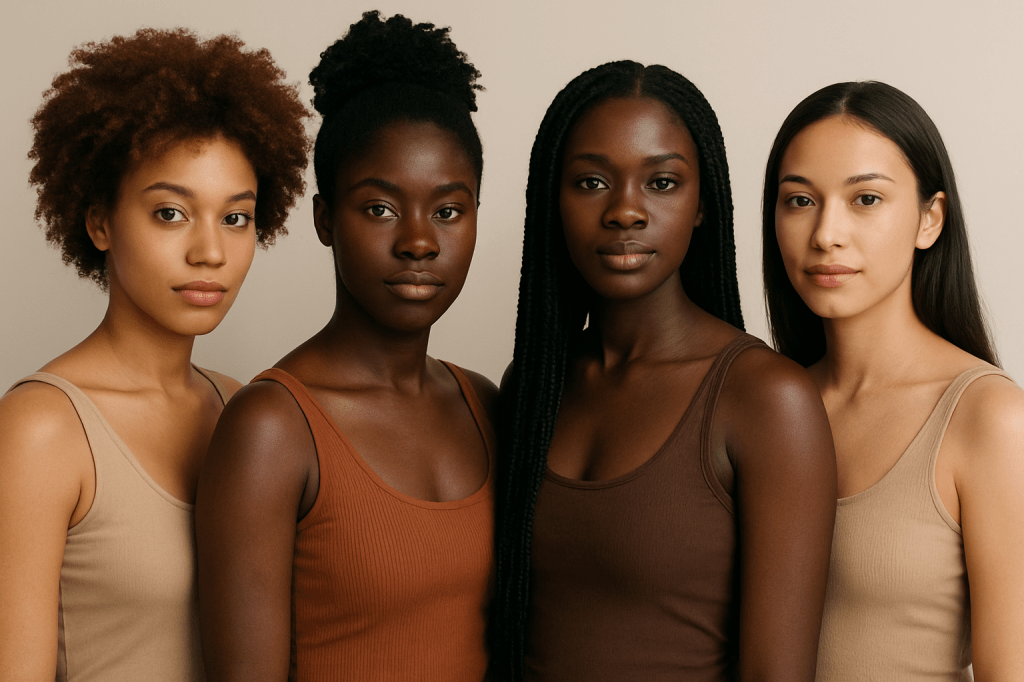
In many societies, skin tone functions as a form of social currency, where lighter complexions are often rewarded with preferential treatment, and darker shades face systemic bias. This phenomenon, widely recognized as colorism, shapes opportunities, self-perception, and interpersonal dynamics. Psalm 139:14 reminds us, “I will praise thee; for I am fearfully and wonderfully made: marvellous are thy works; and that my soul knoweth right well.” Worth is determined by God, not by melanin levels.

Historical legacies perpetuate shade-based hierarchies. Across continents and centuries, lighter skin has been associated with proximity to power, education, and social mobility. Yet, Galatians 3:28 teaches, “There is neither Jew nor Greek, there is neither bond nor free, there is neither male nor female: for ye are all one in Christ Jesus.” Divine equality transcends superficial measures.

Internalized bias affects self-perception. Many darker-skinned individuals grapple with self-doubt and societal rejection. Proverbs 4:7 emphasizes, “Wisdom is the principal thing; therefore get wisdom: and with all thy getting get understanding.” Understanding one’s intrinsic value combats these internalized hierarchies.

Skin-tone capital influences economic opportunity. Studies show that lighter-skinned individuals often access higher-paying roles or public-facing positions. Romans 12:2 exhorts, “And be not conformed to this world: but be ye transformed by the renewing of your mind…” Renewing perspective helps resist societal conditioning.

Media reinforces the bias. Advertising, film, and social media often highlight Eurocentric beauty standards, associating lighter skin with desirability. Proverbs 31:30 teaches, “Favor is deceitful, and beauty is vain: but a woman that feareth the Lord, she shall be praised.” Spiritual and moral qualities surpass superficial valuation.

Shade impacts relationships and community dynamics. Lighter skin can result in privilege within social groups, while darker individuals experience marginalization. Ecclesiastes 4:9-10 states, “Two are better than one; because they have a good reward for their labour. For if they fall, the one will lift up his fellow…” Intentional community support fosters resilience.

Colorism intersects with gender. Darker-skinned women often face compounded bias, navigating societal expectations and systemic discrimination. Proverbs 31:25 affirms, “Strength and honour are her clothing; and she shall rejoice in time to come.” Inner strength and dignity surpass external judgment.

Education and mentorship disrupt shade hierarchies. Knowledge empowers individuals to challenge stereotypes and assert their value. James 1:5 teaches, “If any of you lack wisdom, let him ask of God, that giveth to all men liberally, and upbraideth not; and it shall be given him.” Divine guidance equips for discernment and advocacy.

Faith offers enduring validation. Hebrews 11:6 states, “But without faith it is impossible to please him: for he that cometh to God must believe that he is, and that he is a rewarder of them that diligently seek him.” Spiritual identity resists societal hierarchy based on shade.

Colorism affects mental health. Shame, anxiety, and internalized inferiority often accompany bias. Psalm 34:18 declares, “The LORD is nigh unto them that are of a broken heart; and saveth such as be of a contrite spirit.” Healing begins through divine awareness of personal worth.

Social mobility often aligns with skin-tone bias. Lighter skin frequently correlates with broader acceptance in elite circles. Romans 5:3-4 reminds, “…tribulation worketh patience; And patience, experience; and experience, hope.” Endurance and faith foster resilience beyond superficial advantage.

Faith-centered communities resist external hierarchies. Colossians 3:2 commands, “Set your affection on things above, not on things on the earth.” Anchoring identity in God neutralizes the social power of skin tone.

Media literacy empowers critique. Proverbs 15:14 teaches, “The heart of him that hath understanding seeketh knowledge: but the mouth of fools feedeth on foolishness.” Awareness allows informed engagement with content that perpetuates color bias.

Economic empowerment counters color-based marginalization. Proverbs 31:16 affirms, “She considereth a field, and buyeth it: with the fruit of her hands she planteth a vineyard.” Self-sufficiency and entrepreneurship reduce dependence on shade-based favor.

Interpersonal advocacy disrupts bias. Matthew 5:16 states, “Let your light so shine before men, that they may see your good works, and glorify your Father which is in heaven.” Demonstrating excellence shifts focus from complexion to competence and character.

Self-love challenges societal valuation. 1 Corinthians 6:19-20 reminds, “…your body is the temple of the Holy Ghost…glorify God in your body, and in your spirit, which are God’s.” Embracing skin as God-given rejects hierarchical thinking.

Community dialogue transforms perception. Proverbs 27:17 teaches, “Iron sharpeneth iron; so a man sharpeneth the countenance of his friend.” Honest conversations about bias cultivate awareness and collective empowerment.

Prayer sustains identity. Philippians 4:6 instructs, “Be careful for nothing; but in every thing by prayer and supplication with thanksgiving let your requests be made known unto God.” Spiritual affirmation anchors worth beyond social evaluation.

Legacy requires intentional action. Proverbs 22:6 declares, “Train up a child in the way he should go: and when he is old, he will not depart from it.” Teaching children to value character and faith over shade ensures generational transformation.

Ultimately, skin tone capital may influence perception, but divine truth determines value. Psalm 92:12-14 affirms, “The righteous shall flourish like the palm tree…they shall still bring forth fruit in old age; they shall be fat and flourishing.” Worth and legacy emerge from God-centered living, not the hue of one’s skin.

Pretty Privilege Series: Faces of the Sun — Celebrating the Deepest Shades of Us.

Beauty has always been both a mirror and a weapon—reflecting societal values while often wounding those who fall outside its narrow definitions. The phenomenon known as pretty privilege reveals how beauty grants unspoken advantages, yet historically, this privilege has excluded darker-skinned individuals, especially within the Black community. In this installment, “Faces of the Sun,” we turn toward the light that has too often been dimmed—celebrating the deepest, richest complexions as the living embodiment of radiance, history, and divine artistry.

The term “Faces of the Sun” symbolizes more than melanin; it signifies resilience, warmth, and illumination born from struggle. The sun does not discriminate—it shines equally, yet some societies have long taught people to seek its opposite. In many cultures, including those shaped by colonial influence, dark skin was unjustly stigmatized while lightness became the aesthetic ideal (Hunter, 2007). This bias—rooted in colorism—still permeates beauty industries, employment opportunities, and social hierarchies today.

For centuries, enslaved Africans and their descendants were taught that proximity to whiteness equated to superiority. Light skin was rewarded; darker complexions were marginalized. This internalized system of value manipulation fractured collective identity (Russell, Wilson, & Hall, 2013). Yet, against all odds, the darkest hues endured, retaining the ancestral glow of the first people—the original faces of the sun.

To understand the beauty of dark skin, one must first unlearn Eurocentric paradigms of beauty that prioritize symmetry and fairness as universal standards. In truth, African beauty has always been multidimensional—defined by strength, spirit, and natural brilliance. Anthropologists note that the deep pigmentation found in African populations is an evolutionary masterpiece, perfectly adapted to protect against ultraviolet radiation (Jablonski & Chaplin, 2000). The melanin that once symbolized “less than” is, scientifically, a shield of life.

This scientific truth carries profound cultural and spiritual implications. The same melanin that protects the body also metaphorically protects identity, grounding it in ancestry and divinity. Within many African cosmologies, the sun is a sacred source of life. To call dark-skinned people “faces of the sun” is to affirm that their complexions are celestial—not accidental. It is to remind them that they carry within them the warmth, depth, and eternal glow of creation itself.

Modern media, however, continues to struggle with accurate representation. While there has been progress—through figures like Lupita Nyong’o, Viola Davis, and Duckie Thot—dark-skinned women and men still face underrepresentation or tokenization. Nyong’o (2014) once described her journey to self-acceptance as a process of “learning to see beauty where it had not been taught.” Her words echo a broader cultural awakening that beauty is not defined by the dominant gaze but reclaimed by those once unseen.

Social media has been instrumental in reshaping beauty narratives. Movements like #MelaninPoppin and #BlackGirlMagic have become affirmations of identity and resistance. These digital spaces serve as modern-day salons of empowerment, where dark-skinned individuals can finally see themselves reflected with dignity and admiration (Hobson, 2018).

Yet, the celebration of melanin must not merely be a trend; it must be an enduring cultural correction. Too often, society commodifies Black beauty while ignoring Black pain. It sells the “aesthetic” but not the struggle. The Faces of the Sun series challenges this hypocrisy by centering the full humanity behind the beauty—the intellect, spirituality, and power embedded in every deep shade.

For men, the experience of colorism is often overlooked but equally profound. Dark-skinned Black men are sometimes fetishized as symbols of masculinity and virility while simultaneously criminalized in social perception (Monk, 2014). This duality reveals how colorism not only shapes attraction but also social justice outcomes, influencing employment, sentencing, and media portrayals. The path to healing requires both genders to unlearn these destructive binaries.

Psychologically, internalized colorism affects self-esteem, dating preferences, and even family dynamics. Studies show that darker-skinned individuals report higher instances of discrimination from both white and nonwhite peers (Keith & Herring, 1991). Healing begins with naming these experiences and dismantling the shame attached to skin tone. The mind must be decolonized before the mirror can truly reflect beauty.

Spiritually, celebrating the deepest shades is an act of restoration. In scripture, the Song of Solomon proclaims, “I am black, but comely” (Song of Solomon 1:5, KJV)—a poetic affirmation of divine beauty long before Western constructs defined worth. The “but” in that verse was not an apology; it was a declaration of mystery and majesty, a proclamation that darkness is as sacred as light.

Artists and photographers who celebrate deep skin tones are participating in a form of cultural reclamation. Through careful lighting and composition, they capture how dark skin interacts with illumination—absorbing and reflecting it with unmatched depth. This interplay of light and shadow becomes a metaphor for resilience: the darker the hue, the more it thrives in the brilliance of the sun.

Cinematically, we are witnessing a renaissance in the portrayal of deep-toned characters. Films like Black Panther (2018) and The Woman King (2022) have redefined representation, highlighting beauty, power, and leadership within African diasporic narratives. These works not only entertain but reeducate the collective imagination about what heroism and beauty look like when liberated from whitewashed ideals.

Fashion, too, has begun to embrace the richness of melanin. Designers like Hanifa, Pyer Moss, and LaQuan Smith intentionally feature models with deeper complexions, challenging industries long dominated by Eurocentric aesthetics. This rebalancing is not simply inclusion—it is justice in fabric form.

Still, the work is far from done. Representation cannot end on runways or screens; it must reach classrooms, boardrooms, and pulpits. The next generation must grow up seeing dark skin as divine design, not deviation. Education and media literacy are vital tools in dismantling colorist conditioning and restoring collective dignity.

The celebration of deep shades also invites global unity. Across the diaspora—from Sudan to Jamaica to Atlanta—our varied tones tell stories of migration, resilience, and rebirth. Each hue is a historical archive, holding ancestral wisdom that no bleaching cream or algorithm can erase.

By honoring “faces of the sun,” we acknowledge that beauty was never lost—it was merely unrecognized. When dark skin is illuminated correctly, the world witnesses the art of survival and the poetry of existence written in human form. This illumination is both literal and symbolic: a reminder that true radiance comes from embracing one’s God-given tone, not conforming to someone else’s lens.

In celebrating the deepest shades among us, we resist erasure and affirm life itself. Every melanin-rich face carries the memory of the beginning, when humanity first emerged under African skies. To be dark is not to be shadowed—it is to be kissed by the origin of light. The sun does not apologize for shining, and neither should we.

Ultimately, Pretty Privilege: Faces of the Sun is not just a visual or cultural movement; it is a theological and psychological restoration. It reclaims what colonization and capitalism once devalued—the inherent holiness of Blackness. It reminds us that we are not merely beautiful because we are seen, but because we are of the sun.


References

  • Hobson, J. (2018). The Black body in Hollywood: Visual culture and race politics. Routledge.
  • Hunter, M. L. (2007). The persistent problem of colorism: Skin tone, status, and inequality. Sociology Compass, 1(1), 237–254.
  • Jablonski, N. G., & Chaplin, G. (2000). The evolution of human skin coloration. Journal of Human Evolution, 39(1), 57–106.
  • Keith, V. M., & Herring, C. (1991). Skin tone and stratification in the Black community. American Journal of Sociology, 97(3), 760–778.
  • Monk, E. P. (2014). Skin tone stratification among Black Americans, 2001–2003. Social Forces, 92(4), 1313–1337.
  • Nyong’o, L. (2014). Essence Magazine Interview: Lupita Nyong’o on embracing her beauty. Essence.
  • Russell, K., Wilson, M., & Hall, R. (2013). The color complex: The politics of skin color among African Americans. Anchor Books.

Gold in the Flesh: The Science of Melanated Brilliance.

Photo by Godisable Jacob on Pexels.com

Melanin has long been reduced to a pigment, flattened and misunderstood through colonial science and racial hierarchy. Yet, modern biology, evolutionary anthropology, neurology, and biophysics all reveal a far deeper truth: melanin is not merely color — it is a biochemical masterpiece, a neuroprotective agent, an evolutionary inheritance, and a molecular signature of adaptation, intelligence, and survival. When theologians, geneticists, and cultural historians encounter melanin, they see evidence of both divine intentionality and ancestral brilliance encoded in Black flesh.

Melanin: A Biochemical Crown

Melanin refers to a group of biopolymers — primarily eumelanin and pheomelanin — that protect cellular structures from ultraviolet radiation, oxidative stress, and DNA damage (Solano, 2020). Eumelanin, the dominant form in darker-skinned populations, acts as a natural biochemical shield and antioxidant, absorbing harmful radiation and neutralizing free radicals (Hoogduijn, 2021).

Unlike artificial sunscreens, melanin operates simultaneously as:

  • A photoprotectant
  • A free radical scavenger
  • A DNA protector
  • A biological signaler affecting neural development

Its multifunctionality is singular in nature — no synthetic polymer matches its breadth of protective power.

Evolutionary Brilliance

Human origins trace to melanated ancestors in Africa. High eumelanin concentration evolved as a survival adaptation against intense UV radiation (Jablonski & Chaplin, 2013). This evolutionary presence signifies not primitiveness, but optimal biological design — engineered for heat regulation, UV protection, and vitamin balance.

Melanin was civilization’s original armor — not a mark of inferiority, but proof of humanity’s first and finest engineering.

Melanin and Neurology

Melanin extends beyond skin. Neuromelanin, concentrated in the brain’s substantia nigra and locus coeruleus, plays essential neurological roles (Zecca et al., 2017). These regions impact:

  • Movement and motor control
  • Emotion and stress regulation
  • Executive decision-making
  • Reward and motivation pathways

Dysfunction or loss of neuromelanin is associated with conditions such as Parkinson’s disease (Sulzer et al., 2018). Thus, melanin is not merely surface — it is deeply neural, cognitive, and emotional.

Melanated Skin: The Divine Architecture

Melanin’s complexity leads some scholars to describe it in spiritual language — as a “living molecule” capable of absorbing, transforming, and redistributing energy. Biophysically, melanin absorbs far-infrared, ultraviolet, and visible light, converting it into metabolic energy, a process similar to photosynthesis (García-Celma et al., 2019). This energetic conductivity evokes ancient understandings of the body as a temple of divine light.

Scripture echoes this sacred embodiment:

“I am black, but comely…” (Song of Solomon 1:5, KJV)

Here, Blackness is not deficiency — it is beauty, dignity, and divine inheritance.

Melanin, Culture, and Survival

Beyond biology, melanin carries psychosocial weight. Blackness, once weaponized as a mark of subjugation, has emerged as a symbol of resilience, resistance, and renaissance. The study of melanin intersects with psychology — particularly internalized inferiority and Eurocentric beauty norms — yet modern neurodiversity and identity studies champion melanated embodiment as power.

Black skin has been:

  • Criminalized
  • Exoticized
  • Feared
  • Desired
  • Resisted
  • Worshipped
  • Revived

To be melanated is to carry history in the flesh — pain and majesty intertwined.

Cultural Radiance

Black skin is a visual poem — absorbing light and reflecting depth. It is the aesthetic foundation of civilizations from Kush to Mali, the artistic muse for architecture, textiles, sculpture, and rhythm. Melanin holds memory — ancestral memory — whispering the brilliance of peoples who mapped the stars, engineered pyramids, advanced mathematics, and birthed language long before Europe woke from its tribal infancy.

To study melanin is to study civilizational origin and excellence.

Conclusion

Melanin is not merely pigment. It is:

  • Biological intelligence
  • Neurochemical sophistication
  • Evolutionary mastery
  • Spiritual inheritance
  • Cultural radiance
  • Historical testimony

It is gold in the flesh, crafted by Creator and nature, weaponized by oppressors, and reborn through scholarship, identity, and pride. Melanated brilliance is not myth — it is science, history, and faith converging.

Black skin does not just reflect greatness —
it remembers it.


References

  • García-Celma, J. J., et al. (2019). Biophysical properties of melanin and energy transduction. Journal of Photochemistry and Photobiology, 199, 123–130.
  • Hoogduijn, M. J. (2021). Melanin and its role in skin physiology. International Journal of Molecular Sciences, 22(9), 4352.
  • Jablonski, N. G., & Chaplin, G. (2013). Human skin pigmentation as an adaptation to UV radiation. Proceedings of the National Academy of Sciences, 110(Supplement 2), 17662–17669.
  • Solano, F. (2020). Melanin and melanogenesis: Recent advances in melanocyte biology and function. International Journal of Molecular Sciences, 21(20), 7584.
  • Sulzer, D., et al. (2018). Neuromelanin: Functions and mechanisms. Journal of Neurochemistry, 146(3), 165–181.
  • Zecca, L., et al. (2017). The role of neuromelanin in neurodegenerative diseases. Frontiers in Aging Neuroscience, 9, 1–12.

Silent Battles: Anxiety and Identity for Dark-Skinned Women. #thebrowngirldilemma

Photo by Klaus Nielsen on Pexels.com

Even in the shadows of bias, dark-skinned women carry light within.

The experience of dark-skinned women in a world dominated by Eurocentric beauty ideals is layered with silent battles. Beyond the visible struggles of colorism lies an interior war against anxiety, insecurity, and fractured identity. While society often dismisses these experiences as superficial, the psychological toll is profound. Being constantly evaluated through a biased lens of attractiveness imposes a burden that impacts mental health, self-esteem, and relationships (Hunter, 2007).

Dark-skinned women face a dual invisibility: underrepresentation in mainstream media and overexposure to damaging stereotypes. The lack of affirming images means many young women grow up without role models who reflect their beauty. This absence translates into identity anxiety, where feelings of worth are perpetually questioned. The silence of these struggles can be isolating, leading to internalized doubt and a sense of invisibility even in spaces meant to be inclusive (Craig, 2002).

The Weight of Shades: Mental Health Implications of Color Bias

Color bias functions not only as a social hierarchy but also as a psychological wound. Studies reveal that darker-skinned women are more likely to experience depression, body dissatisfaction, and low self-worth compared to lighter-skinned peers (Keith & Herring, 1991). The constant comparisons create an internalized hierarchy that attaches anxiety to something as natural and immutable as skin tone.

Anxiety is often heightened by experiences of exclusion in dating, employment, and social recognition. These moments, though seemingly individual, accumulate into chronic stressors. The anticipation of being judged negatively because of skin tone fosters hypervigilance—an exhausting cycle where dark-skinned women must brace for bias before it even occurs (Thompson & Keith, 2001).

At its most harmful, color bias produces identity fragmentation. Dark-skinned women may feel compelled to alter or minimize aspects of themselves—through skin-lightening practices, straightening hair, or modifying style choices—in order to fit into biased standards. These behaviors not only reinforce harmful hierarchies but also fuel ongoing cycles of anxiety and alienation, trapping women between cultural authenticity and societal acceptance (Glenn, 2008).

Despite these struggles, resilience emerges as a recurring theme in the narratives of dark-skinned women. Many find healing and strength in community movements such as #MelaninPoppin and #BlackGirlMagic, which provide visibility and affirmation. These cultural affirmations allow dark-skinned women to reconstruct identity, building confidence not through external validation but through collective celebration of self-worth and heritage.

Spirituality also offers a powerful counterweight to anxiety. Psalm 139:14 (KJV) declares, “I will praise thee; for I am fearfully and wonderfully made: marvellous are thy works; and that my soul knoweth right well.” Such affirmations anchor identity beyond cultural bias, reminding dark-skinned women that beauty is divinely conferred and cannot be diminished by human prejudice. Faith creates a space where identity is whole, secure, and celebrated.

Ultimately, the silent battles of anxiety and identity for dark-skinned women are not signs of weakness but reflections of the resilience required to exist within biased systems. By naming these struggles, affirming cultural pride, and fostering representation, society can begin to dismantle the structures that sustain colorism. Until then, dark-skinned women continue to wage silent battles—with courage, with faith, and with a beauty that no bias can erase.


References

Craig, M. L. (2002). Ain’t I a Beauty Queen?: Black Women, Beauty, and the Politics of Race. Oxford University Press.

Glenn, E. N. (2008). Yearning for lightness: Transnational circuits in the marketing and consumption of skin lighteners. Gender & Society, 22(3), 281–302.

Hunter, M. (2007). The persistent problem of colorism: Skin tone, status, and inequality. Sociology Compass, 1(1), 237–254.

Keith, V. M., & Herring, C. (1991). Skin tone and stratification in the Black community. American Journal of Sociology, 97(3), 760–778.

Thompson, M. S., & Keith, V. M. (2001). The Blacker the berry: Gender, skin tone, self-esteem, and self-efficacy. Gender & Society, 15(3), 336–357.