Category Archives: Career

The Wage Gap: How to Navigate Career Growth.

Photo by Paul Efe on Pexels.com

The wage gap remains a persistent challenge, particularly for Black women, who often face compounded disparities due to both gender and racial inequities. According to recent data, Black women earn approximately 63 cents for every dollar earned by White, non-Hispanic men, reflecting systemic barriers in hiring, promotion, and compensation (National Women’s Law Center, 2023). Understanding the wage gap and implementing strategies for career growth are essential for financial equity and professional advancement.

Historical and structural factors contribute to the wage gap. Discrimination in education, employment, and leadership opportunities, coupled with occupational segregation, limits access to high-paying roles. Stereotypes about competence and leadership potential further exacerbate inequities, resulting in underrepresentation in executive and managerial positions (Blau & Kahn, 2017).

To navigate career growth effectively, Black women must develop a combination of skills, networks, and strategic planning. Key strategies include seeking mentorship, acquiring advanced education or certifications, and negotiating salaries assertively. Research indicates that women who engage in salary negotiation and self-advocacy are more likely to reduce the wage gap over time (Babcock & Laschever, 2003).

Navigating Career Growth and Closing the Wage Gap

1. Understand the Gap

  • Be aware of systemic disparities in pay for Black women.
  • Research industry-specific salary trends.
  • Icon: Bar chart showing pay comparison.

2. Develop Skills and Credentials

  • Pursue certifications, advanced education, and specialized skills.
  • Stay updated on industry trends.
  • Icon: Graduation cap, skill icons.

3. Seek Mentorship and Sponsorship

  • Mentors guide; sponsors advocate for your advancement.
  • Build relationships with leaders who can support promotions and raises.
  • Icon: Two figures, one guiding the other.

4. Network Strategically

  • Attend professional events and join industry groups.
  • Leverage online platforms like LinkedIn for visibility.
  • Icon: Network nodes, handshake.

5. Build Personal Brand

  • Document achievements and showcase expertise.
  • Enhance visibility through presentations, publications, and social media.
  • Icon: Portfolio, megaphone.

6. Master Salary Negotiation

  • Research market rates; present contributions clearly.
  • Practice negotiation conversations confidently.
  • Icon: Dollar sign, negotiation arrows.

7. Financial Literacy

  • Budget, invest, and plan for long-term wealth.
  • Understand retirement accounts, savings strategies, and compensation structures.
  • Icon: Piggy bank, calculator.

8. Advocate for Equity

  • Support organizational transparency and anti-bias initiatives.
  • Encourage fair pay policies and inclusive promotion processes.
  • Icon: Gavel, equal sign.

9. Maintain Resilience and Faith

  • Stay grounded through challenges and systemic barriers.
  • Integrate spiritual guidance for confidence and perseverance (Proverbs 16:3, KJV).
  • Icon: Bible, heart, anchor.

Networking and sponsorship are also critical. Building relationships with industry leaders and allies can open doors to promotions, leadership roles, and high-visibility projects. Sponsorship differs from mentorship in that it involves advocates actively promoting career advancement, often influencing compensation and opportunity allocation.

Professional branding and visibility are essential components of career growth. Black women should document accomplishments, cultivate leadership presence, and leverage platforms that showcase expertise. Demonstrating measurable results and value enhances bargaining power during performance evaluations and compensation discussions.

Financial literacy complements career strategies by empowering Black women to manage earnings, invest wisely, and plan for long-term security. Understanding salary trends, retirement planning, and wealth-building tools enables informed decision-making and advocacy for fair compensation.

Negotiation skills are central to closing the wage gap. Preparation involves researching industry benchmarks, articulating contributions clearly, and practicing negotiation conversations. Framing requests in terms of value delivered rather than entitlement increases the likelihood of successful outcomes.

Organizations also play a role in mitigating the wage gap. Advocating for transparency in pay scales, equitable promotion policies, and anti-bias training can create systemic change that benefits all employees. Black women can leverage both individual strategies and collective action to drive progress.

Spiritual grounding and confidence further support career navigation. Faith and self-belief foster resilience in the face of workplace inequities. “Commit thy works unto the Lord, and thy thoughts shall be established” (Proverbs 16:3, KJV) encourages intentionality, diligence, and trust in divine guidance throughout professional endeavors.

In conclusion, navigating career growth amid persistent wage disparities requires a multifaceted approach. Black women can reduce inequities through education, mentorship, networking, negotiation, and financial literacy, while fostering resilience and confidence. By strategically addressing structural barriers and leveraging personal and professional resources, career advancement and financial empowerment are achievable.


References

  • Babcock, L., & Laschever, S. (2003). Women Don’t Ask: Negotiation and the Gender Divide. Princeton University Press.
  • Blau, F. D., & Kahn, L. M. (2017). The gender wage gap: Extent, trends, and explanations. Journal of Economic Literature, 55(3), 789–865.
  • National Women’s Law Center. (2023). The Wage Gap: The Who, How, and Why. Retrieved from https://nwlc.org/
  • The Holy Bible, King James Version.

Balancing Career, Family, and Self-Care

Photo by Anna Shvets on Pexels.com

In modern society, Black women often navigate multiple roles simultaneously—professional, familial, and personal—while managing expectations shaped by race, gender, and culture. Balancing career, family, and self-care is not merely a matter of time management but involves intentional planning, boundary-setting, and prioritization to sustain health, well-being, and personal fulfillment.

Career demands frequently compete with family responsibilities. Black women are often expected to excel professionally while maintaining households, providing emotional support, and fulfilling caregiving roles. Research shows that this “double burden” contributes to higher stress levels, burnout, and decreased overall well-being if self-care is neglected (Lewis & Neville, 2015).

Family responsibilities encompass childcare, eldercare, and domestic management. Cultural expectations within Black communities often emphasize strong familial bonds and multigenerational support, which, while enriching, can place additional demands on women. Effective balancing requires delegation, open communication with family members, and the setting of realistic expectations.

Self-care is a critical yet frequently overlooked component of sustaining this balance. Practices may include regular physical exercise, mental health care, mindfulness, hobbies, and spiritual growth. For Black women, self-care is also a form of resistance against societal pressures to be perpetually strong and self-sacrificing (Greene, 2019).

Balancing Career, Family, and Self-Care for Black Women

1. Career Strategies

  • Prioritize tasks and set realistic goals.
  • Seek mentorship and professional support networks.
  • Negotiate flexible work hours or remote options.
  • Icons: Briefcase, checklist, calendar.

2. Family Responsibilities

  • Delegate household tasks when possible.
  • Communicate openly with family members.
  • Set boundaries to prevent overcommitment.
  • Icons: Family tree, home, heart.

3. Self-Care Practices

  • Physical: Exercise, nutrition, rest.
  • Mental: Therapy, journaling, mindfulness.
  • Spiritual: Prayer, meditation, scripture reflection (Proverbs 31:15, KJV).
  • Icons: Lotus flower, yoga figure, Bible.

4. Time Management

  • Use planners or digital calendars.
  • Schedule dedicated personal time.
  • Break tasks into manageable segments.
  • Icons: Clock, calendar, alarm.

5. Boundary-Setting

  • Learn to say “no” without guilt.
  • Limit exposure to toxic environments.
  • Protect energy and prioritize well-being.
  • Icons: Shield, stop sign, lock.

6. Community & Support

  • Join support groups or online communities.
  • Connect with friends, family, or colleagues who uplift.
  • Share experiences and strategies for balance.
  • Icons: People icons, chat bubbles, network nodes.

Time management strategies, such as creating structured routines, prioritizing tasks, and scheduling personal time, are essential. Using tools like planners, digital calendars, and task lists can help manage competing responsibilities while ensuring space for rest and rejuvenation.

Boundary-setting is equally crucial. Learning to say “no” to overcommitment, limiting exposure to toxic work or social environments, and advocating for equitable distribution of household responsibilities supports both mental and physical health. Boundaries protect energy and reinforce the importance of self-care as non-negotiable.

Career flexibility, such as negotiating remote work, flexible hours, or professional support systems, enables Black women to meet family obligations while pursuing career growth. Mentorship and networking can also provide guidance and support, reducing isolation and promoting sustainable success.

Spiritual grounding and reflective practices enhance resilience. Prayer, meditation, and alignment with personal values offer emotional replenishment and guidance, reinforcing the interconnectedness of personal well-being, family harmony, and professional fulfillment. “She riseth also while it is yet night, and giveth meat to her household, and a portion to her maidens” (Proverbs 31:15, KJV) exemplifies the integration of care for self and others.

Technology can support balance through organizational apps, virtual support communities, and online wellness resources. However, mindful use is critical to avoid digital fatigue, ensuring technology aids rather than exacerbates stress.

In conclusion, balancing career, family, and self-care requires intentionality, resilience, and strategic planning. By setting boundaries, prioritizing self-care, fostering supportive networks, and integrating spiritual and personal practices, Black women can achieve sustainable fulfillment across all life domains. Recognizing that self-care is essential, not indulgent, empowers women to thrive professionally, personally, and spiritually.


References

  • Greene, L. (2019). Self-Care and Resistance: Black Women’s Well-Being in a Demanding World. Routledge.
  • Lewis, J. A., & Neville, H. A. (2015). Construction and initial validation of the Gendered Racial Microaggressions Scale for Black women. Journal of Counseling Psychology, 62(2), 289–302.
  • The Holy Bible, King James Version.

Overcoming Workplace Bias and Discrimination.

Photo by fauxels on Pexels.com

Workplace bias and discrimination remain some of the most pressing challenges in professional environments, particularly for women and people of color. Bias can take many forms, from overt acts of prejudice to subtle microaggressions that undermine self-worth and limit opportunities. Discrimination occurs when individuals are treated unfairly because of race, gender, age, religion, disability, or other protected characteristics. For Black women especially, the workplace often becomes a site of intersecting oppressions, where both racism and sexism converge to create what scholars call a “double bind” (Crenshaw, 1989). Overcoming these barriers requires a combination of individual resilience, institutional accountability, and systemic change.

One of the most significant issues is implicit bias, the unconscious attitudes and stereotypes that influence how people perceive others. Employers may unconsciously assume that women are less competent leaders than men or that Black employees are less capable in technical roles. Such biases contribute to disparities in hiring, promotions, and pay. Research by Moss-Racusin et al. (2012) demonstrates that even when résumés are identical, applicants with traditionally “white-sounding” names receive more callbacks than those with “Black-sounding” names. This illustrates the structural disadvantage that begins before a candidate even enters the workplace.

Discrimination also manifests through microaggressions, small but harmful remarks or behaviors that question one’s competence or belonging. For example, Black women often face comments about their natural hair or are mistaken for administrative staff despite holding senior positions. These experiences create an environment of chronic stress, impacting mental health and overall job satisfaction (Sue et al., 2007). Over time, microaggressions erode confidence and contribute to higher turnover rates among marginalized employees.

However, overcoming workplace bias is possible through awareness, advocacy, and policy change. On an institutional level, companies must implement diversity, equity, and inclusion (DEI) initiatives that go beyond symbolic gestures. Training on implicit bias, cultural competence, and anti-racism can help shift organizational culture. Yet training alone is insufficient—policies must be enacted that hold leaders accountable for measurable progress in equity. Transparent hiring, equitable pay audits, and mentorship programs targeting underrepresented groups are practical steps toward dismantling systemic inequities.

On a personal level, employees can develop strategies for resilience and self-advocacy. Building strong professional networks, seeking mentorship, and documenting instances of bias or discrimination can empower individuals to respond effectively. The Bible emphasizes the importance of wisdom and strength in adversity: “No weapon that is formed against thee shall prosper” (Isaiah 54:17, KJV). For many Black professionals, faith and spirituality become a grounding source of strength in navigating unjust environments.

Another important solution involves representation in leadership. When marginalized employees see themselves reflected in decision-making positions, it challenges stereotypes and normalizes diversity. Leaders who are women or people of color can also advocate for inclusive policies that benefit the entire workforce. Representation not only inspires future generations but also reshapes cultural expectations within organizations.

The role of allies cannot be overlooked. Colleagues in positions of privilege—whether through race, gender, or seniority—must actively work to challenge bias and uplift marginalized voices. Silence in the face of discrimination perpetuates harm. Speaking out, sponsoring underrepresented talent, and using one’s influence to open doors are critical components of allyship (DiAngelo, 2018). Collective action creates safer, more equitable workspaces.

Case Study: Ellen Pao and Gender Bias in Tech

In 2012, Ellen Pao, a junior partner at the Silicon Valley venture capital firm Kleiner Perkins, filed a lawsuit alleging gender discrimination and retaliation. Although she ultimately lost the case, her lawsuit sparked national conversations about sexism in male-dominated industries. Pao’s experience highlighted how women are often excluded from networking opportunities, denied promotions, and subjected to double standards of competence. While not race-based, her case shed light on the systemic barriers women—especially women of color—face in elite professional spaces.

Case Study: Abercrombie & Fitch and Racial Discrimination

In the early 2000s, Abercrombie & Fitch faced multiple lawsuits for racial discrimination in hiring practices. The company was accused of favoring white applicants for sales-floor positions while relegating Black, Asian, and Latino employees to stockroom jobs. A $50 million settlement in 2004 forced the company to change its hiring practices. This case illustrates how racial bias can shape not only opportunities but also how workers are seen as “fit” or “unfit” for customer-facing roles based on appearance.

Case Study: Fox News and Workplace Harassment

More recently, Fox News faced numerous lawsuits alleging racial discrimination and harassment against Black employees. In 2020, several former staffers reported being mocked for their natural hairstyles and stereotyped as “angry” when speaking up. These cases show how racism and sexism intersect to silence Black women in corporate environments. They also highlight the necessity of legal recourse and institutional reform in dismantling toxic workplace cultures.

Bias and discrimination do not merely affect careers; they profoundly impact mental and emotional well-being. Repeated exposure to prejudice often leads to chronic stress, which can manifest physically in headaches, high blood pressure, and sleep disorders. Black women in particular report feeling a heightened need to “prove themselves” in the workplace, leading to imposter syndrome, where even accomplished individuals doubt their own abilities (Clance & Imes, 1978).

The constant policing of behavior—being told not to sound “too aggressive” or to alter natural hair to appear “professional”—creates a form of identity suppression. This forced adaptation can contribute to depression, anxiety, and burnout (Roberts & Mayo, 2019). For some, it triggers symptoms similar to post-traumatic stress disorder (PTSD), especially after prolonged harassment or exclusion. Psychologists describe this as racial battle fatigue—a term capturing the exhaustion marginalized groups experience from fighting daily bias (Smith et al., 2007).

Faith and resilience strategies often help mitigate these effects. Many Black women turn to spirituality as a source of strength. Scripture reminds believers of their worth and identity despite worldly rejection: “Ye are of God, little children, and have overcome them: because greater is he that is in you, than he that is in the world” (1 John 4:4, KJV). This spiritual anchoring provides hope and sustains perseverance in environments that seek to diminish their value.


Toward Solutions

Finally, overcoming workplace discrimination requires a societal shift. Workplaces do not exist in isolation—they reflect broader cultural attitudes about race, gender, and power. Progress in the workplace is intertwined with progress in education, politics, and media. Combating bias and discrimination is not simply about fairness in the office; it is about building a just society where everyone can thrive.

In conclusion, while workplace bias and discrimination remain widespread, they are not insurmountable. Through institutional reform, personal resilience, increased representation, and allyship, organizations can create equitable environments. As Proverbs 31:9 (KJV) instructs: “Open thy mouth, judge righteously, and plead the cause of the poor and needy.” By applying this principle in professional spaces, both individuals and institutions can dismantle systemic barriers and move toward justice, equity, and inclusivity.


References

  • Crenshaw, K. (1989). Demarginalizing the intersection of race and sex: A Black feminist critique of antidiscrimination doctrine. University of Chicago Legal Forum, 1989(1), 139–167.
  • DiAngelo, R. (2018). White fragility: Why it’s so hard for White people to talk about racism. Beacon Press.
  • Moss-Racusin, C. A., Dovidio, J. F., Brescoll, V. L., Graham, M. J., & Handelsman, J. (2012). Science faculty’s subtle gender biases favor male students. Proceedings of the National Academy of Sciences, 109(41), 16474–16479.
  • Sue, D. W., Capodilupo, C. M., Torino, G. C., Bucceri, J. M., Holder, A. M., Nadal, K. L., & Esquilin, M. (2007). Racial microaggressions in everyday life: Implications for clinical practice. American Psychologist, 62(4), 271–286.
  • The Holy Bible, King James Version.

Clance, P. R., & Imes, S. A. (1978). The imposter phenomenon in high achieving women: Dynamics and therapeutic intervention. Psychotherapy: Theory, Research & Practice, 15(3), 241–247.

Roberts, L. M., & Mayo, A. J. (2019). Toward a racially just workplace. Harvard Business Review, 97(11), 1–9.

Smith, W. A., Allen, W. R., & Danley, L. L. (2007). “Assume the position … you fit the description”: Psychosocial experiences and racial battle fatigue among African American male college students. American Behavioral Scientist, 51(4), 551–578.

Sue, D. W., Capodilupo, C. M., Torino, G. C., Bucceri, J. M., Holder, A. M., Nadal, K. L., & Esquilin, M. (2007). Racial microaggressions in everyday life: Implications for clinical practice. American Psychologist, 62(4), 271–286.

U.S. Equal Employment Opportunity Commission. (2004). EEOC resolves racial discrimination lawsuit against Abercrombie & Fitch. Washington, D.C.

Pao v. Kleiner Perkins Caufield & Byers LLC, No. CGC-12-520719 (Cal. Super. Ct. 2015).

The Holy Bible, King James Version.

Affiliate Marketing 101: Strategies, Tips, and Tools to Earn Online.

Affiliate marketing is a performance-based marketing strategy where you promote someone else’s products or services and earn a commission for each sale or action generated through your unique referral link. Essentially, you act as a middleman connecting the product with the customer.

It benefits three parties:

  1. The Merchant: Gains more sales or leads without upfront marketing costs.
  2. The Affiliate (You): Earns a commission for driving traffic or sales.
  3. The Customer: Finds products through trusted recommendations.

In today’s digital world, affiliate marketing has emerged as one of the most popular ways to earn income online. At its core, affiliate marketing is a performance-based strategy where individuals, known as affiliates, promote products or services and earn a commission for every sale, click, or action generated through their unique referral links. It creates a win-win scenario: merchants increase their sales without upfront costs, affiliates earn money by promoting products, and customers gain access to trusted recommendations. For those looking to build a sustainable online income, understanding the fundamentals of affiliate marketing is essential.

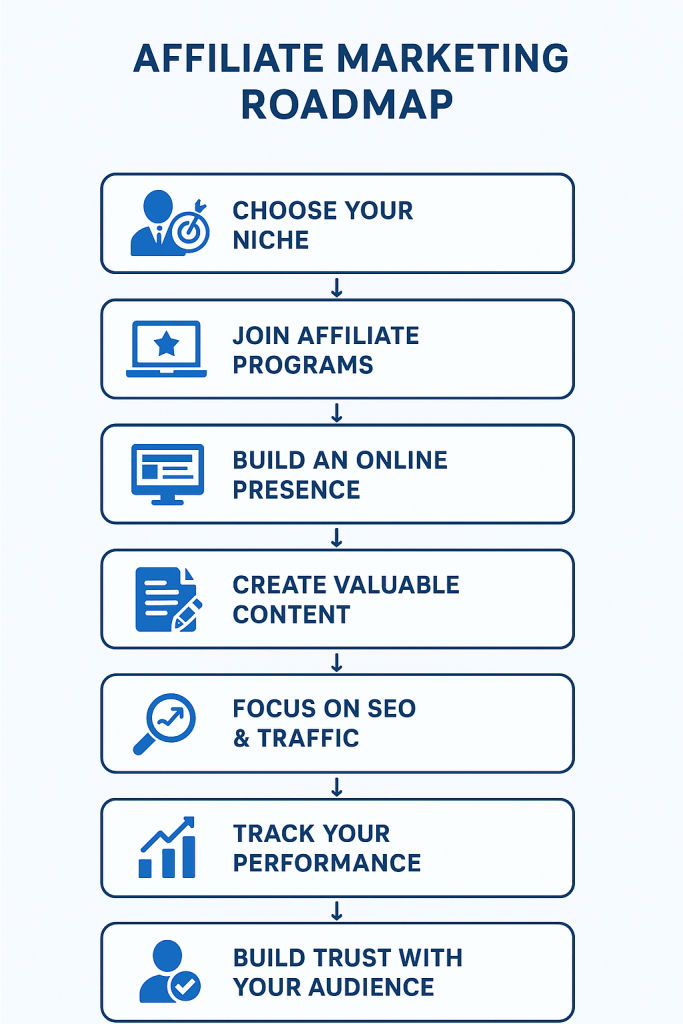
The first step to getting started in affiliate marketing is choosing a niche. A niche is a specific area of interest or industry, such as beauty, fitness, technology, travel, or personal finance. By focusing on a niche, affiliates can build authority and trust with their audience, ensuring that promotions resonate effectively. Once a niche is selected, the next step is to join reputable affiliate programs. Popular networks include Amazon Associates, ShareASale, CJ Affiliate, ClickBank, and Rakuten Marketing. Each platform offers unique benefits, from a wide variety of products to higher commission rates on digital goods, making it possible for affiliates to choose programs that align with their niche and audience.

Choose Your Niche:
Focus on a specific industry or topic you are passionate about, such as beauty, fitness, finance, tech, or travel. A clear niche builds trust and authority with your audience.

Select Affiliate Programs/Companies:
Start with reputable companies and networks. Popular options include:

  • Amazon Associates – Easy to join; wide range of products.
  • ShareASale – Thousands of merchants in various niches.
  • CJ Affiliate (Commission Junction) – High-quality brands and reliable tracking.
  • ClickBank – Digital products, often higher commissions.
  • Rakuten Marketing – Big brands and global reach.

Build an Online Presence:
You’ll need a platform to promote products:

  • Blog or Website: SEO content drives organic traffic.
  • Social Media: Instagram, TikTok, or Pinterest for visual promotions.
  • YouTube: Tutorials and reviews can be highly effective.
  • Email Marketing: Build a subscriber list for recurring promotions.

Affiliate Marketing Tips & Tricks: Quick-Start Guide

1. Choose Your Niche Wisely

  • Pick a topic you are passionate about.
  • Focus on a specific audience to build authority.

2. Join Reputable Affiliate Programs

  • Amazon Associates – Wide variety of products.
  • ClickBank – High commissions on digital products.
  • ShareASale / CJ Affiliate / Rakuten – Access to quality brands.

3. Build an Online Presence

  • Start a blog, YouTube channel, or social media profile.
  • Use email lists to reach your audience directly.

4. Create Valuable Content

  • Tutorials, reviews, comparison guides, and “how-to” articles.
  • Incorporate affiliate links naturally—don’t force them.

5. Focus on SEO & Traffic

  • Optimize your website for search engines to attract organic visitors.
  • Use paid ads strategically for faster results.

6. Track Your Performance

  • Use analytics to monitor clicks, conversions, and top-performing products.
  • Adjust strategies based on what works best.

7. Build Trust with Your Audience

  • Be honest about affiliate links.
  • Share genuine experiences and product recommendations.

8. Diversify & Scale

  • Join multiple affiliate programs to avoid relying on one source.
  • Reinvent and expand your content to reach more audiences.

9. Be Patient & Consistent

  • Earnings grow over time with effort, testing, and optimization.
  • Focus on quality and value rather than quick profits.

10. Learn from Successful Affiliates

  • Follow top affiliates in your niche.
  • Study strategies that consistently convert traffic into sales.

Building a strong online presence is crucial for affiliate marketing success. Affiliates can leverage blogs, websites, social media platforms, YouTube channels, and email marketing to reach potential customers. Content marketing, such as product reviews, tutorials, comparison guides, and “how-to” articles, allows affiliates to provide value while naturally integrating affiliate links. Search engine optimization (SEO) further amplifies reach by attracting organic traffic, while paid advertisements on Google, Facebook, or Instagram can target highly specific audiences to increase conversions. Trust is key; affiliates who provide genuine recommendations and showcase real experiences often see higher engagement and sales.

Content Marketing: Create valuable content like product reviews, “how-to” guides, and comparison articles.

SEO Optimization: Rank your content in search engines to attract free organic traffic.

Paid Ads: Facebook Ads, Google Ads, or influencer partnerships to drive targeted traffic.

Email Campaigns: Promote products to a dedicated audience with newsletters and promotions.

Social Proof & Trust: Use testimonials, case studies, and real experiences to boost credibility.

Successful affiliate marketers employ a combination of strategies to maximize earnings. Tracking performance through analytics enables affiliates to determine which products and promotional methods yield the best results. Diversifying income streams by joining multiple programs and promoting various products reduces risk and increases potential revenue. Email marketing campaigns to a loyal subscriber list can generate recurring income, and integrating social proof—such as testimonials, case studies, or user-generated content—helps establish credibility. Affiliates who prioritize quality over quantity and remain transparent about affiliate links build long-term relationships with their audience.

Pick products you personally trust and align with your audience.

Focus on quality over quantity; promote fewer, high-value products.

Track your performance with analytics to see what converts.

Diversify income streams with multiple affiliate programs.

Always disclose affiliate links; honesty builds trust with your audience.

The earning potential in affiliate marketing varies widely based on niche, traffic, and conversion rates. Beginners might earn between $50 and $500 per month, intermediate affiliates can generate $500–$5,000 monthly, and experienced marketers with multiple platforms and email lists can earn upwards of $50,000 per month. Physical products typically offer lower commissions (1%–10%), while digital products can provide higher rates (30%–75%). The key to success lies in patience, consistency, and reinvesting earnings to scale one’s efforts gradually.

  • Commissions vary by product and program:
    • Physical products: ~1%–10% per sale (Amazon).
    • Digital products: ~30%–75% per sale (ClickBank).
  • Income depends on traffic, conversion rates, and niche:
    • Beginners: $50–$500/month
    • Intermediate: $500–$5,000/month
    • Advanced: $5,000–$50,000+/month (top affiliates often scale with multiple websites and email lists)

Tip: Start small, reinvest earnings, and scale gradually for sustainable income.

In conclusion, affiliate marketing offers a flexible and potentially lucrative way to earn online, provided one approaches it with strategy, integrity, and dedication. By selecting the right niche, collaborating with reputable programs, establishing a robust online presence, and implementing targeted marketing strategies, aspiring affiliates can establish a sustainable source of income. With continuous learning, testing, and adaptation, affiliate marketing not only provides financial opportunities but also allows individuals to share valuable products and services with audiences around the world.

👉 These REFERENCES provide both academic depth and real-world industry insights.

Books & Academic Sources

  • Chaffey, D., & Ellis-Chadwick, F. (2019). Digital Marketing (7th ed.). Pearson.
  • Evans, D. S., & Schmalensee, R. (2016). Matchmakers: The New Economics of Multisided Platforms. Harvard Business Review Press.
  • Strauss, J., & Frost, R. (2016). E-Marketing (7th ed.). Routledge.

Industry & Professional Sources

Statistics & Earnings Potential

  • Statista. (2023). Affiliate Marketing – Statistics & Facts. Retrieved from https://www.statista.com
  • Business Insider Intelligence. (2021). The Affiliate Marketing Report.

👉 These references provide both academic depth and real-world industry insights.