
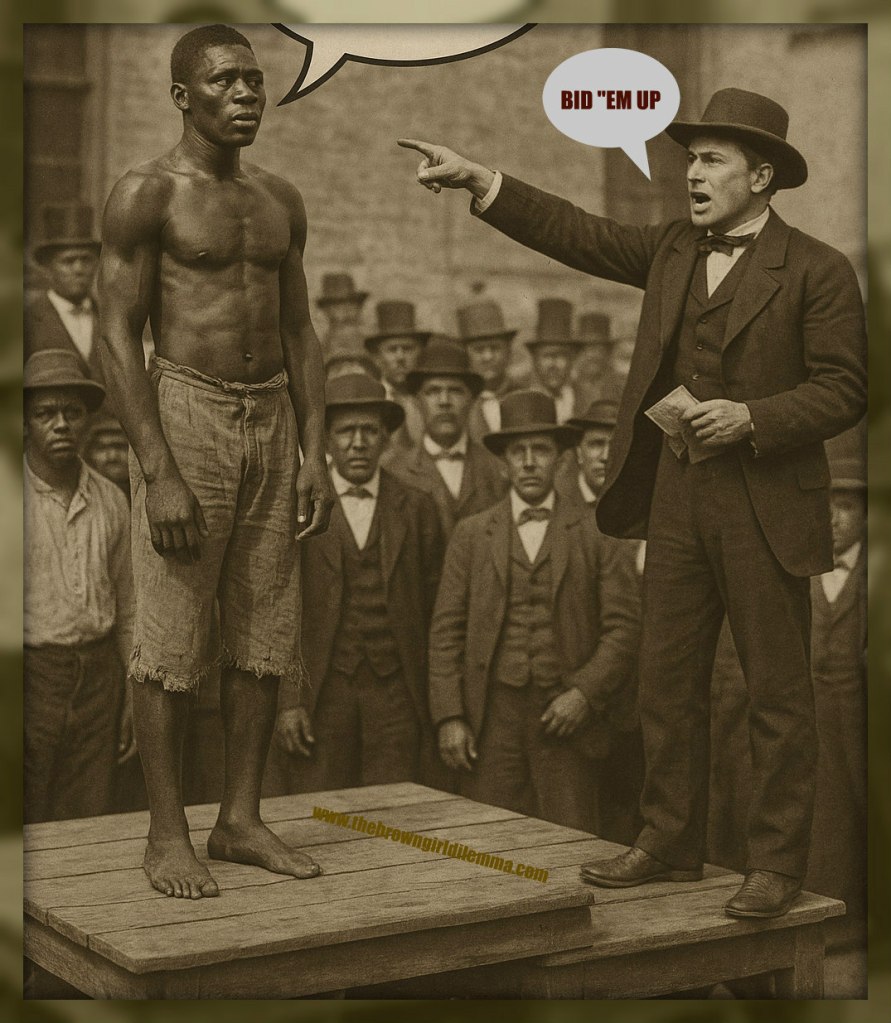
The phrase “Bid ’em up” refers to one of the most dehumanizing practices of the transatlantic slave trade: the process of auctioning African men, women, and children to the highest bidder. It was a command shouted at buyers during slave auctions, urging them to increase their bids as if the people on the block were livestock rather than human beings. This phrase captures the brutality, humiliation, and commercial greed embedded in American slavery.
Slave auctions operated as public markets where enslaved Africans were bought and sold, primarily in the 1700s–1800s, with the largest waves occurring from the early 18th century up to the Civil War in 1861. These auctions were often loud, crowded, and emotionally devastating events. Families were torn apart as husbands, wives, and children were separated, sold to different plantations, and sent to different states based solely on profit margins. “Bid ’em up” was not merely a business tactic—it was a reflection of how deeply racism shaped the economic and social system of the United States.
The auctions often took place in major Southern cities such as New Orleans, Charleston, Richmond, and Savannah. These markets drew slave traders, planters, wealthy merchants, and speculators eager to expand their labor force. In these spaces, the racial hierarchy of America was not hidden or subtle—it was on full display. Black people were forced onto platforms, examined, touched, and evaluated like property. Their bodies were scrutinized for strength, fertility, and obedience.
The enslaved were stripped of humanity through language. Terms like “bucks,” “breeders,” and “hands” reduced people to economic tools. The phrase “Bid ’em up” reveals the cold transactional nature of slavery, where human lives became items in an economic system built entirely on violence and racial domination.
Racism played a central role in justifying these practices. Europeans and white Americans constructed ideologies claiming Black people were inferior, subhuman, or naturally suited for enslavement. These racist beliefs formed the moral foundation for buying and selling millions of Africans. Without racism, the brutality of the slave market could not have been rationalized or sustained.
Slave auctions were not isolated events—they were central to the expansion of American agriculture. The rise of cotton, sugar, and rice industries increased demand for enslaved labor. The years following the 1808 ban on international slave importation saw the rise of the domestic slave trade, where enslaved people were sold from the Upper South to the Deep South in massive numbers.
These auctions were emotional battlegrounds. Many enslaved people prayed, cried, or resisted in small ways as they were forced onto the blocks. Mothers clung to their children, couples begged to stay together, and countless individuals were separated forever. The psychological trauma of these auctions rippled across generations.
The sight of chains, ropes, and shackles haunted the enslaved. Their names were replaced with auction numbers. Their futures were determined not by God or family but by the greed of bidders. The auction block became a symbol of absolute powerlessness.
Even children were not spared. Boys and girls as young as five or six were sold for their future labor value. Infants were sold with their mothers or separated from them, depending on what yielded higher profits. Slave traders calculated the price of innocence.
The practice reached its most infamous moment in 1859 during the largest recorded slave auction in U.S. history: The Weeping Time in Georgia, where over 400 enslaved people were sold over two days. The rain that fell during the event was described as the tears of heaven, mourning the suffering.
The economic impact of these auctions built generational wealth for white families while simultaneously creating generational poverty for Black Americans. Plantations, banks, and insurance companies all profited from human sale and exploitation.
The culture around slave auctions normalized cruelty. Newspapers advertised upcoming sales, listing children alongside horses. Hotels hosted bidders. Judges and sheriffs enforced fugitive slave laws to protect the system. Churches often remained silent, and in some cases participated.
After the Civil War and emancipation, the memory of the auction block became a permanent wound in African American history. It shaped family structures, migration patterns, and the cultural resilience of Black communities. Many African Americans today trace their lineage to ancestors sold on those blocks.
The legacy of “Bid ’em up” exposes how slavery was not just a labor system—it was an industry, a psychology, and a national economic engine grounded in racial violence. Understanding this context helps illuminate the roots of systemic racism in modern America.
The phrase also reminds us of the strength of the ancestors who survived unimaginable pain. Their endurance, faith, and determination laid the foundation for Black progress in the centuries that followed. They were bought and sold, yet they remained unbroken.
Remembering these auctions is not simply an act of historical reflection. It is a testimony to the resilience of a people who were denied humanity but ultimately reclaimed their identity, dignity, and voice. The auction block is a scar, but it is also a monument to survival.
In studying this painful history, we confront the truth of America’s origins. Slavery was not a footnote—it was central. And phrases like “Bid ’em up” force us to acknowledge the systems of racism that endured long after the auctions ended.
This history calls us to honor the ancestors by telling their stories truthfully, challenging systemic injustice, and ensuring that the trauma of the auction block is never forgotten.
References
Berlin, I. (2003). Generations of captivity: A history of African-American slaves. Harvard University Press.
Fett, S. (2002). Working cures: Healing, health, and power on Southern slave plantations. University of North Carolina Press.
Johnson, W. (1999). Soul by soul: Life inside the antebellum slave market. Harvard University Press.
Smallwood, S. (2007). Saltwater slavery: A Middle Passage from Africa to American diaspora. Harvard University Press.
Smith, C. (2012). The Weeping Time: Slave auctions and the economy of the South. Yale University Press.
 THE BROWN GIRL DILEMMA