This photograph is the property of its respective owner. No copyright infringement intended.
Malcolm X, born Malcolm Little on May 19, 1925, in Omaha, Nebraska, was one of the most influential African American leaders of the 20th century. His life journey—from a troubled youth to a prominent civil rights leader—reflects resilience, intellectual growth, and unwavering advocacy for Black empowerment. He died tragically on February 21, 1965, in New York City after being assassinated while preparing to address the Organization of Afro-American Unity.
Early Life: Malcolm was born to Earl Little, a Baptist minister and supporter of Black nationalist Marcus Garvey, and Louise Little, who was of Grenadian descent. Some sources suggest Malcolm may have had mixed ancestry, particularly through his mother’s Caribbean background, although he identified wholly with his African heritage (Marable, 2011). His early life was marked by hardship, including the death of his father under suspicious circumstances and his mother’s institutionalization, leaving Malcolm and his siblings in foster care.
Education and Youth: Malcolm was a bright student but faced systemic racism and personal challenges. Dropping out of school in eighth grade, he became involved in petty crime and was eventually imprisoned in 1946. His prison years became a turning point; he educated himself extensively, reading widely on history, philosophy, and religion, and converted to the Nation of Islam, adopting the surname “X” to symbolize the lost name of his African ancestry.
Nation of Islam and Activism: As a minister and national spokesperson for the Nation of Islam, Malcolm X advocated for Black self-determination, economic independence, and the rejection of racial integrationist strategies favored by other civil rights leaders like Martin Luther King Jr. He emphasized pride in Black identity and self-defense “by any means necessary” (Malcolm X, 1965).
Family Life: Malcolm married Betty Shabazz in 1958. Together they had six daughters: Attallah, Qubilah, Ilyasah, Gamilah, Malaak, and Kareema. His family played a critical role in preserving his legacy, with Betty Shabazz becoming a prominent educator and activist after his death.
Impact and Power: Malcolm X’s influence stemmed not from official awards or honors during his lifetime but from the power of his voice, intellect, and strategic activism. He inspired generations of African Americans to embrace self-respect, political engagement, and the pursuit of justice. His speeches, writings, and autobiography continue to serve as foundational texts for studies on civil rights, Black nationalism, and social justice (X & Haley, 1965).
Legacy: Malcolm X’s transformation after leaving the Nation of Islam in 1964 broadened his message to include global human rights and racial unity. His pilgrimage to Mecca, where he witnessed Muslims of all races praying together, influenced his belief in universal brotherhood while maintaining a focus on Black empowerment.
Awards and Recognition: While Malcolm X did not receive mainstream awards during his life, posthumously he has been honored extensively. He appears on lists of influential Americans, is commemorated through schools, streets, and cultural centers named in his honor, and his life story has been adapted in literature, documentaries, and films, notably the 1992 biographical film Malcolm X directed by Spike Lee and starring Denzel Washington.
Death: On February 21, 1965, Malcolm X was assassinated at the Audubon Ballroom in Manhattan. Three members of the Nation of Islam were convicted for his murder. His death marked a profound moment in the civil rights movement, and his ideas continued to shape Black empowerment movements, including the Black Power movement.
Nationality and Identity: Malcolm X identified as African American, fully embracing his Black heritage and ancestry. Although he may have had mixed ancestry through his mother, his philosophy and activism were rooted in reclaiming African identity and dignity in a racially oppressive society.
Power and Influence: Malcolm X’s power was intellectual, spiritual, and rhetorical. He wielded influence through his charisma, unflinching critique of systemic racism, and ability to mobilize people around principles of justice and self-determination. He challenged complacency, promoted self-education, and inspired activism that extended beyond the United States, connecting the struggle of African Americans to a global fight for human rights.
Conclusion: Malcolm X’s life is a testament to transformation, resilience, and the pursuit of justice. From troubled youth to revolutionary leader, he left an indelible mark on the civil rights movement and the consciousness of African Americans worldwide. His teachings on empowerment, pride, and self-determination remain deeply relevant in contemporary discussions of race, identity, and social justice.
References:
Marable, M. (2011). Malcolm X: A life of reinvention. New York: Viking.
X, M., & Haley, A. (1965). The autobiography of Malcolm X. New York: Grove Press.
Carson, C. (Ed.). (1998). The autobiography of Martin Luther King, Jr. includes comparative studies on civil rights leadership. New York: Warner Books.
Lincoln, C. E., & Mamiya, L. H. (1990). The Black church in the African American experience. Durham, NC: Duke University Press.
Virtue and Victory: Lakita Garth’s Stand for Purity
All photographs are the property of their respective owners. No copyright infringement intended.
Lakita Garth is a shining beacon in a society where the flesh rules and sex without marriage is glorified, while moral values are dismissed as outdated. Radiant in resolve, she stands as a living testimony that true beauty flows from within—a reflection of purity, strength, and unwavering faith. Her grace, intelligence, and conviction remind the world that virtue is not weakness but power under discipline. In an age where compromise is celebrated, Lakita’s steadfast message of abstinence and godly love shines as a sacred light of hope and holiness.
Lakita Garth’s story is one of courage, conviction, and countercultural grace. Born and raised in Los Angeles as the youngest of five children, she was molded by both hardship and faith. Her father, a 27-year Air Force veteran, passed away from cancer when she was just eleven, leaving her mother to raise the family in one of the city’s most dangerous neighborhoods. Yet, out of that adversity, Garth emerged with a fierce commitment to integrity and self-worth—a message she would later carry to stages across the nation.
The Lovely Lakita stands as one of the most prominent voices in the modern abstinence and purity movement. Known for her poise, eloquence, and unapologetic moral stance, she rose to prominence as a speaker, author, and former beauty queen. Her journey from pageantry to purpose embodies the balance of external beauty and inner conviction, reminding young people that true virtue radiates from within. Garth’s message has resonated globally, challenging cultural norms that equate freedom with sexual indulgence and redefining what it means to live a life set apart for God.
From her youth, Garth adopted a radical stance on sexuality in a society obsessed with physical pleasure. Inspired by her grandfather’s lifelong devotion to his late wife, she decided early to remain abstinent until marriage. That personal vow became the cornerstone of her mission: to teach young people that purity is not repression, but empowerment. Her voice rose as a clarion call in an era when virginity was mocked, redefining abstinence as an act of dignity, discipline, and self-respect.
In 1995, Garth’s poise and beauty earned her the title of Miss Black California and second runner-up in the Miss Black America pageant. Her grace on stage was matched by the substance of her message off it. She used her platform not for fame, but to advocate for sexual integrity and moral leadership among youth. Publications such as Vogue, Seventeen, and Cosmopolitan featured her, recognizing a woman who could embody both elegance and ethical strength. Lakita Garth’s early life was marked by academic excellence and a deep commitment to faith. After winning the title of Miss Black California, she used her platform not merely for glamour but to promote moral integrity and self-respect among youth. She attended the University of Southern California, where she graduated with honors, showing that intelligence and virtue can walk hand in hand. Her rise to national recognition came not from controversy but from conviction—a rare feat in an age where public attention is often tied to scandal.
Her breakthrough moment came through public speaking. Garth became one of the most sought-after abstinence educators in America, addressing thousands of students, parents, and leaders nationwide. She has testified before the U.S. Congress, appeared on major television programs such as Politically Incorrect with Bill Maher and MTV’s Sex in the ’90s, and has spoken at countless universities, churches, and conferences. Her charisma, intelligence, and unapologetic conviction allowed her to bridge both secular and faith-based audiences.
Garth’s central message was that abstinence is not just about saying “no” to sex—it is about saying “yes” to purpose, power, and self-respect. In her bestselling book The Naked Truth: Real Talk About Sex, Shame, and Transparency, she lays out a four-phase decision-making framework to help young people navigate relationships with clarity. Her approach balanced biblical truth with practical insight, encouraging both women and men to pursue holiness and healthy relationships rooted in self-control.
Throughout her career, Garth has been a sought-after motivational speaker, addressing thousands of students and adults across the United States and abroad. She has spoken at universities, churches, and conferences, delivering messages grounded in biblical truth. Her lectures often reference 1 Corinthians 6:19-20 (KJV)—“What? know ye not that your body is the temple of the Holy Ghost… therefore glorify God in your body, and in your spirit, which are God’s.” This scripture became the cornerstone of her message, reminding audiences that purity is not repression but reverence.
Garth’s impact extended beyond the pulpit and stage. As an author and media commentator, she appeared on major networks including MTV, BET, and CNN, where she fearlessly defended abstinence and moral clarity in a culture obsessed with sexual expression. Her ability to articulate biblical principles with intelligence and humor made her one of the few Christian voices respected in both secular and faith-based arenas. She emphasized that purity was not simply about abstaining from sex, but about guarding the heart, as commanded in Proverbs 4:23 (KJV)—“Keep thy heart with all diligence; for out of it are the issues of life.”
Her message was particularly influential among young women who struggled with societal pressure to conform to hypersexualized ideals. Garth championed modesty and discipline not as restrictions, but as divine protection. She often declared that “true power comes from self-control,” echoing Galatians 5:22-23 (KJV), which lists temperance as a fruit of the Spirit. In a world where the lines between love and lust were blurred, Garth’s bold stance reminded youth that spiritual and emotional purity are essential for holistic growth.
However, her message was not without opposition. Critics accused her of promoting outdated ideals and restricting young people’s freedom. Some media commentators labeled her teachings as “unrealistic” or “judgmental,” particularly in the wake of the sexual liberation movements. Yet, Garth remained undeterred. She countered with biblical wisdom, citing Romans 12:2 (KJV)—“And be not conformed to this world: but be ye transformed by the renewing of your mind.” Her resilience against criticism demonstrated that standing for righteousness often invites rejection from a culture steeped in moral compromise.
Despite negative remarks, many praised her authenticity and grace. Lakita’s beauty, both physical and spiritual, drew admiration even from those who disagreed with her. Unlike many public figures who folded under scrutiny, she exemplified 1 Peter 3:3-4 (KJV)—“Whose adorning let it not be that outward adorning… but let it be the hidden man of the heart.” Her ability to remain poised and gracious under criticism reflected divine strength and character.
Her influence extended into community leadership and mentorship programs, where she worked to empower youth through education and moral guidance. Garth’s workshops and seminars encouraged self-worth, teaching that every individual has inherent value given by God. Through her initiatives, she sought to break cycles of promiscuity, fatherlessness, and low self-esteem that plague many communities. Her message of purity thus became a movement of restoration and empowerment.
In the realm of Christian leadership, Garth’s voice remains one of steadfast truth. She continues to be cited by purity advocates, youth ministers, and educators who use her teachings as a blueprint for moral education. Her unwavering faith and courage embody Philippians 4:13 (KJV)—“I can do all things through Christ which strengtheneth me.” Lakita Garth’s life reminds believers that holiness is not antiquated—it is timeless truth wrapped in grace and purpose.
Ultimately, Lakita Garth’s legacy transcends beauty and fame. She is a living testament that spiritual integrity can coexist with elegance and ambition. Her life challenges believers to rise above compromise and reflect the light of Christ in all they do. Through her example, she redefined what it means to be a woman of virtue in a modern age, proving that purity is not the absence of passion, but the redirection of passion toward divine purpose.
Her advocacy has had a measurable impact. Evaluations of youth programs led by Garth found significant shifts in perspective: after hearing her speak, 92% of students affirmed the advantages of abstinence, and 80% said they felt more capable of saying no to sexual pressure. These outcomes demonstrated that her approach—rooted in compassion and conviction—resonated powerfully with the next generation.
In 2005, at the age of 36, Lakita Garth married Jeffrey Wright, remaining a virgin until her wedding day. She famously shared that her first kiss was reserved for her husband at the altar—a testimony that shocked some and inspired many. Her marriage became a symbol of the fulfillment of her faith-based commitment, proving that waiting is possible and worth it. Her story encouraged thousands of women to believe that self-restraint could coexist with beauty, ambition, and joy.
Throughout her career, Garth has been honored with numerous awards and accolades for her service and advocacy. She received recognition from the U.S. Congress, faith-based organizations, and educational boards for her work in character development and abstinence education. She also served as a consultant for the California Department of Health and was featured in documentaries and news specials addressing youth morality, self-esteem, and sexual ethics.
Yet, her message has not been without criticism. Some commentators have accused abstinence-only education of promoting unrealistic standards or reinforcing the so-called “purity myth.” Secular outlets such as Rewire News argued that the emphasis on virginity before marriage might stigmatize those who fall short of that ideal. Others questioned whether abstinence programs adequately addressed the complexities of sexual health and identity. Still, Garth stood firm, responding with grace and conviction, often reminding critics that her message was not about shame—but about choice, discipline, and spiritual empowerment.
Even amidst debate, Lakita Garth’s legacy remains profound. Her influence stretches far beyond classrooms and auditoriums; it has become part of a larger cultural movement toward reclaiming moral clarity in a confused world. Her beauty and brilliance remind many that strength and femininity need not be at odds. Through her life, she has shown that true confidence is born from conviction, and real freedom is found not in indulgence, but in obedience to divine wisdom. Her story continues to inspire young women to live with purpose, protect their worth, and wait for love that mirrors God’s perfect design.
References
The Holy Bible, King James Version (KJV)
Garth, L. (2004). The Naked Truth: Real Talk About Sex, Shame, and Transparency. Baker Books.
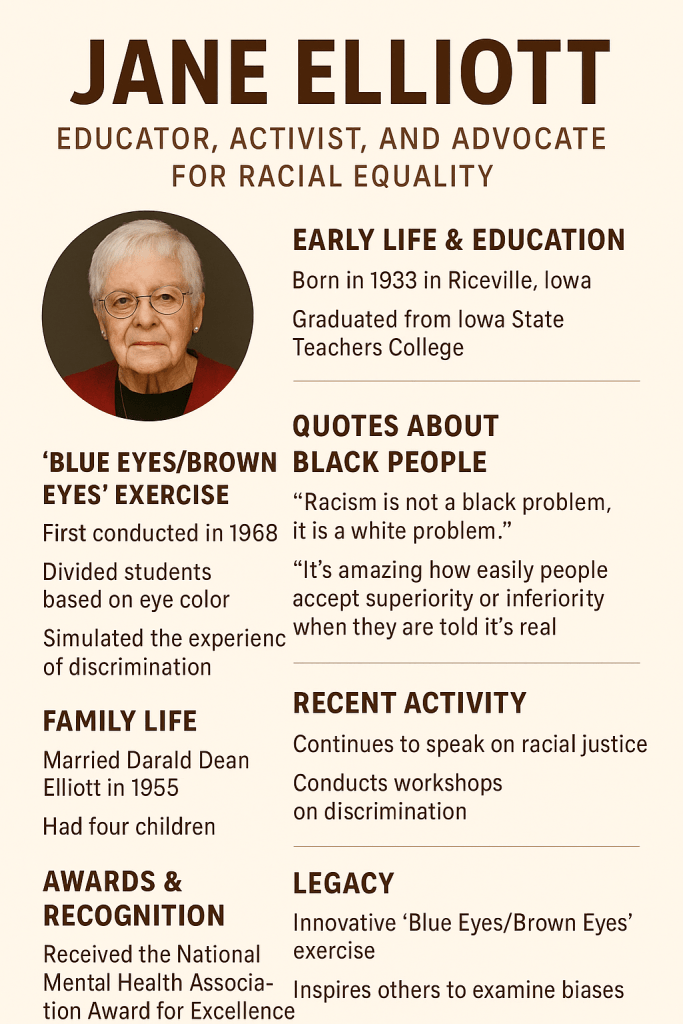
Elliott has spoken candidly about race and prejudice, emphasizing the importance of awareness and accountability. Two notable quotes include:
We don’t know anything about racism. We’ve never experienced it. If words can make a difference in your life for seven minutes, how would it affect you if you heard this every day of your life?” — Jane Elliott BrainyQuote
“Racism is a learned affliction, and anything that is learned can be unlearned.” — Jane Elliott A-Z Quotes
Jane Elliott is a prominent American educator and anti-racism activist, renowned for her innovative approach to teaching about prejudice and discrimination. Her most notable contribution is the “Blue Eyes/Brown Eyes” exercise, which she first conducted with her third-grade class in 1968, the day after the assassination of Dr. Martin Luther King Jr. This exercise aimed to simulate the experience of discrimination by dividing students based on eye color and assigning them arbitrary privileges and disadvantages accordingly. The profound impact of this exercise has led to its widespread adoption in various educational and corporate settings.
Early Life and Education
Born Jane Jennison on November 30, 1933, in Riceville, Iowa, she was the fourth of several children in her family. After graduating from high school in 1952, Elliott attended the Iowa State Teachers College (now the University of Northern Iowa), where she obtained an emergency elementary teaching certificate in five quarters. In 1953, she began teaching in a one-room school in Randall, Iowa, marking the start of her long career in education.
The “Blue Eyes/Brown Eyes” Exercise
In 1968, following Dr. King’s assassination, Elliott sought to teach her all-white, small-town students about the realities of discrimination. She divided the class into two groups based on eye color, assigning privileges to one group and disadvantages to the other. The exercise demonstrated how quickly individuals could internalize superiority or inferiority based on arbitrary characteristics, providing a powerful lesson on the mechanisms of prejudice. The exercise was documented in the 1970 film The Eye of the Storm and revisited in the 1985 PBS special A Class Divided.
Transition to Full-Time Activism
The success and impact of the “Blue Eyes/Brown Eyes” exercise led Elliott to leave her teaching position and pursue a career as a full-time speaker and educator on issues of race and discrimination. She has since conducted the exercise and lectured on its effects worldwide, including with college students, as seen in the 2001 documentary The Angry Eye.
Family Life
Elliott married Darald Dean Elliott in 1955. Together, they had four children. Darald Dean Elliott passed away in 2013. Elliott’s family life has been marked by her commitment to social justice and her role as a mother and educator.
Awards and Recognition
Throughout her career, Elliott has received numerous accolades for her work in education and anti-racism activism. She was honored with the National Mental Health Association Award for Excellence in Education. Her innovative approach to teaching about discrimination has been recognized globally, and she continues to be a sought-after speaker and trainer.
Advocacy for Racial Equality
Elliott’s work extends beyond the classroom. She has been an outspoken advocate for racial equality, challenging individuals and institutions to confront and address systemic racism. Her advocacy includes speaking engagements, workshops, and media appearances aimed at raising awareness and promoting change.
Public Speaking and Workshops
As a public speaker, Elliott has addressed a wide range of audiences, including educators, students, corporate leaders, and community groups. Her workshops often involve participatory exercises designed to help individuals experience and reflect on the impact of discrimination. These sessions are intended to foster empathy and inspire action toward greater inclusivity and equity.
Media Appearances
Elliott’s work has been featured in various media outlets, including documentaries, interviews, and news programs. Her appearances have helped to bring the conversation about race and discrimination into the public eye, reaching audiences beyond those who attend her workshops and lectures.
Philosophy on Race and Discrimination
Elliott’s philosophy centers on the idea that racism is a learned behavior that can be unlearned through education and awareness. She emphasizes the importance of confronting uncomfortable truths and encourages individuals to take responsibility for their actions and beliefs.
Critiques and Controversies
While Elliott’s methods have been widely praised, they have also faced criticism. Some argue that the “Blue Eyes/Brown Eyes” exercise can be emotionally distressing for participants. Elliott acknowledges these concerns but maintains that the discomfort experienced is necessary for individuals to understand the pain caused by discrimination.
Legacy and Impact
Elliott’s legacy is evident in the continued use of her “Blue Eyes/Brown Eyes” exercise in educational settings around the world. Her work has inspired countless individuals to examine their own biases and take action against racism. She remains a prominent figure in the fight for racial equality. In recent years, Elliott has continued her advocacy through speaking engagements and workshops. She remains active in promoting racial justice and educating others about the realities of discrimination. Reflecting on her career, Elliott expresses a deep commitment to her mission of combating racism. She views her work as a lifelong endeavor and remains dedicated to making a difference in the lives of others.
Conclusion
Jane Elliott’s contributions to the field of anti-racism education have had a lasting impact. Through her innovative exercises, public speaking, and unwavering commitment to social justice, she has challenged individuals and institutions to confront and address racism. Her work continues to inspire and educate, fostering a more inclusive and equitable society.



 THE BROWN GIRL DILEMMA