
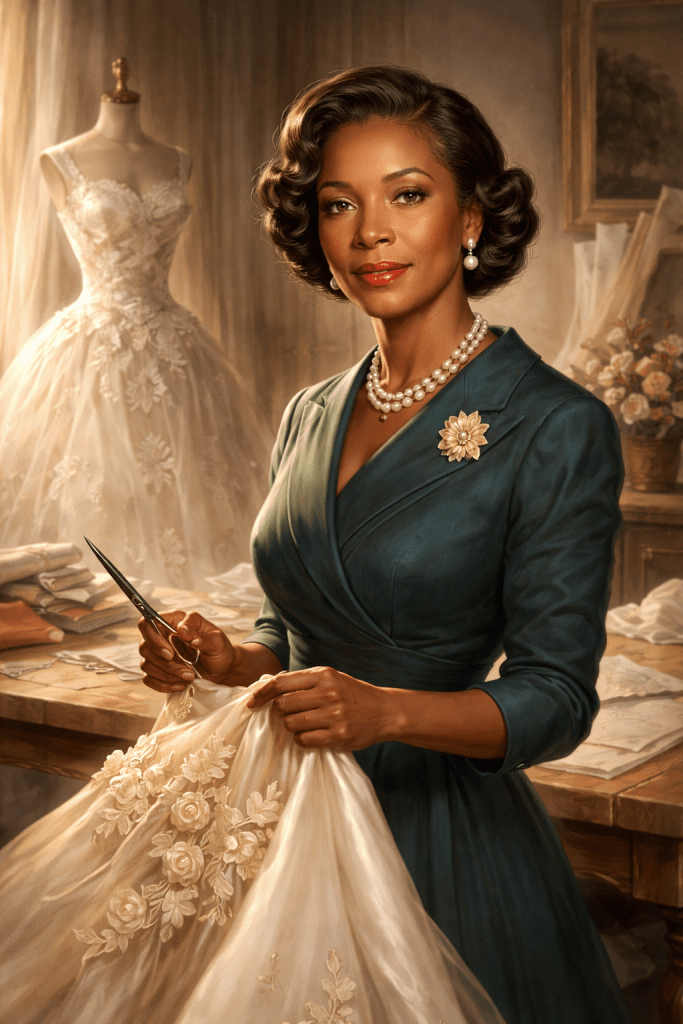
Ann Lowe stands as one of the most underrecognized yet profoundly influential figures in American fashion history, a woman whose genius was stitched into some of the most iconic garments of the twentieth century. Born into a lineage shaped by both artistry and oppression, Lowe’s life and career represent a powerful intersection of race, resilience, and refined craftsmanship. Despite working during an era deeply entrenched in racial segregation, she rose to dress some of the most elite women in America, leaving behind a legacy that continues to inspire designers and historians alike.
Born in 1898 in Clayton, Alabama, Ann Lowe was the great-granddaughter of an enslaved seamstress and the daughter of a skilled dressmaker. Her family’s talent for design was cultivated under the harsh conditions of slavery, where Black women were often forced to create garments for wealthy white families. This generational inheritance of skill became Lowe’s foundation, transforming what began as forced labor into a refined art form that would later captivate high society.
Lowe’s early exposure to couture techniques came through her mother and grandmother, who designed elaborate gowns for prominent Southern families. After her mother’s death, Lowe completed an unfinished set of dresses for a governor’s wife at just sixteen years old, astonishing clients with her ability. This moment marked the beginning of her independent career, signaling a rare and extraordinary talent that would defy the limitations imposed on Black women in her time.
Determined to refine her craft, Lowe enrolled in a design school in New York, where she faced segregation even within education. She was separated from her white classmates but excelled beyond expectations, completing her program ahead of schedule. Her perseverance in the face of discrimination highlighted both her resilience and her commitment to excellence.
Lowe eventually established herself in New York City, where she opened her own salon. She became known for her intricate hand-sewn floral appliqués, delicate embroidery, and structured silhouettes that reflected both European couture traditions and her own distinct aesthetic. Her work was often described as ethereal, feminine, and technically masterful.
Among her elite clientele were members of America’s most prominent families, including the Rockefellers and the du Ponts. Yet, despite her high-profile clients, Lowe remained largely uncredited due to the racial dynamics of the era. Many of the women who wore her gowns received public admiration, while Lowe’s name remained hidden behind the seams.
One of the most significant moments in her career came when she was commissioned to design the wedding gown for Jacqueline Bouvier Kennedy, who would later become the wife of John F. Kennedy. This gown would become one of the most iconic bridal dresses in American history.
The dress itself was a masterpiece of ivory silk taffeta, featuring a portrait neckline, fitted bodice, and a voluminous skirt adorned with intricate folds. Lowe also designed the bridesmaids’ dresses, ensuring a cohesive and elegant visual presentation for the entire wedding party. Her attention to detail and commitment to perfection were evident in every stitch.
However, just days before the wedding, a catastrophic flood in Lowe’s studio destroyed the dresses she had painstakingly created. Without informing her client, Lowe worked tirelessly to recreate each garment in time for the ceremony, absorbing the financial loss herself. This act of dedication exemplified her professionalism and unwavering commitment to her craft.
Despite the monumental success of the wedding and the global attention it received, Lowe was not publicly credited at the time. When asked about the designer, Jacqueline Kennedy reportedly described the dress as made by “a colored dressmaker,” reflecting the racial attitudes that obscured Lowe’s recognition.
Lowe’s connection to Jacqueline Kennedy remains one of the most discussed aspects of her legacy, symbolizing both her brilliance and the systemic barriers she faced. It was not until years later that her role in creating the gown was widely acknowledged, allowing her to finally receive the recognition she deserved.
In addition to her work for high society, Lowe also designed dresses for debutantes, particularly for the annual Azalea Ball in Florida. These gowns became a rite of passage for wealthy young women, further cementing her reputation as a designer of elegance and tradition.
Lowe’s designs are now preserved in several prestigious institutions, most notably the Smithsonian Institution, where her work is recognized as a vital part of American cultural and fashion history. Her garments are also held in collections at the Metropolitan Museum of Art, ensuring that her legacy endures for future generations.
Her inclusion in these museums represents a significant shift in how her contributions are valued, transforming her from an overlooked artisan into a celebrated pioneer. These institutions acknowledge not only her technical skill but also the cultural significance of her work as a Black woman navigating a segregated industry.
Lowe’s career was not without hardship. Financial instability plagued her business, partly due to her reluctance to charge her wealthy clients what her work was truly worth. This, combined with systemic racism, limited her financial success despite her immense talent.
Nevertheless, her influence can be seen in the generations of designers who followed. Her emphasis on craftsmanship, detail, and elegance set a standard that continues to resonate within the fashion industry today. She remains a symbol of excellence achieved against overwhelming odds.
Lowe’s story also serves as a lens through which to examine the broader history of Black labor in America. From slavery to the twentieth century, Black artisans have often been the invisible architects of beauty and culture, their contributions minimized or erased. Lowe’s life challenges this narrative, demanding recognition and respect.
Her work embodies a quiet form of resistance, demonstrating that excellence can thrive even in the most restrictive conditions. Through her designs, she asserted her identity and artistry in a society that sought to marginalize both.
Today, Ann Lowe is increasingly celebrated as a trailblazer, a woman who transformed inherited skill into high art. Her story is not just one of fashion but of perseverance, dignity, and the enduring power of creativity.
In reclaiming her legacy, we honor not only Ann Lowe but also the countless unnamed Black women whose talents shaped history from behind the scenes. Her stitches, once hidden, now tell a story of brilliance that can no longer be ignored.
References
Bolton, A. (2016). Jacqueline Kennedy: The White House Years. Metropolitan Museum of Art.
Harris, A. (2018). The Hidden History of American Fashion: Rediscovering Ann Lowe. Fashion Studies Journal, 12(3), 45–62.
Smithsonian Institution. (n.d.). Ann Lowe: American Couturier. National Museum of African American History and Culture.
Vreeland, D. (1965). American Fashion and Its Designers. New York: Harper & Row.
Walker, R. (2020). Threads of Legacy: African American Dressmakers and the Politics of Recognition. Journal of American History, 107(2), 389–412.
Discover more from THE BROWN GIRL DILEMMA
Subscribe to get the latest posts sent to your email.
 THE BROWN GIRL DILEMMA