
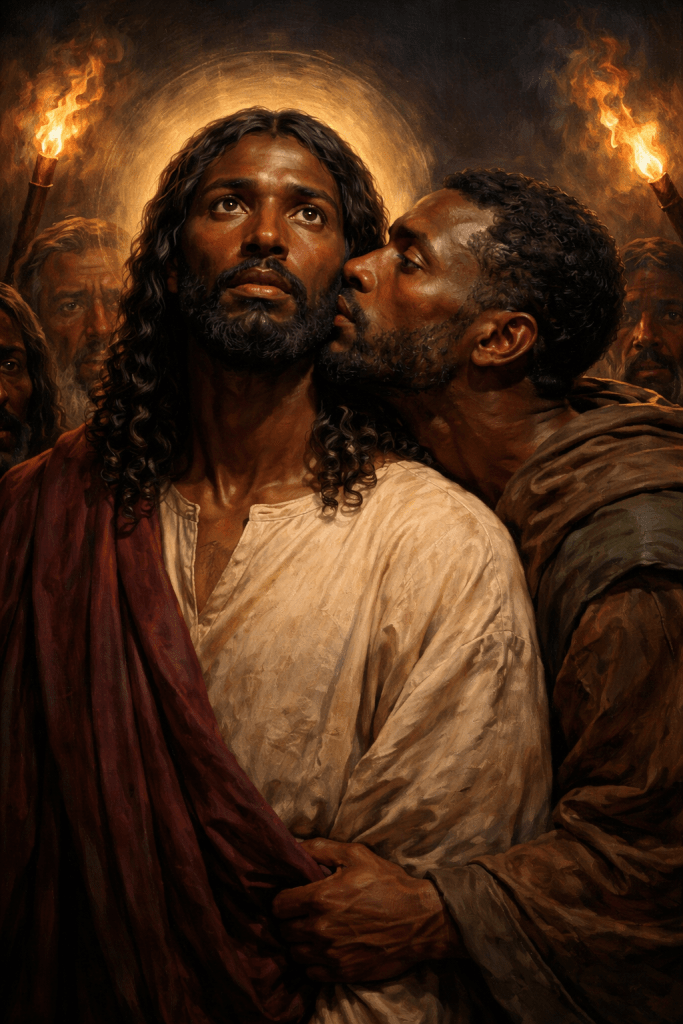
The moment commonly known as “the kiss of betrayal” is one of the most dramatic and spiritually significant events recorded in the New Testament. In the Gospels, the disciple Judas Iscariot identifies Jesus to the arresting authorities with a kiss on the cheek in the Garden of Gethsemane. This act, described in the Gospel of Matthew 26:47–50 and the Gospel of Luke 22:47–48, transformed a gesture of affection and respect into a symbol of treachery. The event has since become an enduring metaphor for betrayal carried out under the appearance of friendship.
Judas Iscariot was one of the original twelve disciples chosen personally by Jesus. The twelve apostles represented the foundational leadership of the early Christian movement, entrusted with spreading Christ’s teachings. According to the Gospel of Mark 3:13–19, Judas was called just like the others—Peter, James, John, and the rest—and he traveled with Jesus during His ministry. Judas witnessed miracles, heard Christ’s teachings, and participated in the communal life of the disciples.
Despite his privileged position, the Gospels portray Judas as having a conflicted character. In the Gospel of John 12:4–6, he is described as the keeper of the disciples’ money bag and is accused of stealing from it. This detail suggests that Judas struggled with greed and personal ambition, weaknesses that eventually contributed to his betrayal. His role among the disciples was therefore paradoxical: a trusted follower who secretly harbored moral corruption.
The betrayal begins to take shape during the final days of Jesus’ ministry in Jerusalem. Religious authorities viewed Jesus as a political and theological threat. His growing influence among the people alarmed the leaders of the temple, who feared unrest and Roman intervention. According to the Gospel of Matthew 26:14–16, Judas approached the chief priests and asked what they would give him if he delivered Jesus to them.
The priests agreed to pay Judas thirty pieces of silver. This amount, referenced in the Gospel of Matthew 26:15, carries symbolic significance because it echoes the prophecy found in the Book of Zechariah 11:12–13, where thirty pieces of silver is the price placed on a shepherd rejected by his people. In ancient Israelite law, this sum also corresponded to the compensation paid for a slave accidentally killed (Exodus 21:32). Thus, the price reflects both prophetic fulfillment and the tragic undervaluation of Christ.
The Gospel writers also emphasize the spiritual dimension behind Judas’s decision. In the Gospel of Luke 22:3, it is written that “Satan entered into Judas.” This phrase suggests that Judas’s betrayal was not merely a human act of greed but part of a larger spiritual conflict between divine purpose and demonic influence. The narrative frames Judas as someone who opened himself to evil through his choices.
Similarly, the Gospel of John 13:27 recounts that after receiving bread from Jesus at the Last Supper, Satan entered Judas again, prompting Jesus to say, “What thou doest, do quickly.” This passage illustrates the tension between human free will and divine foreknowledge. Jesus knew the betrayal was imminent and allowed it to unfold according to the plan that would ultimately lead to redemption.
The betrayal itself occurs in the Garden of Gethsemane shortly after the Last Supper. Judas leads a crowd of soldiers and temple officials to the place where Jesus had gone to pray. To identify Him in the darkness, Judas tells the authorities that the man he greets with a kiss is the one they should arrest. This signal transforms an intimate greeting into an act of deception.
When Judas approaches Jesus, he greets Him respectfully and kisses Him on the cheek. According to the Gospel of Matthew 26:49, he says, “Hail, Rabbi.” Jesus responds with calm awareness, asking, “Friend, wherefore art thou come?” The response reveals both sorrow and understanding. In the Gospel of Luke 22:48, Jesus asks, “Judas, betrayest thou the Son of man with a kiss?”
The kiss, therefore, becomes symbolic of betrayal disguised as loyalty. In the ancient Mediterranean world, a kiss was a sign of respect between a disciple and a teacher. By using this gesture as a signal to arrest Jesus, Judas weaponized trust. The act represents the tragedy of intimate betrayal—being harmed by someone within one’s own circle.
The question of why Judas betrayed Jesus has been debated for centuries by theologians and historians. Some scholars argue that greed motivated him, as suggested by the payment of silver. Others believe he may have been disillusioned with Jesus, expecting a political messiah who would overthrow Roman rule. When Jesus instead spoke of sacrifice and the spiritual kingdom, Judas may have turned against Him.
Another interpretation suggests that Judas attempted to force Jesus to reveal His power. Some scholars speculate that Judas believed arresting Jesus would provoke Him to demonstrate divine authority and establish His kingdom. If this theory holds, Judas’s betrayal may have been rooted in misunderstanding rather than pure malice.
Theologically, Judas also plays a role within the framework of prophecy and divine purpose. Jesus’ betrayal was foretold in passages such as the Book of Psalms 41:9, which says, “Mine own familiar friend… hath lifted up his heel against me.” Early Believers interpreted this as a prophetic foreshadowing of Judas’s actions.
Because of these prophecies, some theologians argue that Judas fulfilled a role necessary for the events leading to the crucifixion. Without the betrayal, Jesus might not have been arrested in the manner described in the Gospels. From this perspective, Judas’s actions became part of the unfolding plan for redemption.
However, the presence of divine purpose does not eliminate personal responsibility. Christian theology generally holds that Judas acted out of his own choices and desires. His betrayal demonstrates how human weakness can align with darker spiritual forces, resulting in tragic consequences.
After Jesus was condemned, Judas experienced deep remorse. According to the Gospel of Matthew 27:3–5, he returned the thirty pieces of silver to the priests, confessing that he had betrayed innocent blood. The priests refused responsibility, leaving Judas overwhelmed by guilt.
Judas then threw the silver into the temple and left. The Gospel account states that he went away and hanged himself. This tragic end illustrates the destructive weight of guilt and the devastating consequences of betrayal.
The chief priests later used the returned money to purchase a field known as the “Field of Blood.” This event again aligns with the prophecy in Zechariah 11:13 and contributes to the narrative symbolism surrounding Judas’s actions.
Despite his betrayal, the story of Judas serves as a cautionary lesson within Biblical teaching. It demonstrates how proximity to truth does not guarantee faithfulness. Judas walked with Jesus, witnessed miracles, and heard divine teaching, yet still chose betrayal.
The message behind the story of Judas and the kiss is therefore multifaceted. It warns against greed, hypocrisy, and spiritual vulnerability. It also emphasizes the sovereignty of God, showing that even acts of betrayal cannot ultimately thwart divine purpose.
Finally, the betrayal leads directly to Jesus’ crucifixion and resurrection, which form the foundation of the followers of Christ. What appeared to be a moment of darkness ultimately became part of the narrative of redemption. The kiss of betrayal, therefore, stands as both a symbol of human treachery and a turning point in the story of salvation.
References
Bauckham, R. (2015). Jesus: A very short introduction. Oxford University Press.
Brown, R. E. (1994). The death of the Messiah: From Gethsemane to the grave. Yale University Press.
Ehrman, B. D. (2014). How Jesus became God. HarperOne.
The Holy Bible, King James Version. (1769/2017). Cambridge University Press.
Wright, N. T. (2012). How God became king: The forgotten story of the Gospels. HarperOne.
Discover more from THE BROWN GIRL DILEMMA
Subscribe to get the latest posts sent to your email.
 THE BROWN GIRL DILEMMA