
Across the evolving landscape of Western cinema and fashion, certain women have emerged not merely as stars, but as aesthetic archetypes—faces that defined decades, influenced global standards, and embodied what their eras called “perfection.” From the violet-eyed mystique of Elizabeth Taylor to the sculpted intensity of Angelina Jolie, the swan-like refinement of Audrey Hepburn, and the porcelain prominence of Brooke Shields—hailed as the face of the 1980s—these women collectively represent a lineage of luminous white femininity that Hollywood elevated into myth. Their beauty was not incidental to their fame; it was central to their branding, their marketability, and their enduring mystique.
Elizabeth Taylor
Violet Eyes, Diamond Fire, and a Beauty That Ruled an Era
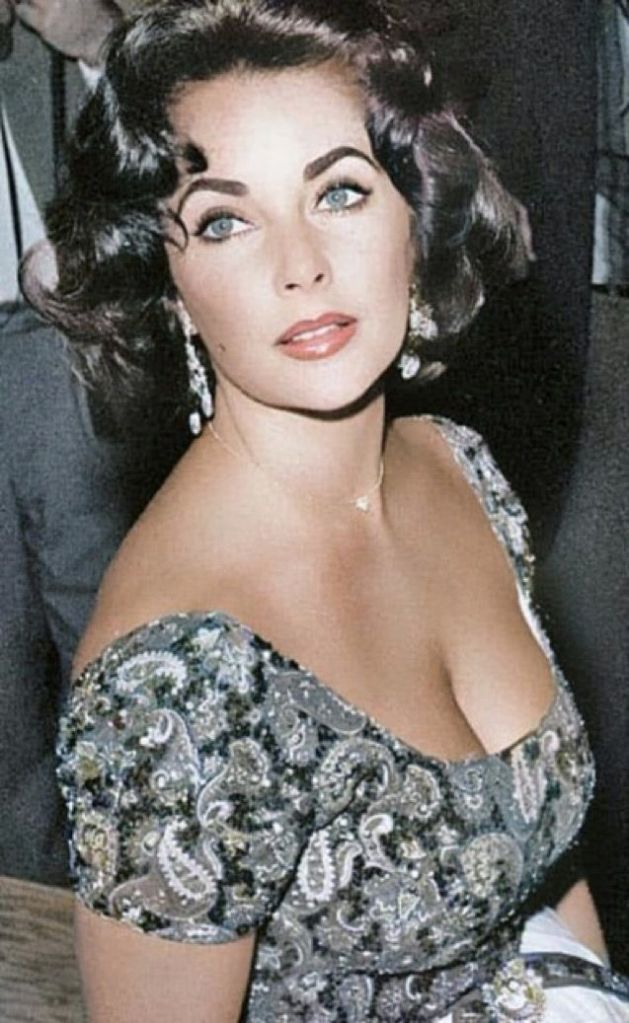
Elizabeth Taylor was born on February 27, 1932, in London, England, to American parents, and rose to prominence as one of the most luminous screen icons of Hollywood’s Golden Age. From her earliest performances in films such as National Velvet (1944), she possessed a rare magnetism—an arresting combination of innocence and intensity that matured into one of cinema’s most legendary presences. Taylor’s beauty became the subject of global fascination, particularly her naturally dark hair, porcelain complexion, and famously rare violet-blue eyes, often enhanced by a double row of eyelashes caused by a genetic mutation (distichiasis). Studios framed her as the embodiment of aristocratic glamour, yet her screen performances—especially in Cat on a Hot Tin Roof (1958) and Butterfield 8 (1960)—proved she was not merely ornamental, but an actress of formidable emotional power.
Taylor’s artistry earned her two Academy Awards for Best Actress, first for Butterfield 8 (1960) and later for Who’s Afraid of Virginia Woolf? (1966), a performance widely regarded as one of the greatest in American cinema. In that latter role, she deliberately shed the polished veneer of conventional beauty, gaining weight and embracing harsh realism to portray Martha, a volatile and wounded wife, demonstrating that her greatness transcended physical appearance. Her peers often remarked that the camera did not simply capture her; it adored her. Director George Stevens once noted that Taylor possessed a face “made for the close-up.” At the same time, media coverage of the mid-twentieth century routinely described her as “the most beautiful woman in the world,” a superlative repeated in magazines across Europe and America.
Beyond the screen, Taylor’s life was inseparable from spectacle. Her eight marriages—including two to actor Richard Burton—fed public fascination, framing her as a romantic heroine whose passions were as brilliant as her jewels. Indeed, her love of extraordinary gemstones became legendary; pieces such as the Taylor-Burton Diamond and the La Peregrina Pearl were not merely accessories but symbols of opulence and self-possession. Yet her identity as an “Ivory Doll” transcends adornment. She represented a Eurocentric ideal of mid-century glamour—radiant skin, symmetrical features, regal bearing—yet she infused that ideal with depth, vulnerability, and unapologetic sensuality. In an era that often reduced women to aesthetic objects, Taylor wielded beauty as power.
Elizabeth Taylor was considered extraordinary not only because she conformed to classical Western standards of loveliness, but because she animated them with intensity, resilience, and emotional authenticity. Her beauty was described as almost mythic—“too much and yet perfect,” wrote contemporary critics—suggesting that she seemed sculpted rather than born. Even as fashions changed, her image endured as a benchmark of cinematic glamour. To call her an Ivory Doll is to acknowledge how she embodied and defined a particular archetype of luminous white femininity in Hollywood’s imagination—untouchable, jeweled, and unforgettable—yet unmistakably human beneath the brilliance.
Angelina Jolie
Sculpted Beauty, Untamed Spirit, and a Face That Redefined Modern Glamour
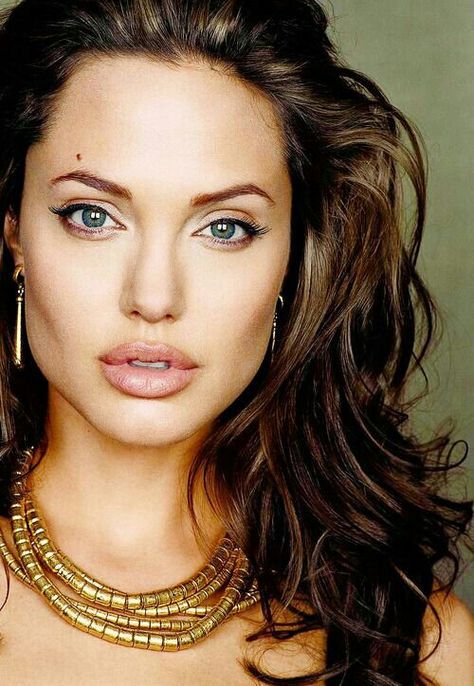
Angelina Jolie was born on June 4, 1975, in Los Angeles, California, the daughter of Academy Award–winning actor Jon Voight and actress Marcheline Bertrand. Emerging in the 1990s with an unconventional intensity, Jolie quickly distinguished herself from traditional Hollywood ingénues. Her breakthrough role in Girl, Interrupted (1999) earned her an Academy Award for Best Supporting Actress, solidifying her reputation as a performer capable of raw psychological depth. Yet it was her portrayal of Lara Croft in Lara Croft: Tomb Raider (2001) that crystallized her global image: bold, statuesque, and unmistakably striking. Her full lips, high cheekbones, luminous pale complexion, and piercing gaze were hailed by media outlets as embodying a contemporary evolution of classical beauty—sensual yet severe, delicate yet formidable.
Jolie’s beauty has often been described as sculptural and otherworldly, evoking Renaissance portraiture infused with modern edge. Critics and fashion editors repeatedly referred to her as one of the most beautiful women in the world, with magazines such as People and Vanity Fair placing her atop annual beauty rankings. Unlike the soft glamour of Old Hollywood, Jolie’s aesthetic projected intensity—an almost feline poise that seemed to challenge the camera rather than merely invite it. Director Clint Eastwood once remarked on her emotional authenticity before the lens, while collaborators noted her ability to command attention in stillness. Her presence in films such as Mr. & Mrs. Smith (2005) and Maleficent (2014) reinforced her image as a woman whose beauty carried an undercurrent of danger and sovereignty.
Her personal life amplified public fascination. High-profile marriages to actors Billy Bob Thornton and Brad Pitt, along with her role as a mother to six children from diverse cultural backgrounds, positioned her at the intersection of glamour and global humanitarianism. Jolie’s extensive advocacy work with the United Nations High Commissioner for Refugees (UNHCR) reframed her public identity beyond aesthetics, aligning beauty with conscience and moral engagement. In 2013, her public disclosure of a preventive double mastectomy due to a BRCA1 gene mutation further reshaped cultural conversations about women’s health, courage, and bodily autonomy—revealing vulnerability beneath the polished exterior.
Angelina Jolie is considered an Ivory Doll not simply because she reflects Western standards of physical allure, but because she embodies a modern archetype of pale, high-fashion elegance fused with intellectual gravity and emotional complexity. Her features—often described as symmetrical to near mathematical precision—became templates in cosmetic and fashion industries, influencing trends in lip augmentation and facial contouring. Yet what renders her extraordinary is the paradox she carries: ethereal beauty combined with visible scars of experience, cinematic grandeur intertwined with humanitarian conviction. She stands as a figure through whom contemporary culture reimagined white femininity—not fragile porcelain, but carved marble—resilient, luminous, and enduring.
Audrey Hepburn
Swan-Necked Elegance, Timeless Grace, and the Poetry of Simplicity
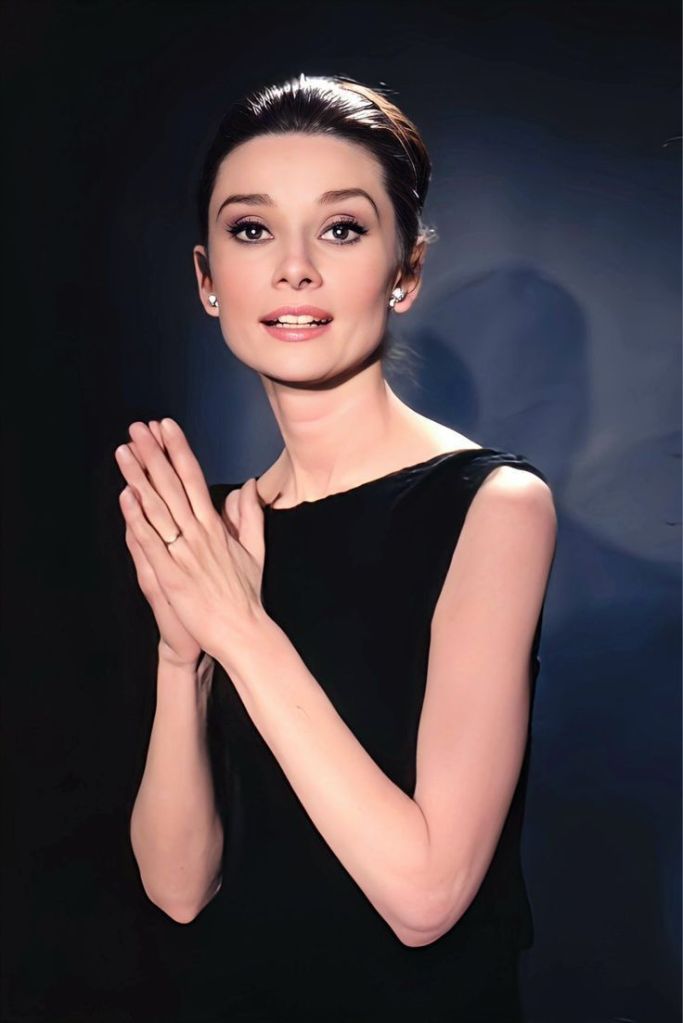
Audrey Hepburn was born on May 4, 1929, in Ixelles, Belgium, and rose to international prominence as one of the most refined and enduring icons of twentieth-century cinema. Emerging from the shadows of World War II Europe, where she endured hardship during the Nazi occupation of the Netherlands, Hepburn brought to Hollywood not only delicacy of frame but resilience of spirit. Her breakthrough performance in Roman Holiday (1953) opposite Gregory Peck earned her the Academy Award for Best Actress, instantly positioning her as a new archetype of feminine beauty—slender, luminous, and disarmingly natural. In an era dominated by voluptuous glamour, Hepburn’s big doe eyes, arched brows, and swan-like neck introduced a minimalist elegance that redefined aesthetic standards.
Her collaboration with designer Hubert de Givenchy further immortalized her image, particularly in Breakfast at Tiffany’s (1961), where the black Givenchy dress became a symbol of chic restraint and cosmopolitan poise. Hepburn’s beauty was frequently described as “elfin” and “ethereal,” marked not by excess but by proportion and grace. Critics emphasized her expressive eyes and gamine silhouette, suggesting that her allure emanated from movement and manner as much as physical symmetry. Unlike the sultry magnetism of contemporaries, Hepburn’s presence conveyed innocence blended with intelligence—a quiet radiance that seemed to glow from within rather than demand attention.
Hepburn’s accolades extended beyond her Academy Award to include multiple BAFTA Awards, a Tony Award, and a posthumous Presidential Medal of Freedom for her humanitarian work. Later in life, she served as a Goodwill Ambassador for UNICEF, drawing upon her childhood experiences of hunger to advocate for vulnerable children worldwide. Public admiration for her beauty thus became inseparable from admiration for her compassion. Writer Dominick Dunne once observed that Hepburn possessed “a face that mirrored kindness,” reinforcing the perception that her loveliness was inseparable from moral refinement. In cultural memory, she remains less a figure of spectacle and more an embodiment of cultivated grace.
Audrey Hepburn is considered an Ivory Doll not merely because she reflected mid-century European ideals of pale, delicate femininity, but because she refined them into something enduring and aspirational. Her extraordinary quality lay in paradox: fragility paired with fortitude, simplicity elevated to haute couture, and understatement transformed into legend. She did not overwhelm the gaze; she invited it gently. In doing so, she expanded Hollywood’s conception of beauty—proving that elegance need not shout to be unforgettable, and that true radiance is as much character as countenance.
Brooke Shields
The Face of the ’80s—Porcelain Beauty, Power Brows, and Cultural Provocation
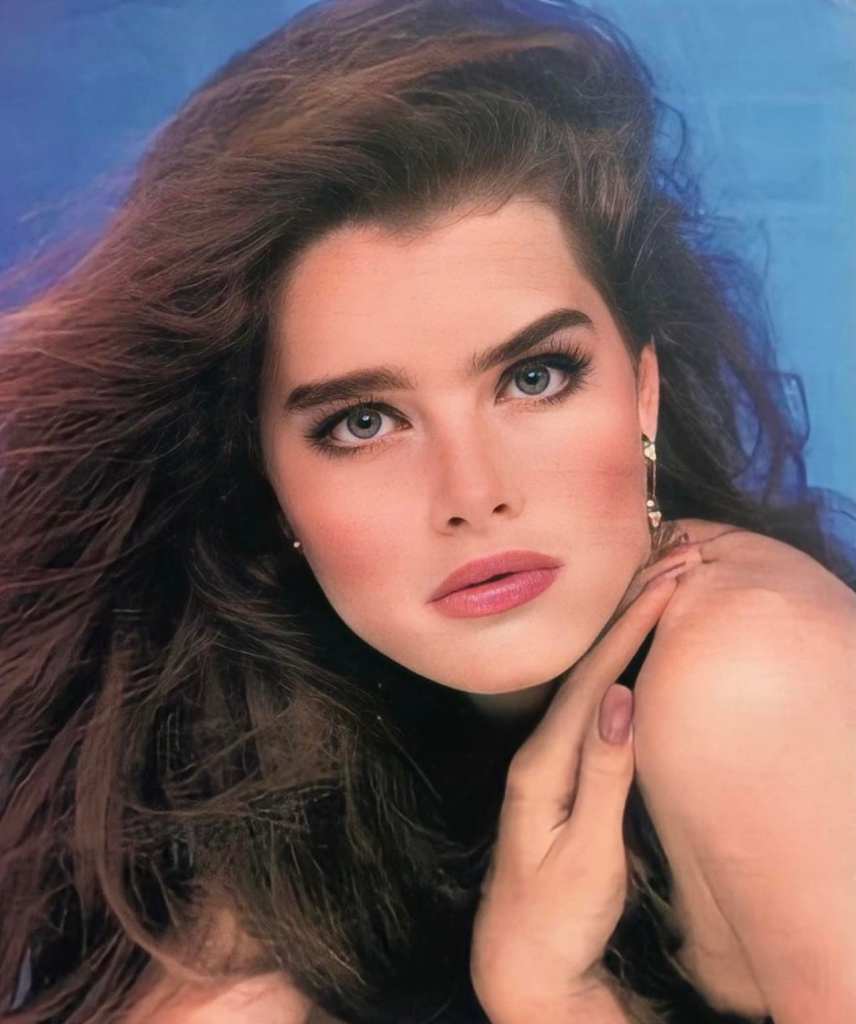
Brooke Shields was born on May 31, 1965, in New York City, and emerged as one of the most recognizable faces of late twentieth-century popular culture. A child model before she was a teenager, Shields entered the public imagination with striking force—tall, poised, and possessed of luminous fair skin framed by famously bold eyebrows that would become her signature. Her early film roles, particularly in Pretty Baby (1978) and The Blue Lagoon (1980), ignited both acclaim and controversy, placing her at the intersection of innocence and sensuality. By the early 1980s, she was widely heralded as “the face of the ’80s,” a supermodel-actress whose image saturated fashion campaigns, magazine covers, and television screens with unprecedented ubiquity.
Her Calvin Klein jeans advertisements—most notably the provocative line, “You want to know what comes between me and my Calvins? Nothing”—became emblematic of the era’s bold commercial aesthetic and cemented her status as a cultural phenomenon. Photographers and designers praised her classical proportions, alabaster complexion, and expressive eyes, often comparing her to Renaissance portraiture infused with modern attitude. Shields’ beauty was described as both wholesome and daring, a duality that allowed her to navigate film, fashion, and Broadway with equal visibility. Unlike fleeting trends, her look defined a decade’s visual language, influencing everything from eyebrow styles to the merging of high fashion with youth culture.
Shields’ career extended beyond modeling into acting and academia; she later graduated from Princeton University, challenging stereotypes that beauty and intellect were mutually exclusive. Public commentary on her appearance frequently emphasized symmetry and camera magnetism—qualities that made her a favorite of photographers such as Richard Avedon and Francesco Scavullo. At the height of her fame, media outlets routinely listed her among the world’s most beautiful women, framing her as an icon of American glamour during a period of cultural excess and stylistic experimentation. Even as public scrutiny surrounded aspects of her early career, Shields’ composure and longevity demonstrated resilience beneath the porcelain exterior.
Brooke Shields is considered an Ivory Doll not simply because she embodied Eurocentric ideals of fair-skinned, classical femininity, but because she became the definitive aesthetic emblem of a transformative decade. Her extraordinary quality lay in her ability to project vulnerability and confidence simultaneously—soft features underscored by an unwavering gaze. As the face of the ’80s, she symbolized youth, luxury, and media saturation in equal measure. In cultural memory, her image remains suspended in time: luminous, sculpted, and unmistakably emblematic of an era when beauty became both brand and battleground.
Yet beauty, in their cases, functioned as more than symmetry and complexion. It became narrative. Taylor’s opulence shimmered with diamonds and drama; Hepburn’s elegance whispered restraint and cultivated grace; Shields’ youthful glamour fused innocence with provocation; Jolie’s angular features suggested power and modern autonomy. Each woman reflected the aesthetic and psychological needs of her generation. Their faces appeared on magazine covers, film posters, couture campaigns, and philanthropic platforms, shaping global conversations about desirability, womanhood, and aspiration. They were described in superlatives—“the most beautiful woman in the world,” “timeless,” “otherworldly,” “iconic”—phrases that reveal how deeply society invests meaning in physical form.
To call them “Ivory Dolls” is not merely to reference complexion, but to identify a particular cultural positioning: elevated, polished, displayed, and often idealized as delicate yet untouchable. The term gestures toward how Western media historically framed pale femininity as the aesthetic benchmark—porcelain skin illuminated under studio lights, features sculpted into classical proportion, bodies adorned in couture and jewels. In this framing, beauty becomes both privilege and burden: a pedestal that amplifies admiration while intensifying scrutiny. These women were celebrated, commodified, protected, and critiqued—sometimes all at once.
Together, they form a gallery of cinematic and cultural memory—figures whose appearances shaped industries and influenced generations of women’s self-perception. Their extraordinary quality was not solely a matter of genetic fortune, but of the interplay among image, performance, media narrative, and public imagination. In studying their beauty, one is not merely studying faces; one is examining how power, race, glamour, commerce, and femininity converge in the construction of iconography. The Ivory Dolls, then, are more than beautiful women—they are mirrors reflecting what their societies chose to exalt, preserve, and remember.
While Elizabeth Taylor, Angelina Jolie, Audrey Hepburn, and Brooke Shields did not always frame their public identities around race-specific discourse, their documented actions—ranging from civil rights support to global humanitarian advocacy and cross-cultural engagement—reflect patterns of inclusion and compassion rather than hostility toward Black people.
References
Brown, S. (2022). Elizabeth Taylor: The grit and glamour of an icon. Lyons Press.
Parish, J. R. (2011). Elizabeth Taylor: Hollywood’s last star. Wiley.
Spoto, D. (1995). A passion for life: The biography of Elizabeth Taylor. HarperCollins.
Turan, K. (2011, March 23). Elizabeth Taylor dies at 79; legendary actress won 2 Oscars. Los Angeles Times.
Biskind, P. (2010). Star: How Warren Beatty seduced America. Simon & Schuster.
Jolie, A. (2013, May 14). My medical choice. The New York Times.
Parish, J. R. (2017). Hollywood beauties: The evolution of screen glamour. McFarland.
UNHCR. (2022). Angelina Jolie’s humanitarian advocacy and global impact. United Nations High Commissioner for Refugees.
Dunne, D. (2004). Too much money. Crown Publishers.
Hepburn, S. (2015). Audrey Hepburn: An elegant spirit. Atria Books.
Spoto, D. (2006). Enchantment: The life of Audrey Hepburn. Harmony Books.
United Nations Children’s Fund (UNICEF). (1993). Audrey Hepburn’s humanitarian legacy. United Nations.
Shields, B. (2014). There was a little girl: The real story of my mother and me. Dutton.
Shields, B. (2021). Brooke Shields is not allowed to get old: Thoughts on aging as a woman. Flatiron Books.
Trebay, G. (2021, November 8). Brooke Shields on aging, beauty and survival. The New York Times.
Vogue Archive. (1980–1985). Brooke Shields cover features and fashion editorials. Condé Nast.
Discover more from THE BROWN GIRL DILEMMA
Subscribe to get the latest posts sent to your email.
 THE BROWN GIRL DILEMMA