
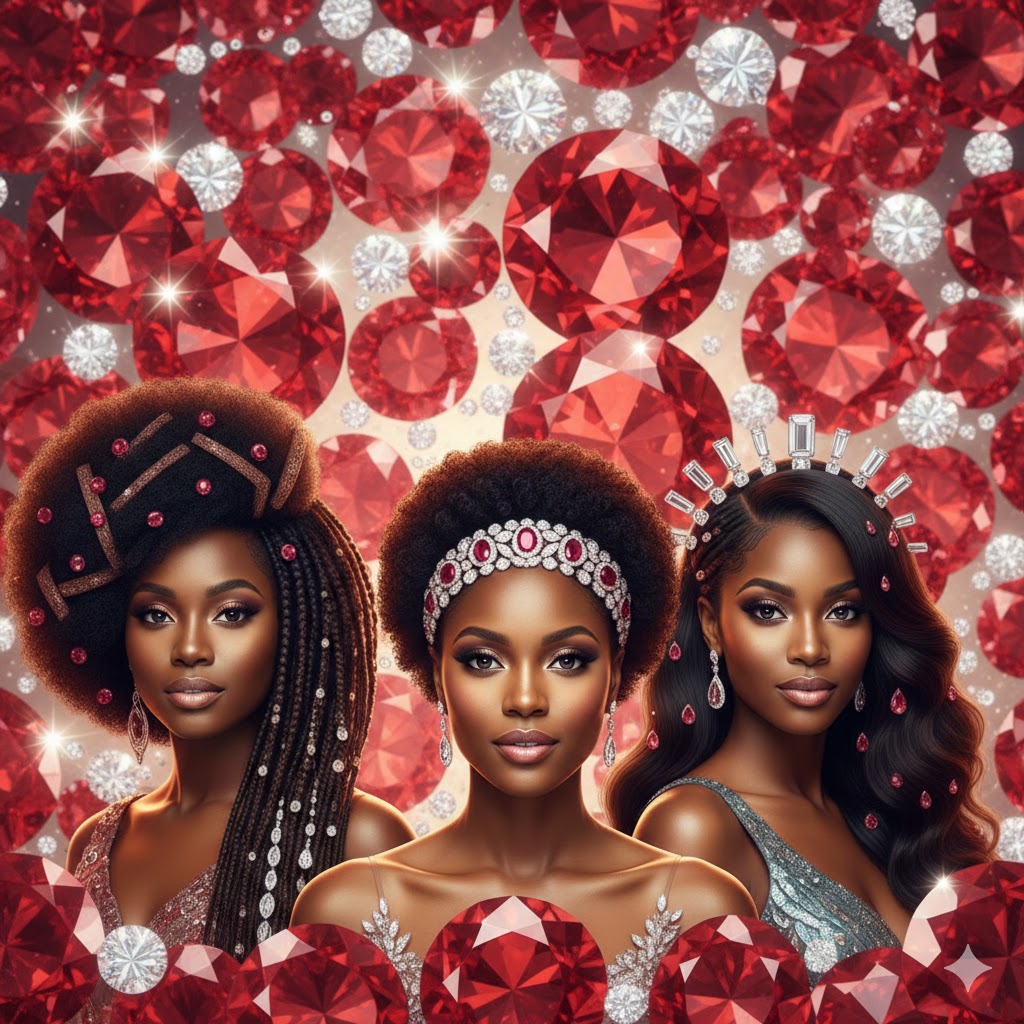
Brown girls have long existed at the intersection of visibility and erasure, seen when convenient yet ignored when their voices disrupt dominant narratives. From classrooms to media, from pulpits to policy, their presence has often been minimized while their labor, creativity, and resilience are consumed. This contradiction has produced a quiet harm, teaching many brown girls that to be valued they must first be validated by systems that were never built with them in mind.
Historically, the devaluation of brown girls is inseparable from the legacy of slavery and colonialism, where Black female bodies were reduced to commodities rather than recognized as bearers of intellect, spirit, and humanity. Enslaved African women were forced into roles that denied their femininity while simultaneously exploiting it, creating a distorted image that still echoes today. These inherited myths continue to shape how brown girls are treated, disciplined, and dismissed in modern society.
Colorism further complicates this reality, establishing a hierarchy within Blackness itself that privileges proximity to Eurocentric features. Brown girls often find themselves navigating a world that praises their culture while policing their skin tone, hair texture, and facial features. Research has shown that darker-skinned women face harsher discipline in schools, reduced romantic desirability in media, and fewer economic opportunities, reinforcing a message of disposability.
In media representation, brown girls are frequently absent or misrepresented. When they do appear, they are often cast in roles defined by struggle, aggression, or hypersexualization rather than joy, innocence, and complexity. This limited imagery narrows the public imagination and subtly instructs brown girls on how society expects them to exist.
Psychologically, invisibility functions as a form of trauma. When young girls do not see themselves affirmed, they internalize silence as survival. Studies in racial identity development show that chronic invalidation can lead to diminished self-esteem, anxiety, and a fractured sense of worth, especially during adolescence.
Yet despite these forces, brown girls have always resisted erasure. From the wisdom of enslaved women who preserved culture through oral tradition to modern scholars, activists, and artists, brown girls have continuously asserted their humanity. Their resistance has often been quiet but enduring, rooted in community, spirituality, and ancestral memory.
Biblically, invisibility has never equaled insignificance. Scripture repeatedly affirms that God sees those whom society overlooks. Hagar, a Black woman in bondage, is the first person in the Bible to name God, calling Him “El Roi,” the God who sees. Her story stands as divine confirmation that marginalized women are not unseen by heaven.
The Psalmist’s declaration that humanity is “fearfully and wonderfully made” directly challenges narratives that diminish brown girls. This scripture is not conditional upon skin tone, social status, or cultural acceptance. It affirms intrinsic worth bestowed by God, not granted by society.
Song of Solomon’s proclamation, “I am black, but comely,” confronts ancient and modern beauty hierarchies. It boldly asserts that Blackness and beauty are not opposites but companions. For brown girls, this verse offers both validation and resistance against internalized shame.
Educational systems have often failed brown girls by misinterpreting their confidence as defiance and their vulnerability as weakness. Studies reveal that Black girls are disciplined at disproportionate rates, criminalizing their childhood and accelerating adultification. This systemic bias communicates that their innocence is less worthy of protection.
Within faith spaces, brown girls are sometimes celebrated for their service but silenced in leadership. Their bodies are policed while their spiritual gifts are overlooked. True liberation within the church requires acknowledging how theology has been weaponized to control rather than affirm Black womanhood.
Despite these barriers, brown girls continue to redefine value on their own terms. Through self-love movements, natural hair reclamation, and intellectual production, they are dismantling imposed hierarchies. This reclamation is not vanity but survival, a refusal to accept inherited lies.
Womanist theology reminds us that the experiences of Black women are not peripheral to God’s story but central to understanding justice, redemption, and love. When brown girls speak their truth, they reveal dimensions of faith that challenge both racism and sexism simultaneously.
Invisibility thrives in silence, but healing begins with naming harm. When brown girls are encouraged to tell their stories, write their narratives, and honor their emotions, they reclaim agency. Storytelling becomes a sacred act of restoration.
Community plays a vital role in affirming value. Intergenerational mentorship, sisterhood, and cultural affirmation counteract isolation. When brown girls are surrounded by those who see them fully, their confidence flourishes.
Economically, recognizing the value of brown girls means investing in their education, creativity, and leadership. Equity is not charity; it is justice. Societies that uplift marginalized girls create stronger, healthier futures for all.
Romantically and relationally, brown girls deserve to be chosen without condition. They are not consolation prizes or aesthetic trends. They are worthy of love that honors their minds, bodies, and spirits without comparison.
The reclaiming of beauty is not about competing with Eurocentric standards but dismantling the need for them altogether. Brown girls are not seeking inclusion; they are asserting authorship over their own image.
Ultimately, invisibility is a lie sustained by systems, not a reflection of truth. Brown girls have always been invaluable, whether acknowledged or not. Their worth predates oppression and outlives it.
To affirm brown girls is to participate in restoration. It is to declare that what was once ignored is now honored, what was dismissed is now celebrated, and what was undervalued is now recognized as essential. Brown girls are not invisible. They are invaluable, divinely seen, and historically significant.
References
Banks, I. (2015). Hair matters: Beauty, power, and Black women’s consciousness. New York, NY: New York University Press.
Collins, P. H. (2000). Black feminist thought: Knowledge, consciousness, and the politics of empowerment (2nd ed.). New York, NY: Routledge.
Craig, M. L. (2002). Ain’t I a beauty queen? Black women, beauty, and the politics of race. Oxford, UK: Oxford University Press.
Davis, A. Y. (1981). Women, race & class. New York, NY: Vintage Books.
Hunter, M. (2007). The persistent problem of colorism: Skin tone, status, and inequality. Sociology Compass, 1(1), 237–254. https://doi.org/10.1111/j.1751-9020.2007.00006.x
Hunter, M. (2011). Buying racial capital: Skin bleaching and cosmetic surgery in a globalized world. The Journal of Pan African Studies, 4(4), 142–164.
hooks, b. (1992). Black looks: Race and representation. Boston, MA: South End Press.
Russell, K., Wilson, M., & Hall, R. (1992). The color complex: The politics of skin color among African Americans. New York, NY: Anchor Books.
Walker, A. (1983). In search of our mothers’ gardens: Womanist prose. San Diego, CA: Harcourt Brace Jovanovich.
Williams, D. S. (1993). Sisters in the wilderness: The challenge of womanist God-talk. Maryknoll, NY: Orbis Books.
Townes, E. M. (2006). Womanist ethics and the cultural production of evil. New York, NY: Palgrave Macmillan.
Biblical References (KJV)
The Holy Bible, King James Version.
Psalm 139:14 – “I will praise thee; for I am fearfully and wonderfully made…”
Genesis 1:27 – “So God created man in his own image…”
Song of Solomon 1:5 – “I am black, but comely…”
Isaiah 43:4 – “Since thou wast precious in my sight, thou hast been honourable…”
1 Samuel 16:7 – “For the LORD seeth not as man seeth…”
Discover more from THE BROWN GIRL DILEMMA
Subscribe to get the latest posts sent to your email.
 THE BROWN GIRL DILEMMA