
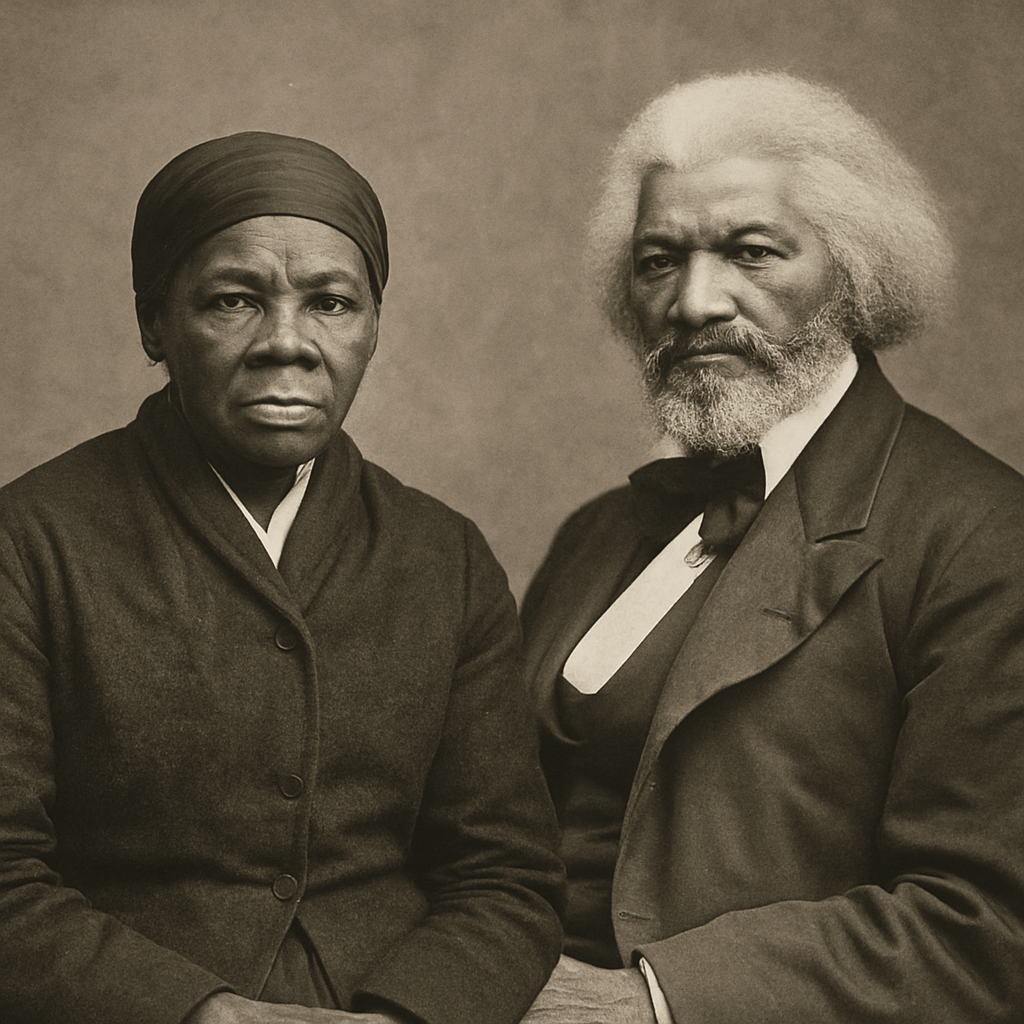
Harriet Tubman and Frederick K.C. Douglass remain towering figures in the memory of the enslaved, the emancipated, and the freedom-seeking. Their lives, though emerging from the same soil of Maryland slavery, unfolded into two complementary wings of liberation—one leading people through the hidden corridors of the night, the other leading a nation through the piercing clarity of truth. Their testimonies stand as a sacred record, binding faith, intellect, and courage into an enduring legacy.
Harriet Tubman was born Araminta Ross around 1822 on the Brodess plantation in Dorchester County, Maryland. Her parents, Benjamin Ross and Harriet “Rit” Green, were enslaved but deeply spiritual, planting in her a sense of identity that no system could break. Tubman was one of nine children, and she experienced the trauma of family separation early, watching her sisters being sold away. This fear of fragmentation shaped her later work—freedom meant nothing unless her family could share it.
Frederick K.C. Douglass entered the world in February 1818 as Frederick Augustus Washington Bailey. He was born in Talbot County, Maryland, to Harriet Bailey, an enslaved woman, and likely to a white father whose identity he was never officially told. He saw his mother only a handful of times before her death, forming a childhood built on absence and longing. These early wounds sharpened his understanding of slavery’s psychological violence.
Tubman married John Tubman, a free Black man, in 1844. Their marriage was strained—her desire for freedom clashed with his fear of risking his own status. When she escaped in 1849, he refused to join her. Later, she remarried Nelson Davis, a Civil War veteran, with whom she shared a quiet companionship in her later years. Though Tubman had no biological children, she adopted a daughter, Gertie, whom she raised with fierce devotion.
Douglass married Anna Murray, a free Black woman from Baltimore who played a crucial role in his escape. She saved money, supplied clothing, and believed in his potential long before the world acknowledged it. Together, they had five children: Rosetta, Lewis Henry, Frederick Jr., Charles Remond, and Annie (who died young). After Anna’s passing in 1882, Douglass later married Helen Pitts, a white abolitionist and intellectual, in a union that stirred controversy but reflected his unwavering belief in human equality.
Harriet Tubman’s education came not from books but from the wilderness, the stars, and the whispers of enslaved elders. She mastered the marshlands, the seasonal rhythms, herbal medicine, and spiritual discernment. Her literacy was in intuition, geography, and divine communication—skills that would later guide hundreds to freedom. Her “visions,” often linked to the head injury she suffered as a teen, became her compass in moments when logic alone could not ensure survival.
Douglass’s education was both miraculous and dangerous. Sophia Auld, the wife of his enslaver, began teaching him the alphabet before being ordered to stop. That prohibition ignited his hunger for knowledge. Douglass secretly traded bread for reading lessons among white boys and devoured abolitionist newspapers. Literacy became his key to mental emancipation, and later, his primary weapon in dismantling slavery’s ideological chains.
Harriet Tubman’s work on the Underground Railroad made her the most successful conductor in its history. The Railroad was not a literal railway but a clandestine network of safe houses, coded messages, abolitionist allies, free Black communities, and courageous fugitives. Tubman led at least thirteen missions into slave territory, rescuing family members, neighbors, and strangers. Her methods were sophisticated: timing journeys during winter when nights were long, using the North Star as direction, employing disguises, carrying a pistol for protection, and trusting her spiritual instincts. She never lost a single passenger.
Frederick K.C. Douglass supported the Underground Railroad from a different position. His home in Rochester, New York, became a major station, sheltering more than 400 fugitive slaves. His newspaper, The North Star, spread vital information about abolitionist efforts, and his speeches raised funds for escape missions. While Tubman moved bodies through forests and swamps, Douglass moved minds across continents.
Tubman’s Civil War contributions remain some of the most historically overlooked achievements of any American figure. She served as a nurse, spy, scout, and strategist for the Union Army. Her greatest achievement—the Combahee River Raid of 1863—freed more than 700 enslaved people in a coordinated military operation she helped plan and lead. Tubman became the first woman in U.S. history to command a military assault.
Douglass, too, played a critical role during the war. He met with Abraham Lincoln multiple times, urging equal pay for Black soldiers, fair treatment for the United States Colored Troops, and full citizenship for freedmen. His sons Lewis and Charles served in the 54th Massachusetts Regiment, embodying the family’s multi-generational commitment to liberation.
Tubman received honors in her later years, though far fewer than she deserved. She became a symbol of heroism, receiving recognition from women’s suffrage leaders like Susan B. Anthony and from Black communities nationwide. Today, schools, battleships, monuments, and proposed currency designs bear her name. Her later life was devoted to community building, including establishing the Harriet Tubman Home for the Aged in Auburn, New York.
Douglass’s list of awards and honors is extensive. He became U.S. Marshal for the District of Columbia, Recorder of Deeds, and U.S. Minister Resident to Haiti. Colleges and cities honored him, and international leaders sought his counsel. He was one of the most photographed men of the 19th century—a deliberate strategy to combat racist imagery.
Harriet Tubman’s final years were marked by illness, poverty, and continued generosity. She died in 1913 surrounded by friends and family, reportedly saying, “I go to prepare a place for you.” Frederick Douglass died in 1895 after attending a women’s rights meeting, his voice still committed to justice until his last breath.
Together, these two figures reveal the full architecture of liberation: Tubman’s embodied courage and Douglass’s intellectual fire. One delivered people from bondage by the movement of her feet, the other by the movement of his words. One freed the body; the other freed the mind. Both shattered the idea that enslaved people were powerless.
Their stories—intertwined yet unique—remain essential chapters in the history of Black resistance. Through them, we learn that freedom is neither a gift nor an accident; it is a choice, a strategy, and a sacrifice. The Slave Files preserve their testimony so that future generations might understand the cost of freedom and the magnitude of their courage.
Harriet Tubman and Frederick K.C. Douglass stand as two of the most luminous figures in the long night of American slavery. Their lives, though shaped by brutality, testify to a divine strength that transcended chains, ignorance, and fear. Together, they represent a dual legacy—one of action and one of articulation; one who liberated through movement, and one who liberated through speech. Their stories continue to ignite the moral imagination of generations seeking freedom.
Tubman and Douglass were born into the same system but carved remarkably different paths. Tubman, born Araminta Ross in Maryland, would grow into the most revered conductor of the Underground Railroad. Douglass, born Frederick Bailey, would rise from the plantations of Maryland’s Eastern Shore to become one of the greatest orators and writers in American history. Though shaped by the same soil, they blossomed into distinct instruments of liberation.
Harriet Tubman’s early years were marked by violence that left permanent scars. A blow to her head from a heavy iron weight resulted in seizures, visions, and intense headaches that accompanied her throughout her life. Yet Tubman came to understand these visions as spiritual guidance, believing God was directing her path. Her faith became her compass as she navigated both literal and spiritual darkness.
Frederick Douglass, meanwhile, discovered liberation through literacy. After being taught the alphabet by Sophia Auld, he continued learning in secret, understanding that education was the gateway to freedom. “Once you learn to read, you will be forever free,” he later wrote—words that encapsulate the transformative power of knowledge for the enslaved.
Tubman’s escape from slavery in 1849 marked the beginning of her life’s mission. She could have settled into anonymity in the North, as many fugitives did. Instead, she returned repeatedly to the South, risking recapture, torture, and death. Her journeys rescued nearly seventy people directly, and her guidance influenced hundreds more. Her courage was unmatched, her instincts uncanny, and her leadership unwavering.
Douglass’s escape in 1838 was a carefully executed strategy involving forged documents and borrowed courage. Once free, he quickly became a leading voice in abolitionist circles. His autobiography, Narrative of the Life of Frederick Douglass, published in 1845, shocked the nation. Readers immediately recognized that slavery was not merely a political issue—it was a moral catastrophe.
Despite their different approaches, Tubman and Douglass shared a deep respect for each other. Douglass once wrote to her, “The difference between us is very marked… I have wrought in the day—you in the night.” He acknowledged that while his advocacy was praised openly, Tubman’s was carried out in shadows, under threat of death. In his eyes, Tubman’s work demanded a bravery far beyond his own.
Tubman’s service extended beyond the Underground Railroad. During the Civil War, she became a scout, nurse, cook, and eventually the first woman to lead a military expedition in U.S. history. Her Combahee River Raid freed more than seven hundred enslaved people in a single night—an operation still studied in military strategy.
Douglass, on the other hand, used rhetoric to shape national consciousness. He advised presidents, debated intellectuals, and championed voting rights, education, and equality. Lincoln consulted him concerning the arming of Black soldiers, recognizing Douglass’s influence among African Americans. His speeches thundered across the country, challenging the hypocrisy of a nation founded on liberty yet built on bondage.
The spiritual dimension of both leaders cannot be overlooked. Tubman believed God spoke to her, guiding her steps and warning her of danger. Douglass grounded his activism in a Christian critique of American hypocrisy, distinguishing between the Christianity of Christ and the corrupted Christianity of slaveholders. Both found faith to be a weapon against injustice.
Though they survived slavery, neither escaped its long shadow. Tubman lived in poverty for much of her life, often giving away what little she had to others. Douglass faced threats, racially motivated attacks, and the emotional scars of family separation. Yet both persisted, refusing to allow suffering to define them.
Tubman’s commitment to her people endured long after the war. She established a home for elderly and indigent African Americans, understanding that freedom required more than legal emancipation—it required community care. Her final years were spent nurturing the very people she once risked her life to save.
Douglass continued fighting until his last breath. His speeches on Reconstruction, citizenship, and dignity shaped African American political thought for decades. He served in government roles, traveled internationally, and remained a fierce critic of injustice until his death in 1895.
Together, Tubman and Douglass embodied a complete portrait of resistance: Tubman representing movement, Douglass representing message; Tubman freeing bodies, Douglass freeing minds. Both understood that freedom required action and truth, courage and articulation, strategy and spirit.
Their stories remind us that slavery sought to erase Black humanity, but could not extinguish Black brilliance. The Slave Files record not a narrative of defeat but of victory—testimonies of those who refused to remain silent, still, or subjugated. Their lives demonstrate that even in the darkest systems, God raises deliverers.
Today, Tubman and Douglass remain symbols of what is possible when the oppressed rise with purpose. Their journeys continue to inspire activists, scholars, faith leaders, and communities across the world. The story of Black liberation is incomplete without their names etched boldly into its chapters.
Harriet Tubman and Frederick K.C. Douglass challenged a nation, awakened a conscience, and altered the trajectory of history. Their legacy is a call to action—a reminder that justice is never given, only demanded. Through them, the world learns that freedom is both a birthright and a battle.
Their stories endure not because of myth, but because of truth: these were ordinary individuals who made extraordinary choices. The Slave Files preserve their witness, ensuring that every generation understands the cost of liberation and the power of a determined spirit.
References
Blight, D. W. (2018). Frederick Douglass: Prophet of freedom. Simon & Schuster.
Bradford, S. (1869). Harriet Tubman: The Moses of her people. Lockwood & Co.
Clinton, C. (2004). Harriet Tubman: The road to freedom. Little, Brown and Company.
Douglass, F. (1845). Narrative of the life of Frederick Douglass, an American slave. Anti-Slavery Office.
Humez, J. (2003). Harriet Tubman: The life and the life stories. University of Wisconsin Press.
Larson, K. C. (2004). Bound for the promised land: Harriet Tubman, portrait of an American hero. Ballantine Books.
McFeely, W. S. (1991). Frederick Douglass. W. W. Norton.
Nell, W. C. (1855). The colored patriots of the American Revolution. Robert F. Wallcut.
Sterling, D. (Ed.). (1997). We are your sisters: Black women in the nineteenth century. W.W. Norton.
Taylor, Y. (2017). Remaking Black power: How Black women transformed an era. University of North Carolina Press.
Discover more from THE BROWN GIRL DILEMMA
Subscribe to get the latest posts sent to your email.
 THE BROWN GIRL DILEMMA