
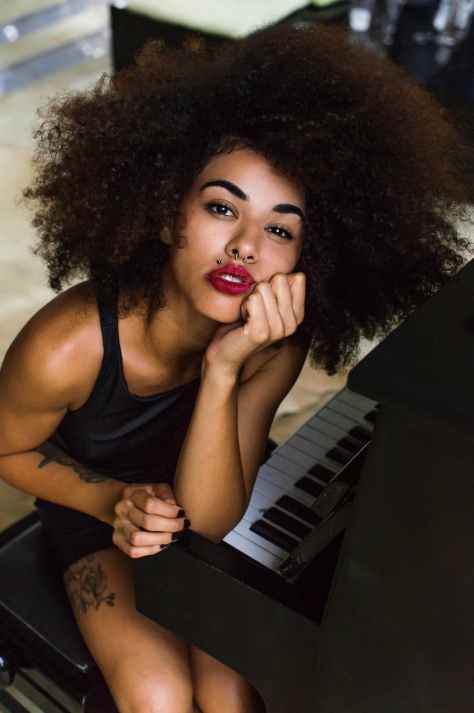
The question “Why don’t you do something with your hair?” carries weight far beyond casual conversation. It reflects the long, complicated history of hair politics within the Black community, where hair is not merely aesthetic but deeply tied to identity, culture, and social status. The question assumes that the natural hair that grows out of a Black woman’s scalp is insufficient, needing alteration to be considered beautiful or presentable. This dilemma plays out daily in salons, workplaces, and even among friends, revealing the enduring tension between assimilation and authenticity.
Hair politics in the Black community have roots that trace back to pre-colonial Africa. African hairstyles once symbolized tribe, social rank, marital status, and even spiritual beliefs (Byrd & Tharps, 2014). Intricate braids, twists, and natural textures were celebrated as markers of identity and belonging. This changed dramatically during the transatlantic slave trade. Enslaved Africans were often forced to shave their heads, stripping them of cultural identity and dignity (White & White, 1998). This dehumanizing act laid the groundwork for centuries of stigma against African hair textures.
During slavery and later segregation, Eurocentric beauty standards dominated. Straight hair was viewed as a marker of respectability and proximity to whiteness. Many Black women began straightening their hair as a means of survival, using hot combs and later chemical relaxers to fit into white society’s expectations (Rooks, 1996). This survival strategy was both empowering—opening doors to employment and social acceptance—and damaging, as it subtly communicated that natural hair was unkempt or undesirable.
This tension birthed the concept of “good hair” versus “bad hair.” “Good hair” was typically defined as straighter, looser, and more European-like, while “bad hair” referred to tightly coiled, kinky textures. This language continues to shape how Black girls grow up viewing themselves. The woman in the store who questioned another’s natural fro echoed centuries of conditioning that privileges one texture over another.
Biblically, this judgment contradicts the affirmation of divine creation. Psalm 139:14 (KJV) declares, “I will praise thee; for I am fearfully and wonderfully made: marvellous are thy works.” If God made hair textures diverse, then natural Black hair is good by design. The cultural insistence on altering hair to be acceptable reflects a deeper issue of internalized oppression rather than divine truth.
Hair also became a political statement during the Civil Rights and Black Power movements of the 1960s and 1970s. The Afro emerged as a symbol of pride, rebellion, and resistance against white supremacy. To wear one’s hair in its natural state became an act of defiance and self-acceptance. Angela Davis famously wore her iconic Afro as both a personal choice and a political statement, making natural hair synonymous with the fight for liberation (Davis, 1981).
However, as mainstream culture commodified Black style, the natural hair movement lost some of its radical edge. The emergence of weaves, wigs, and chemical relaxers in the 1980s and 1990s introduced new standards of glamour and professionalism. While these styles offered versatility and creative expression, they also reinforced the idea that natural hair was only acceptable if controlled or hidden.
Celebrities have weighed in on this hair dilemma, often sparking debate. Viola Davis removed her wig on the hit show How to Get Away With Murder in a powerful scene that revealed her natural hair, stating in interviews that she wanted to normalize textured hair on television (Dockterman, 2014). Solange Knowles has also been vocal about the politics of natural hair, penning the song “Don’t Touch My Hair” as an anthem of autonomy and identity.
On the other side, some celebrities have been criticized for perpetuating Eurocentric beauty ideals. Rapper Lil’ Kim and others who have dramatically lightened their skin and straightened their hair have been accused of reflecting the deep scars of colorism and texturism. These choices are not simply personal but political, given the influence celebrities have on shaping beauty standards.
Workplace politics also play a major role in the natural-versus-straight hair conversation. For years, natural hairstyles such as locs, braids, and twists were deemed “unprofessional” in many corporate environments. It wasn’t until the passing of laws like the CROWN Act (2019) that discrimination against natural hairstyles began to be legally challenged in several U.S. states. This shows that hair policing is not just cultural but institutional.
The debate over natural hair versus weaves or wigs is complex. On one hand, weaves allow Black women to experiment with style, color, and length without damaging their natural hair. On the other, they can become a crutch if they are used to hide self-hatred or avoid confronting the stigma against natural textures. The key issue is not the style chosen but the motivation behind it—whether it flows from freedom or from shame.
Mentally, constant scrutiny over hair can lead to stress and self-esteem issues. Black girls as young as five report feeling pressured to straighten their hair for special occasions or school pictures (Opie & Phillips, 2015). This teaches them early that their natural state is less acceptable, planting seeds of insecurity that can take years to unlearn.
Spiritually, the church can play a role in affirming natural hair. Unfortunately, some church communities have perpetuated respectability politics by favoring women with straightened hair or wigs, especially in leadership roles. This contradicts the biblical principle in 1 Peter 3:3-4 (KJV), which states that beauty should not merely be about “plaiting the hair” or outward adornment but about “the hidden man of the heart.” This verse calls believers to focus on character rather than conformity to beauty standards.
The natural hair movement of the 21st century has made significant strides in reversing stigma. Social media platforms like Instagram and YouTube have created spaces for Black women to share tips, tutorials, and encouragement for embracing natural curls and coils. This digital sisterhood has birthed a new generation of women who proudly wear their afros, twist-outs, and locs as declarations of self-love.
Nevertheless, the pressure to conform to a certain standard of natural hair perfection—“curl envy”—has emerged as a new form of hair politics. Women with looser curl patterns are often celebrated more in natural hair campaigns than those with tighter coils, revealing that even within the movement, hierarchies still exist.
The Politics, Pain, and Power of Black Hair
I was standing in line at a neighborhood store when I overheard two women talking. One wore a sleek weave, carefully laid edges, and perfectly straightened strands; the other rocked a short, natural fro. With a laugh, the first woman asked, “Girl, why don’t you do something with your hair?” The second woman smiled politely, but her face betrayed the familiar sting that so many Black women know too well. That small exchange speaks volumes about the history and politics of Black hair — a history that stretches from the villages of West Africa to the plantations of the Americas, from the barbershops and beauty salons of the Jim Crow era to the hashtags and viral videos of today.
Hair has never been just hair for Black people. In pre-colonial Africa, hair was identity. Styles communicated tribe, social status, fertility, and even spiritual meaning (Byrd & Tharps, 2014). To cut someone’s hair was to humiliate them, stripping away dignity. Enslavers understood this, which is why many Africans brought to the Americas had their heads forcibly shaved, severing a crucial connection to their homeland (White & White, 1998). This trauma planted the seed for centuries of stigma against African textures.
In America, Black hair became a site of both survival and rebellion. For many, straightening hair was a way to gain access to jobs, education, and respectability in a white-dominated society (Rooks, 1996). The hot comb, famously popularized by Madam C.J. Walker, was both a tool of empowerment and a symbol of assimilation. “My grandmother told me that straightening her hair helped her get her first job as a teacher,” said Sharon, 62, in an interview. “But she also told me she always felt like she was wearing a mask.”
The language of “good hair” versus “bad hair” emerged from these survival tactics. “Good hair” was associated with looser, straighter textures — often linked to mixed ancestry — while “bad hair” was used to describe kinky, coily textures. “I grew up in the 90s, and my aunties would sigh whenever I wore my hair natural,” said Angela, 33. “They would say, ‘We gotta do something with this nappy mess.’ It made me feel like who I was naturally was a problem to be fixed.”
Biblically, this tension challenges what Scripture teaches about God’s creation. Genesis 1:31 (KJV) declares, “And God saw every thing that he had made, and, behold, it was very good.” If every hair texture is created by God, then none can be deemed “bad.” Psalm 139:14 reminds us that we are “fearfully and wonderfully made.” To degrade natural hair is to deny the Creator’s artistry.
The Civil Rights and Black Power era redefined hair politics. The Afro became a crown of pride and a political statement. “When I wear my Afro, I am making a statement that I am Black and proud,” Angela Davis wrote (Davis, 1981). To wear one’s hair naturally was to reject assimilation and embrace African identity. This was a time when hair became activism — the body itself was a protest sign.
But as the decades passed, relaxers, weaves, and wigs became mainstream again. For some, this was a matter of convenience and creative expression. For others, it was a return to old pressures to conform. “I love my weave because I can switch up my look,” said Monique, 27, during a focus group. “But I also hate that people assume I don’t love myself when I wear it. It’s not that — I just like the versatility.”
The natural hair movement of the 2010s reignited the call for authenticity. YouTube vloggers and Instagram influencers created a renaissance of tutorials, hair care tips, and motivational content celebrating curls, coils, and kinks. Yet, even within the natural hair community, hierarchies emerged. Looser curl patterns (3A–3C) were celebrated more prominently than tightly coiled textures (4B–4C), leading to what some call “texturism” (Robinson, 2011).
Celebrities have weighed in powerfully on the conversation. Viola Davis’s decision to remove her wig on How to Get Away with Murder was more than just a TV moment — it was a cultural reset. “I wanted to humanize her,” Davis explained. “And part of that is letting her be who she really is — natural hair and all” (Dockterman, 2014). Solange Knowles, in her song “Don’t Touch My Hair,” transformed her experience of unwanted hair-policing into an anthem of bodily autonomy.
Despite these victories, discrimination remains a reality. Studies show that Black women with natural hairstyles are often rated as less professional or less competent in corporate settings (Opie & Phillips, 2015). The passage of the CROWN Act (2019) in multiple U.S. states is a step toward protecting Black hair from workplace discrimination — but the cultural bias runs deep.
The question “Why don’t you do something with your hair?” carries an assumption: that natural hair is undone, messy, or unacceptable. But natural hair is done the moment it grows from the scalp. It does not need fixing to be valid. Romans 12:2 (KJV) reminds us, “Be not conformed to this world: but be ye transformed by the renewing of your mind.” Breaking free from the belief that straight is the only acceptable form is a mental and spiritual renewal.
Healing hair trauma requires unlearning generations of internalized shame. “I had to stop calling my daughter’s hair ‘difficult,’” said Candace, 40. “Now I tell her it’s beautiful, full, and strong — just like her.” This kind of language shift is revolutionary. It teaches young girls that their hair is a source of pride, not a burden.
There is also space for freedom of choice. Some women wear wigs or relaxers not out of shame but for self-expression. The issue is not the style but the root motivation. Galatians 5:1 (KJV) declares, “Stand fast therefore in the liberty wherewith Christ hath made us free.” Freedom in Christ includes freedom from the bondage of beauty standards — whether those standards push toward assimilation or prescribe a rigid idea of “natural purity.”
The politics of hair also affect men, though they are often left out of the conversation. Dreadlocks, cornrows, and afros on Black men have been criminalized, labeled as unkempt or threatening. Celebrities like J. Cole and Bob Marley used their hair as political and spiritual statements, reminding the world that natural hair is not just style but identity.
Moving forward, education is key. Schools, churches, and community spaces must normalize the full spectrum of Black hair. Representation in media matters — children need to see characters who look like them wearing braids, locs, fros, and curls with confidence and beauty.
Ultimately, the woman in the store who questioned the natural fro was voicing a generational script — one we must now rewrite. By embracing natural hair as inherently good, by affirming every style chosen freely, and by dismantling the good-hair/bad-hair dichotomy, the Black community can heal from centuries of hair trauma.
In the end, the question is no longer “Why don’t you do something with your hair?” but “What will we do with the legacy of hair politics?” Will we pass down shame or pass down pride? Will we perpetuate Eurocentric hierarchies or celebrate the God-given diversity of our crowns? The choice is ours — and it is time to choose freedom.
Healing from hair politics requires both internal and communal work. Internally, Black women must embrace that their hair—whatever its texture—is inherently good and worthy of care. Communally, there must be a shift in language, moving away from “good hair” and “bad hair” to affirming the full spectrum of textures as beautiful.
Parents play a critical role in shaping hair identity. Teaching young girls to love their hair early on, letting them see positive representations of their texture in books, movies, and social media, helps inoculate them against the pressures they will face. Such affirmation can prevent the painful moment when a stranger or even a friend asks, “Why don’t you do something with your hair?”
In conclusion, hair politics in the Black community are both a burden and an opportunity. The burden lies in centuries of stigma and division, but the opportunity lies in reclaiming hair as a site of freedom, creativity, and identity. When a woman chooses a fro, a weave, braids, or a bald head from a place of self-love, she resists the narrative that her natural state is not enough. By rooting our worth in biblical truth and affirming the diversity of Black beauty, the Black community can end the cycle of judgment and instead celebrate the crown that God has given.
References
- Byrd, A., & Tharps, L. (2014). Hair story: Untangling the roots of Black hair in America (2nd ed.). St. Martin’s Press.
- Davis, A. (1981). Women, race, & class. Vintage Books.
- Dockterman, E. (2014, October 17). Viola Davis explains why she took off her wig on How to Get Away With Murder. TIME.
- Opie, T., & Phillips, K. W. (2015). Hair penalties: The negative influence of Afrocentric hair on ratings of Black women’s dominance and professionalism. Frontiers in Psychology, 6, 1311.
- Rooks, N. (1996). Hair raising: Beauty, culture, and African American women. Rutgers University Press.
- White, S., & White, G. (1998). Slave hair and African American culture in the eighteenth and nineteenth centuries. Journal of Southern History, 63(1), 45–76.
Discover more from THE BROWN GIRL DILEMMA
Subscribe to get the latest posts sent to your email.
 THE BROWN GIRL DILEMMA