
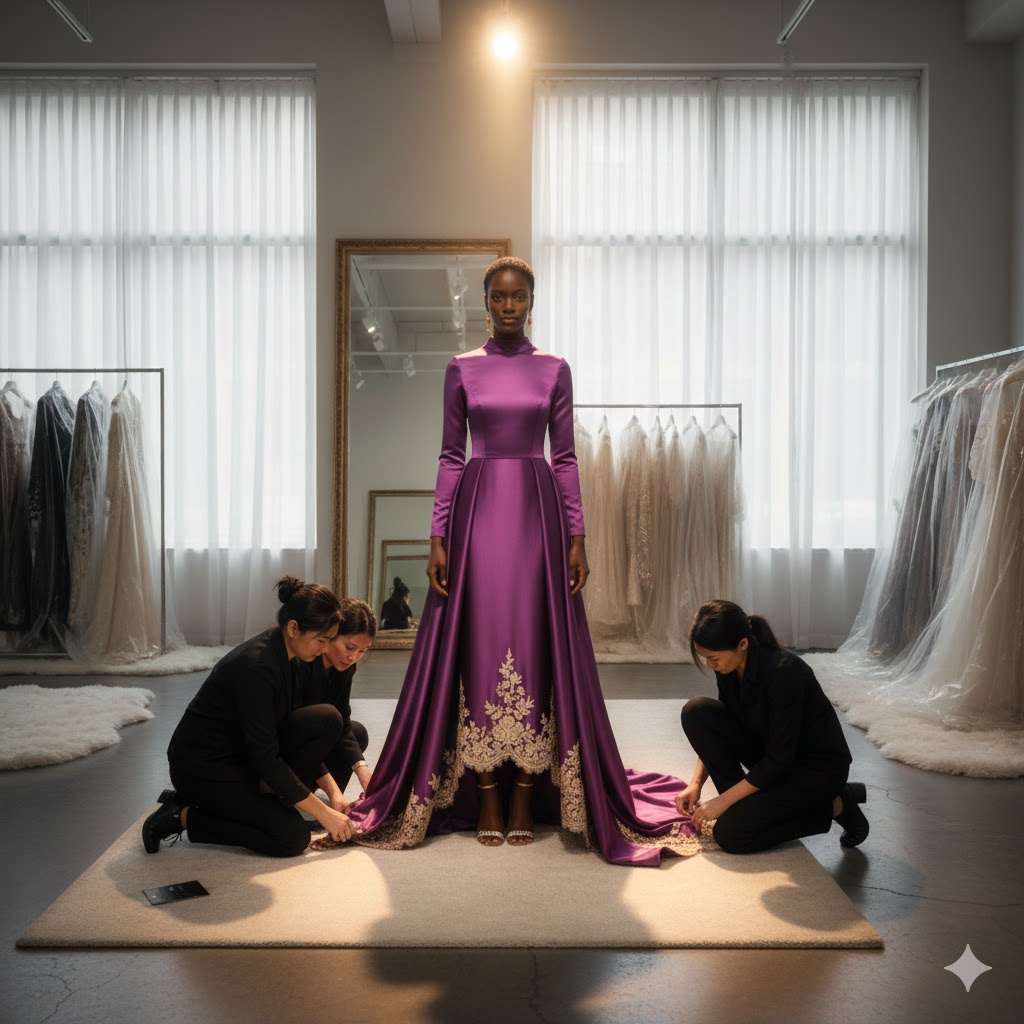
She is light. Not because the world crowned her, but because God placed radiance in her before her first breath. The beauty of a Black woman is not an accident, not an afterthought, not an alternate version of anything else. It is intentional, divine, and woven with the fingerprints of a Creator who makes no mistakes. Her melanin is not simply a pigment; it is a reflection of God’s artistry, absorbing light, reflecting warmth, and telling a story thousands of years old.
Her beauty was never meant to be measured by the standards of societies that once denied her humanity. Her light predates oppression, predates Western ideals, predates any system designed to diminish her. Long before colorism or colonialism, the Black woman was already crowned with dignity, already adorned with strength, already declared “good” by God in Eden. She was never created to compete—only to shine.
Her skin, rich with depth and dimension, testifies of resilience and royalty. Melanin is protective, powerful, and majestic—evidence of survival, adaptation, and divine engineering. It glows under the sun, holds warmth in winter, and remains a symbol of strength across generations. When Scripture says, “I am black, but comely” (Song of Solomon 1:5, KJV), it is not a concession—it is a declaration. Beautiful and Black have always belonged in the same sentence.
Her hair, coiled like the rivers of Eden, holds its own testimony. Whether tightly curled, loosely waved, loc’d, braided, pressed, or natural, her hair defies gravity and rules. It stretches when pulled and shrinks when free—it expands and contracts like creation itself. Every curl is a fingerprint of identity, a crown that changes form but never loses its glory. God designed her hair to hold history, culture, versatility, and pride all at once.
Her features—full lips, broad nose, high cheekbones, deep eyes—were crafted with intention, artistry, and balance. These traits have traveled from ancient kingdoms, adorned queens, and birthed nations. What some once mocked, the world now imitates. What was dismissed as “too much” is now desired globally. The features of a Black woman are a reminder that nothing about her needs shrinking, altering, or apologizing for. She is already enough.
Psychologically, Black women have endured centuries of messages suggesting their beauty is conditional, rare, or negotiable. Yet despite that, they rise with a knowing that cannot be erased. The internal strength it takes to love oneself in a world that profits from insecurity is itself a testimony of divine resilience. She learns to heal from inherited pain, to reject generational comparisons, and to embrace the full truth of who she is.
Her beauty is not merely external—it is spiritual. Scripture calls her “fearfully and wonderfully made” (Psalm 139:14, KJV), meaning she is constructed with reverence and awe. She carries light not only in her appearance but in her spirit, compassion, intuition, wisdom, and emotional depth. Her beauty radiates in her ability to nurture, lead, feel, empathize, and discern. She is a vessel of both softness and fire.
Society has often feared the Black woman’s light because it cannot be contained. It is too powerful, too rich, too ancient. Attempts to dilute that light—through colorism, misogynoir, erasure, and standards that were never made with her in mind—were never successful. She is still here. Still glowing. Still redefining beauty on her own terms.
Her walk carries confidence that comes from ancestors who survived storms. Her smile carries joy that cannot be taken. Her presence shifts atmospheres because her essence carries history, promise, and creativity. She is not simply seen—she is felt. Whole rooms brighten when she embraces who she is.
In relationships, families, friendships, and sisterhood, her light offers refuge. She encourages, uplifts, and heals with a word, a touch, a look. Her beauty is not vain; it is functional. It restores. It nourishes. It inspires. It teaches the world what divine femininity looks like in motion. Her spirit mirrors the Proverbs 31 woman in strength, wisdom, and dignity.
Even in adversity, she shines. She turns pain into purpose, obstacles into innovations, and wounds into wisdom. Her beauty is seen in her survival, her laughter, her voice, and her refusal to let darkness dim her brilliance. She is a living reflection of Isaiah 61:3—the one who brings forth “beauty for ashes.”
When she loves herself, she becomes magnetic. When she embraces her identity, she becomes unstoppable. When she honors her body, her skin, her hair, her voice, her story—she becomes a force too powerful to erase. Her beauty becomes a declaration of victory over everything meant to silence her.
Spiritually, her beauty has always been connected to purpose. God never designed beauty without intention. The Black woman’s beauty speaks of strength, spiritual discernment, nurturing, leadership, and sacred femininity. She carries the reflection of African matriarchs, biblical mothers, and modern queens who shaped nations with their presence.
She is light when she walks into a room. She is light when she prays. She is light when she dreams. She is light when she speaks truth. She is light when she heals. She is light because God said she is, and no culture, system, or opinion can override divine affirmation.
Healing from comparison and colorism is the beginning of awakening. She learns that her complexion is not a ranking, but a revelation. Her beauty does not exist in shades, but in essence. Every shade of Black skin is sacred. Every curl pattern is divine. Every feature is intentional. She is not a trend—she is a blueprint.
The world may try to rewrite definitions, but God’s original design stands. When she looks in the mirror, she looks into history, divinity, and promise. She carries the brilliance of galaxies in her skin, the depth of oceans in her eyes, and the artistry of creation in her form. She is not ordinary—she is extraordinary.
The celebration of Black beauty is more than affirmation—it is restoration. It breathes life into what society tried to suppress. It unravels lies and replaces them with truth. It teaches daughters to celebrate themselves long before the world tries to teach them to shrink. It reminds mothers and aunties that they are still beautiful, still chosen, still radiant.
She is light because she was born with light. She is radiant because God called her radiant. She shines not because she tries, but because she is. Her beauty is eternal, spiritual, ancestral, and divine. She is light—and the world is brighter because she is in it.
References
Boylorn, R. M. (2013). Sweetwater: Black women and narratives of resilience. Peter Lang.
Hunter, M. (2007). The persistent problem of colorism: Skin tone, status, and inequality. Sociology Compass, 1(1), 237–254.
Jones, C., & Shorter-Gooden, K. (2003). Shifting: The double lives of Black women in America. HarperCollins.
Robinson-Moore, C. L. (2008). Beauty standards reflect Eurocentric paradigms—A Black female perspective. Journal of Black Studies, 39(2), 326–344.
White, L. (2020). Melanin and the biological benefits of pigmentation. Journal of Dermatological Science, 98(3), 241–250.
The Holy Bible, King James Version. (1769/2023). Cambridge University Press.
Discover more from THE BROWN GIRL DILEMMA
Subscribe to get the latest posts sent to your email.
 THE BROWN GIRL DILEMMA