
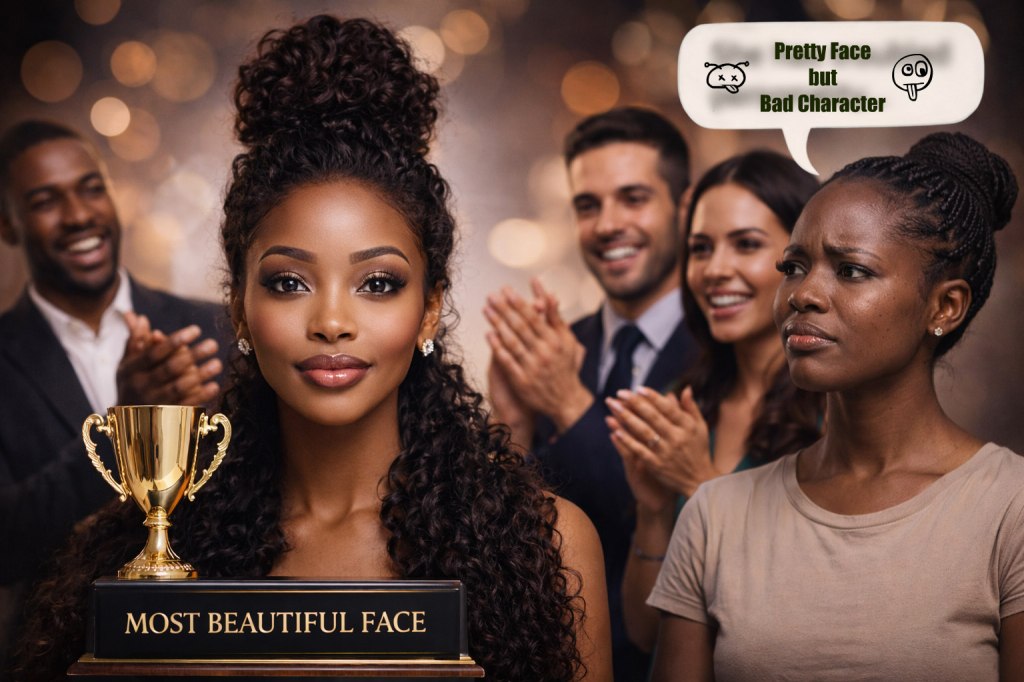
Modern society repeatedly demonstrates a troubling inversion of values: appearance is rewarded more consistently than integrity, charisma more than conscience, and beauty more than moral substance. This imbalance is not accidental but structural, reinforced through psychology, media, economics, and social conditioning. When the world rewards the face instead of the character, it reshapes how people define success, worth, and even goodness itself.
From early childhood, individuals learn that attractiveness carries social advantages. Attractive children are often perceived as smarter, kinder, and more capable by teachers and peers, receiving more encouragement and leniency. These early rewards create cumulative advantages that follow individuals into adulthood, long before character has a chance to speak for itself.
Psychological research identifies this phenomenon as the “halo effect,” where one positive trait—such as physical attractiveness—spills over into unrelated judgments about morality, intelligence, and trustworthiness. As a result, beauty becomes mistaken for virtue, and ethical credibility is quietly assigned based on appearance rather than conduct.
In professional spaces, this bias manifests in hiring, promotion, and compensation. Attractive individuals are more likely to be hired, earn higher wages, and receive favorable performance evaluations. Success is then framed as merit-based, obscuring the role appearance played in tilting opportunity. Character becomes secondary to presentation.
Justice systems are not immune. Studies consistently show that attractive defendants receive lighter sentences, are perceived as less dangerous, and are more likely to be believed. Conversely, those deemed unattractive or threatening—often racialized—face harsher punishment. Justice, while symbolically blind, is socially sighted.
Social media has amplified this imbalance by transforming visibility into currency. Algorithms reward faces that conform to dominant beauty norms, granting them influence, credibility, and economic opportunity. Moral authority increasingly follows aesthetic appeal, allowing those who look “right” to speak louder than those who act right.
This distortion is especially harmful to marginalized communities. Within Black communities, colorism compounds appearance bias, granting lighter skin and Eurocentric features greater social grace and moral assumption. Darker-skinned individuals are more likely to be scrutinized, distrusted, or required to prove their worth through exceptional behavior.
Character, by contrast, develops quietly. Integrity, empathy, discipline, and accountability do not photograph well. They do not go viral. In a culture driven by optics, character work often goes unnoticed, undervalued, and unrewarded, despite being essential to communal health.
The moral danger lies not only in rewarding beauty but in punishing those without it. When people learn that goodness does not protect them from exclusion or harm, cynicism grows. Ethical behavior begins to feel impractical in a world that prizes surface over substance.
This value inversion shapes desire as well. Romantic and social choices are influenced by perceived status attached to appearance. People with “beautiful” partners gain social validation, while those who choose character over aesthetics may be subtly devalued. Love itself becomes performative.
The long-term cost is cultural hollowness. Societies that reward faces over character cultivate leaders skilled in performance rather than principle. Charm replaces accountability, and image management substitutes for moral responsibility.
Undoing this distortion requires conscious resistance. Institutions must interrogate bias, media must expand representations of worth, and individuals must question their reflexive judgments. Character must be relearned as a visible form of beauty, even if it does not immediately gratify the eye.
Ultimately, a just society cannot survive on appearance alone. Faces age, trends fade, and filters fail. Character endures. When the world learns again to reward integrity over image, beauty will return to its rightful place—as adornment, not authority.
References
Eagly, A. H., Ashmore, R. D., Makhijani, M. G., & Longo, L. C. (1991). What is beautiful is good, but… A meta-analytic review of research on the physical attractiveness stereotype. Psychological Bulletin, 110(1), 109–128.
Hamermesh, D. S. (2011). Beauty pays: Why attractive people are more successful. Princeton University Press.
Hunter, M. (2007). The persistent problem of colorism: Skin tone, status, and inequality. Sociology Compass, 1(1), 237–254.
Langlois, J. H., Kalakanis, L., Rubenstein, A. J., Larson, A., Hallam, M., & Smoot, M. (2000). Maxims or myths of beauty? A meta-analytic and theoretical review. Psychological Bulletin, 126(3), 390–423.
Stewart, J. E. (1980). Defendant’s attractiveness as a factor in the outcome of criminal trials. Journal of Applied Social Psychology, 10(4), 348–361.
Zebrowitz, L. A. (2017). First impressions from faces. Oxford University Press.
Zuboff, S. (2019). The age of surveillance capitalism. PublicAffairs.
Discover more from THE BROWN GIRL DILEMMA
Subscribe to get the latest posts sent to your email.
 THE BROWN GIRL DILEMMA