
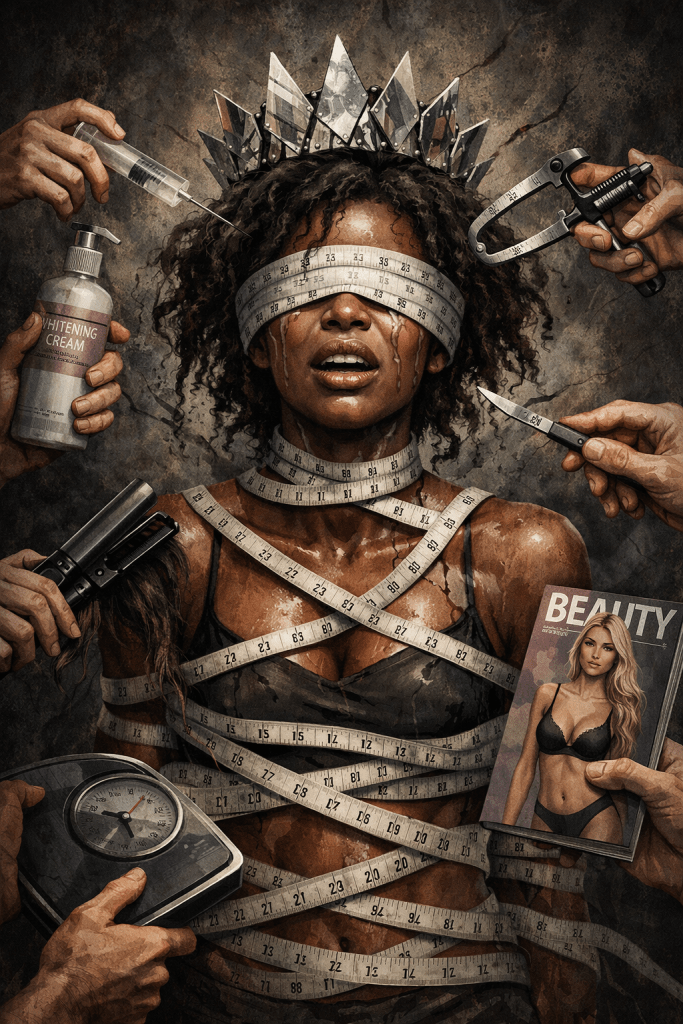
Beauty standards are often framed as harmless preferences or cultural aesthetics, yet their impact is anything but benign. They operate as a quiet, normalized form of violence—psychological, social, economic, and spiritual—imposed upon bodies that fall outside narrowly defined ideals. This violence is subtle enough to evade accountability and powerful enough to shape life outcomes, self-worth, and social hierarchies across generations.
The violence of beauty standards begins with definition. When a dominant culture determines which features are worthy of admiration and which are to be tolerated or erased, it establishes a hierarchy of human value. These hierarchies do not emerge organically; they are historically constructed through colonialism, slavery, class stratification, and racialized power relations that elevate proximity to whiteness, youth, thinness, and Eurocentric features.
For Black communities in particular, beauty standards have functioned as an extension of racial domination. During slavery and colonial rule, physical features were used to classify, rank, and commodify African-descended people. Lighter skin, straighter hair, and narrower features were rewarded with marginal privileges, while darker skin and African phenotypes were associated with labor, disposability, and dehumanization.
This legacy persists through colorism, a system in which skin tone operates as a social currency within and beyond racial groups. Colorism is not merely a preference; it is an internalized enforcement mechanism that reproduces racial hierarchy without the need for overt racism. Its violence lies in how it fractures communal bonds and assigns worth based on phenotype rather than character or humanity.
Beauty standards also enact violence through psychological harm. Repeated exposure to exclusionary ideals fosters chronic self-surveillance, body dissatisfaction, anxiety, and depression. Individuals learn to scrutinize their faces, hair, weight, and aging as problems to be fixed rather than natural expressions of life. This internalized gaze becomes a form of self-policing that mirrors external oppression.
The economic violence of beauty standards is equally profound. Entire industries profit from manufactured insecurity, extracting billions of dollars through skin-lightening products, cosmetic surgery, anti-aging treatments, and hair alteration. Those who can afford to approximate beauty ideals gain social and professional advantages, while those who cannot are penalized in employment, dating, media representation, and social mobility.
Gender intensifies this violence. Women and girls are disproportionately subjected to aesthetic regulation, with their value often tethered to attractiveness rather than intellect, integrity, or contribution. From childhood, girls are conditioned to equate beauty with worth, learning that visibility and validation are contingent upon meeting external standards that shift with trends yet remain rooted in patriarchal control.
Men are not immune to the violence of beauty standards, though it manifests differently. Rigid ideals of masculinity—height, muscularity, stoicism, dominance—discipline male bodies and emotions, discouraging vulnerability and self-acceptance. Men who deviate from these ideals face ridicule, emasculation, and social exclusion, revealing beauty standards as tools of behavioral conformity.
Media functions as a primary weapon in the enforcement of beauty norms. Through film, advertising, social media, and fashion, a narrow range of bodies and faces is repeatedly elevated as aspirational. Algorithmic amplification further entrenches these ideals, rewarding certain looks with visibility while rendering others invisible or stereotyped.
The violence intensifies in the digital age, where beauty standards are no longer distant images but interactive currencies. Likes, follows, and monetization transform appearance into measurable social capital. This quantification of beauty deepens comparison, fuels self-objectification, and accelerates the commodification of the self.
Beauty standards also operate as moral judgments. Attractive bodies are frequently associated with goodness, discipline, intelligence, and virtue, while those deemed unattractive are implicitly linked to laziness, moral failure, or incompetence. This phenomenon, often described as the halo effect, embeds aesthetic bias into decision-making processes that shape education, employment, and criminal justice outcomes.
The violence of beauty standards extends into spiritual dimensions. When individuals are taught to despise the bodies they inhabit, a rupture forms between self and creation. For faith traditions that affirm humanity as divinely made, beauty hierarchies function as theological distortions, subtly contradicting teachings about inherent worth and sacred design.
Historically marginalized bodies carry the heaviest burden of this violence. Disabled bodies, fat bodies, aging bodies, dark-skinned bodies, and gender-nonconforming bodies are treated as deviations rather than variations of human existence. The insistence on correction or concealment communicates that some lives are less deserving of comfort, desire, and dignity.
Resistance to beauty standards is often dismissed as oversensitivity or lack of self-esteem, yet such resistance is deeply political. To reject imposed ideals is to challenge systems that rely on comparison, insecurity, and consumption. It is an act of reclaiming agency over one’s body and narrative.
Cultural movements that celebrate diverse forms of beauty offer important counter-narratives, but they are not immune to co-optation. Inclusion is frequently aestheticized without dismantling underlying power structures, resulting in superficial diversity that leaves hierarchies intact. True liberation requires structural change, not symbolic representation alone.
Education plays a crucial role in disrupting the violence of beauty standards. Critical media literacy, historical context, and conversations about embodiment can equip individuals to recognize how ideals are constructed and whose interests they serve. Awareness does not erase harm, but it weakens its authority.
Healing from beauty-based violence is both personal and collective. Individually, it involves unlearning internalized contempt and cultivating self-regard beyond appearance. Collectively, it requires building communities that affirm worth independent of aesthetics and challenge discriminatory practices in institutions and media.
The language we use around beauty matters. Compliments, critiques, and casual comments can reinforce or resist harmful norms. Shifting language toward appreciation of character, creativity, resilience, and wisdom helps decenter appearance as the primary measure of value.
Ultimately, the violence of beauty standards lies in their ability to disguise domination as desire. They persuade individuals to participate in their own marginalization, to chase approval at the cost of peace, and to mistake conformity for empowerment. Naming this violence is the first step toward dismantling it.
A more just vision of beauty does not require the abandonment of aesthetics, but their reorientation. Beauty can be expansive, contextual, and humane when divorced from hierarchy and exclusion. In reclaiming beauty from violence, society moves closer to affirming the full dignity of every body.
References
Bordo, S. (2003). Unbearable weight: Feminism, Western culture, and the body. University of California Press.
Collins, P. H. (2004). Black sexual politics: African Americans, gender, and the new racism. Routledge.
Crenshaw, K. (1991). Mapping the margins: Intersectionality, identity politics, and violence against women of color. Stanford Law Review, 43(6), 1241–1299.
Dion, K., Berscheid, E., & Walster, E. (1972). What is beautiful is good. Journal of Personality and Social Psychology, 24(3), 285–290.
Hunter, M. (2007). The persistent problem of colorism: Skin tone, status, and inequality. Sociology Compass, 1(1), 237–254.
hooks, b. (1992). Black looks: Race and representation. South End Press.
Kaw, E. (1993). Medicalization of racial features: Asian American women and cosmetic surgery. Medical Anthropology Quarterly, 7(1), 74–89.
Wolf, N. (1991). The beauty myth: How images of beauty are used against women. HarperCollins.
Discover more from THE BROWN GIRL DILEMMA
Subscribe to get the latest posts sent to your email.
 THE BROWN GIRL DILEMMA