
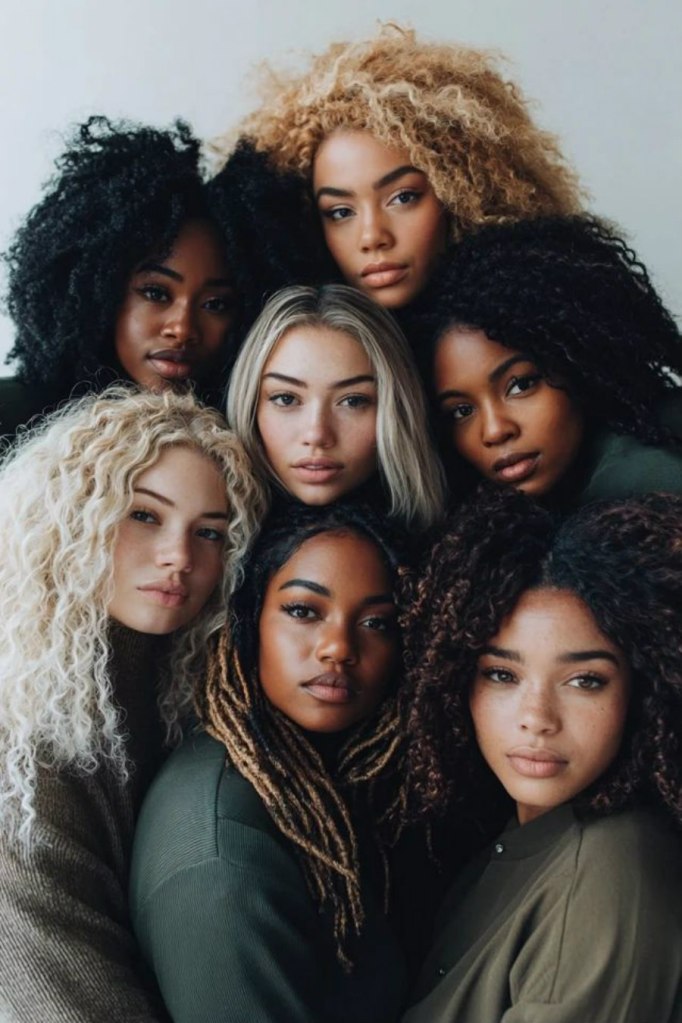
The story of the Brown girl is a sacred hymn written not in ink, but in the richness of melanin and the quiet endurance of her soul. She walks through the world as a living psalm — a testimony of divine craftsmanship and unbroken lineage. In her reflection, we see God’s artistry, not merely in the hue of her skin but in the rhythm of her spirit. “I will praise thee; for I am fearfully and wonderfully made” (Psalm 139:14, KJV) is not just a verse—it is her anthem, one that echoes against centuries of rejection and redefinition.
For generations, the Brown girl has been taught to question her worth, to compare her glow against a false light. But the Creator never designed her to mimic another’s reflection. Her shade, like the soil of Eden, carries the very breath of life. From her crown of coiled glory to the curve of her hips, every part of her was formed with intention and reverence. Her beauty does not seek validation—it speaks of divine origin.
History tried to dim her brilliance through the politics of color and the hierarchy of skin. Yet, even in bondage, she remained radiant. The same sun that darkened her skin also kissed her strength. From the plantations to the pulpits, from the cotton fields to classrooms, she became a bearer of wisdom, resistance, and grace. She survived, not by accident, but by divine decree.
Her skin tells the story of her ancestors’ resilience—those who toiled in chains but dreamed of freedom. Each melanin cell is a monument to survival, each curl a scripture of identity. The Brown girl’s body is not a battleground of beauty standards; it is sacred architecture built by the hands of a Holy God. Her existence itself refutes every lie told by colonial mirrors.
In a world where Eurocentric beauty was exalted, the Brown girl was forced to unlearn self-hate disguised as admiration. She was told that to be lighter was to be lovelier, that proximity to whiteness meant worthiness. Yet the Spirit whispered truth: you were never meant to blend in with those who were never meant to define you. Her beauty, like a psalm, was meant to stand apart and lift the hearts of those who forgot that the Creator does not make mistakes.
The Brown girl’s psalm is also a declaration of liberation. It reminds her that she does not have to bleach her blessings, straighten her identity, or silence her power to be accepted. She can rest in the truth that her image was shaped in the likeness of divinity. When she walks, heaven recognizes her gait, for she carries the DNA of queens, prophets, and poets who have spoken life over deserts of despair.
In her eyes shines the reflection of generations—of Sarah’s faith, Hagar’s endurance, Esther’s courage, and Mary’s devotion. Her story, though rewritten by men, is restored by God. The Brown girl’s psalm teaches her that her scars are not shame but sacred ink—proof that she has survived what was meant to erase her.
This psalm also calls her to rise in purpose. Her voice was not meant to be background harmony but a solo of strength. She must reclaim the narrative that her foremothers were forced to whisper. Each time she affirms, I am fearfully and wonderfully made, she restores what history tried to erase—her identity as both divine creation and divine reflection.
The Brown girl’s confidence does not rest in external admiration but in internal revelation. She understands that self-love is not vanity but victory. When she adores her reflection, she honors the God who shaped her. When she embraces her hair, her nose, her skin, she offers praise not to herself but to the One who called her good from the beginning.
Psalm 139 becomes her mirror, not as a verse recited but as a truth embodied. It reminds her that she was known before she was born, loved before she was named, and chosen before she was celebrated. The Brown girl is not an afterthought—she is the first light after a long night of erasure.
The Brown girl’s psalm is also a lament. It grieves for the little girls who once hated their skin, who longed for lighter shades and looser curls, who never saw themselves in dolls or dreams. But the lament transforms into healing as she learns to sing again, her melody now one of restoration and self-acceptance.
Through time, her presence has always symbolized the sacred balance between beauty and strength. She can nurture nations and lead revolutions, pray with power and walk in poise. Her softness is not weakness—it is divine wisdom wrapped in compassion. Her resilience is not hardness—it is the evidence of God’s sustaining hand.
Her psalm also speaks to men, children, and generations yet unborn. It calls the world to see her not as an object of desire or envy but as an image of God’s glory. The world must unlearn its gaze and see her not as a symbol of struggle but of sacredness. She is the divine feminine in her purest form, clothed in majesty, kissed by creation.
The Brown girl’s existence is a prayer fulfilled. Her laughter is a hymn, her tears are baptisms, her dreams are prophecies. When she walks in truth, she resurrects the legacy of those who died never knowing they were beautiful. She becomes both the psalmist and the psalm.
In this psalm, love becomes her language. She learns to love the reflection that was once foreign to her. Her body becomes a temple of gratitude, her mind a sanctuary of peace. The beauty she carries is not confined to appearance—it is a moral, spiritual, and ancestral inheritance.
Every Brown girl who reads this psalm is invited to rewrite her story with grace. To forgive herself for believing lies. To anoint herself with truth. To declare, “I am my ancestors’ answered prayer.” For in her smile is the dawn, and in her voice, the echo of freedom.
She is not defined by society’s metrics but by heaven’s masterpiece. When she embraces her reflection, she sees more than beauty—she sees purpose. The Brown girl’s psalm teaches her to stand unapologetically in the fullness of her creation, unbothered by comparison, anchored in divine affirmation.
Her life is an offering. Each day she awakens, she adds another verse to the sacred song of womanhood. And as she learns to walk in love, justice, and truth, she becomes the melody of hope for those still finding their way to the mirror.
The Brown girl is fearfully and wonderfully made—an everlasting psalm written by the hand of God and sung through the ages. Her beauty is not a trend but a testimony. Her existence is not accidental—it is divine poetry in motion.
References
- The Holy Bible, King James Version. (Psalm 139:14).
- hooks, b. (1992). Black Looks: Race and Representation. South End Press.
- Morrison, T. (1970). The Bluest Eye. Holt, Rinehart and Winston.
- Lorde, A. (1984). Sister Outsider: Essays and Speeches. Crossing Press.
- Davis, A. (1981). Women, Race, & Class. Random House.
- Hill Collins, P. (2000). Black Feminist Thought: Knowledge, Consciousness, and the Politics of Empowerment. Routledge.
- Cooper, B. (2018). Eloquent Rage: A Black Feminist Discovers Her Superpower. St. Martin’s Press.
Discover more from THE BROWN GIRL DILEMMA
Subscribe to get the latest posts sent to your email.
 THE BROWN GIRL DILEMMA