
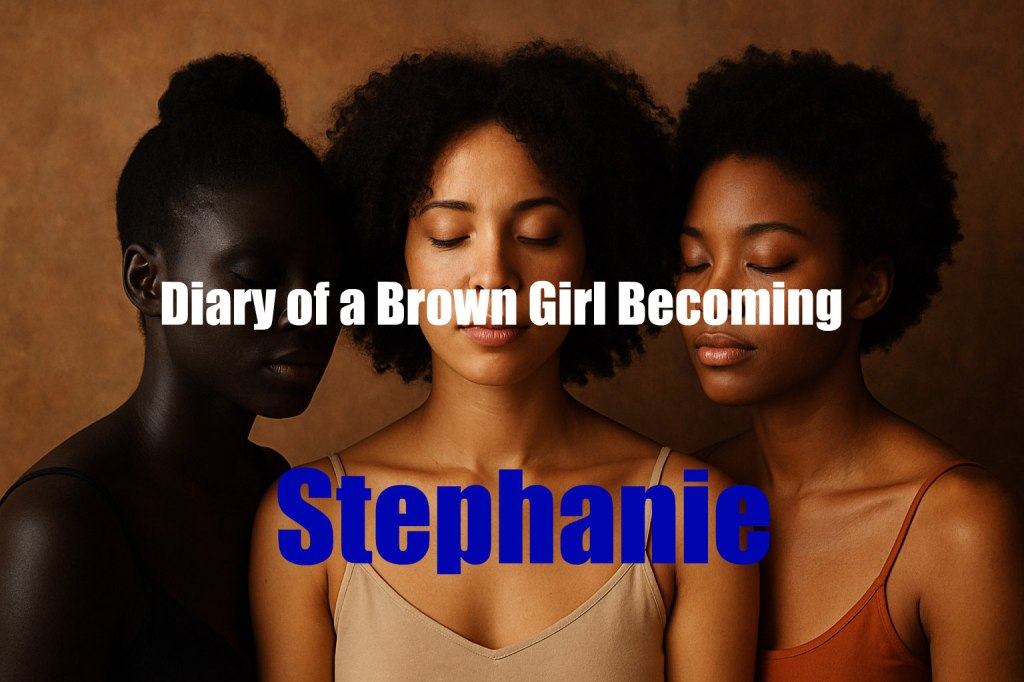
Stephanie had always known that her skin was dark. The mirror told her, the sunlight confirmed it, and the world never let her forget it. In school, she was the girl the boys didn’t pick first, the one whispered about when conversations turned to “pretty.” She learned early that beauty came in shades the world found easier to love.
But Stephanie’s story is not one of pity—it is one of awakening. For years, she tried to make herself smaller, quieter, less noticeable, as if fading into the background would protect her from comparison. When lighter-skinned girls were called beautiful, she smiled politely, swallowing the ache. When men overlooked her, choosing others with the kind of adoration she longed for, she convinced herself that maybe she wasn’t meant to be desired—only admired from a safe distance.
The pain was quiet but deep, built from the small cuts of colorism that society disguised as “preference.” She noticed how dark-skinned girls were praised for their strength but rarely for their softness. Their beauty was called “unique,” as if it were an exception to the rule.
Stephanie’s turning point came not through validation from others, but through reclamation of self. She began to see that the problem was never her complexion—it was the lens through which the world viewed her. She started to adorn her melanin with pride: bright gold earrings that gleamed against her skin, bold lipstick that spoke before she did. Her confidence became a revolution, a quiet defiance against a culture that had long tried to silence her shine.
She learned to love her reflection not because others did, but because she finally saw what God had made. Every shade of brown in her was a story of survival, every curve and contour a testimony of her ancestry. She realized she carried the glow of her foremothers—the women who bore the sun in their skin and refused to be dimmed.
One day, when she looked in the mirror, she didn’t see “too dark.” She saw the divine. And with that revelation, Stephanie stopped waiting to be chosen. She chose herself.
Now, when people tell her she’s beautiful, she smiles—not because she needs to hear it, but because she already knows. Her beauty is not a surprise; it’s a fact.
Stephanie’s story is every dark-skinned girl’s anthem: a journey from invisibility to illumination. From being overlooked to being unshakable. From hiding to becoming.
Discover more from THE BROWN GIRL DILEMMA
Subscribe to get the latest posts sent to your email.
 THE BROWN GIRL DILEMMA