
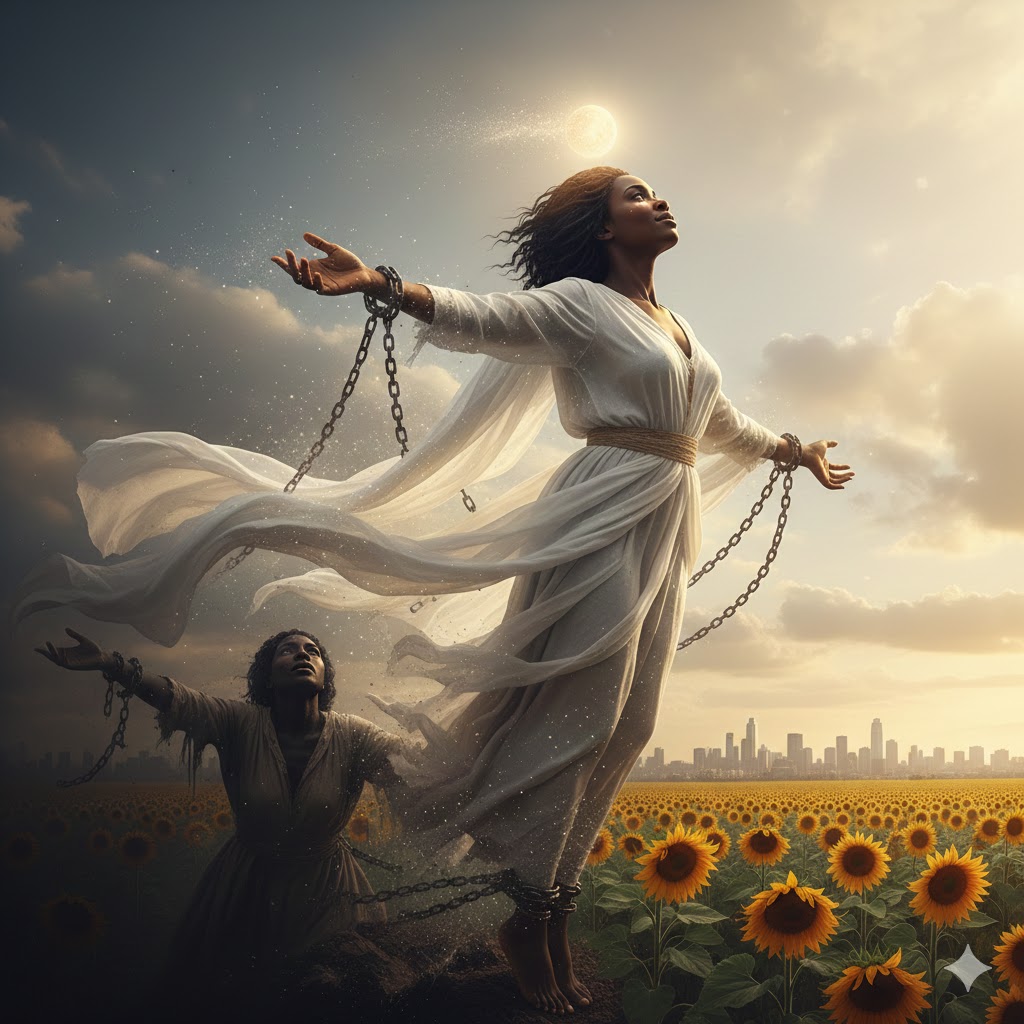
The journey of becoming is both sacred and disruptive. It is the quiet shedding of former versions of oneself in order to rise into purpose, identity, and inner alignment. To evolve is to confront the limitations of yesterday with the courage to embrace the unknown possibilities of tomorrow. For many Black women navigating the intersections of history, faith, and personal growth, evolution is more than a process—it is liberation.
Evolution requires the bravery to examine inherited narratives. Many women carry stories shaped by family, culture, trauma, or expectations that never belonged to them in the first place. The freedom of evolving lies in acknowledging these inherited patterns, blessing what once served them, and releasing what no longer aligns with their calling.
At the core of evolution is self-awareness. It is impossible to transform while avoiding the mirror. Becoming demands honesty, introspection, and a willingness to confront one’s own desires, fears, and habits. When a woman begins to understand herself, she gains the spiritual authority to rewrite her life from a place of truth.
The beauty of evolving is that it does not demand perfection—only progress. Growth is a series of small, courageous decisions made repeatedly in the direction of authenticity. These choices shape a narrative where healing becomes more than survival; it becomes creation.
As a Black woman evolves, she inevitably reclaims her voice. This reclamation is revolutionary in a society that has historically silenced, minimized, or misrepresented Black womanhood. Evolution becomes a declaration: I am no longer shrinking to fit narratives that dishonor my existence.
Faith is a central anchor in the journey of transformation. Scripture reminds believers that renewal is a divine mandate—“Be ye transformed by the renewing of your mind” (Romans 12:2, KJV). Evolution, then, is not merely personal; it is spiritual obedience. It is alignment with the creator’s design.
Through evolution, a woman learns to separate her worth from her wounds. Trauma may explain parts of her story, but it does not define her identity. Healing becomes an act of reclamation, a sacred right to wholeness. This freedom allows her to step forward without dragging the weight of her past.
The freedom of evolving also teaches discernment. As one grows, the soul becomes sensitive to environments, relationships, and habits that cannot accompany the next season. Letting go is not abandonment—it is wisdom. Pruning is necessary for spiritual and emotional fruit to flourish.
Evolving encourages rest. In a world that celebrates overworking, overachieving, and overextending, growth often happens in stillness. Rest becomes resistance; silence becomes clarity; solitude becomes strength. Through rest, the soul recalibrates and regains spiritual focus.
Another dimension of evolution is identity. Many women are conditioned to define themselves by roles—mother, wife, leader, daughter, caretaker. But evolving reveals that identity is rooted not in tasks but in essence. It is the discovery of one’s God-given purpose beyond social labels.
The freedom of evolving empowers women to dream again. Childhood aspirations buried beneath responsibility or disappointment begin to resurface. Dreams become evidence of hope—a reminder that the future still holds promise. Reimagining life becomes an act of resurrection.
Confidence begins to rise naturally through evolution, not from ego but from alignment. When a woman knows who she is and whose she is, she walks differently. She speaks with clarity, sets boundaries with conviction, and cultivates spaces that nourish her spirit.
Evolution also invites forgiveness. Not only forgiveness of others, but the deeper, more challenging forgiveness of self. Releasing past mistakes liberates the heart to move forward without shame. In this release, love becomes expansive, compassionate, and restorative.
At times, evolution can feel lonely. Growth often separates the evolving from the familiar. But this solitude is purposeful; it allows God to reveal identity without external noise. In this sacred isolation, one learns that being alone is not abandonment—it is refinement.
The freedom of evolving transforms relationships. As one becomes whole, the types of connections they attract shift. Evolution demands reciprocity, emotional maturity, and peace. The evolving woman learns to cultivate love that aligns with her healed self.
Strength arises not from resistance but from surrender. Evolution teaches that surrendering to God’s plan opens doors human effort could never unlock. Letting go of control becomes the first step toward divine alignment.
As a woman evolves, she becomes a mirror for others. Her transformation inspires those around her to pursue healing and purpose. She becomes a testimony—living evidence that change is possible and freedom is attainable.
The freedom of evolving culminates in self-love. Not the shallow self-love promoted by culture, but the deep, spiritual love rooted in worthiness and identity. This love empowers her to honor her boundaries, nurture her gifts, and protect her peace.
Ultimately, evolution is liberation. It is stepping into the highest version of oneself—mind renewed, spirit awakened, identity restored. It is embracing the divine truth that becoming is not a destination but a lifelong journey of freedom, faith, and transformation.
The evolving woman is evidence that God still creates masterpieces in motion. Every season shapes her, every lesson strengthens her, and every breakthrough elevates her. This is the freedom of evolving—the sacred art of becoming who she was always meant to be.
References
Brown, B. (2012). Daring greatly: How the courage to be vulnerable transforms the way we live, love, parent, and lead. Gotham Books.
hooks, b. (1992). Black looks: Race and representation. South End Press.
Morrison, T. (2003). Sula. Vintage Books.
Myers, D. G. (2014). Exploring psychology (9th ed.). Worth Publishers.
Piper, J. (2007). When the darkness will not lift: Doing what we can while we wait for God—and joy. Crossway.
Tatum, B. D. (1997). Why are all the Black kids sitting together in the cafeteria? And other conversations about race. Basic Books.
Tolle, E. (1999). The power of now: A guide to spiritual enlightenment. New World Library.
Willard, D. (1998). The spirit of the disciplines: Understanding how God changes lives. HarperCollins.
Discover more from THE BROWN GIRL DILEMMA
Subscribe to get the latest posts sent to your email.
 THE BROWN GIRL DILEMMA