
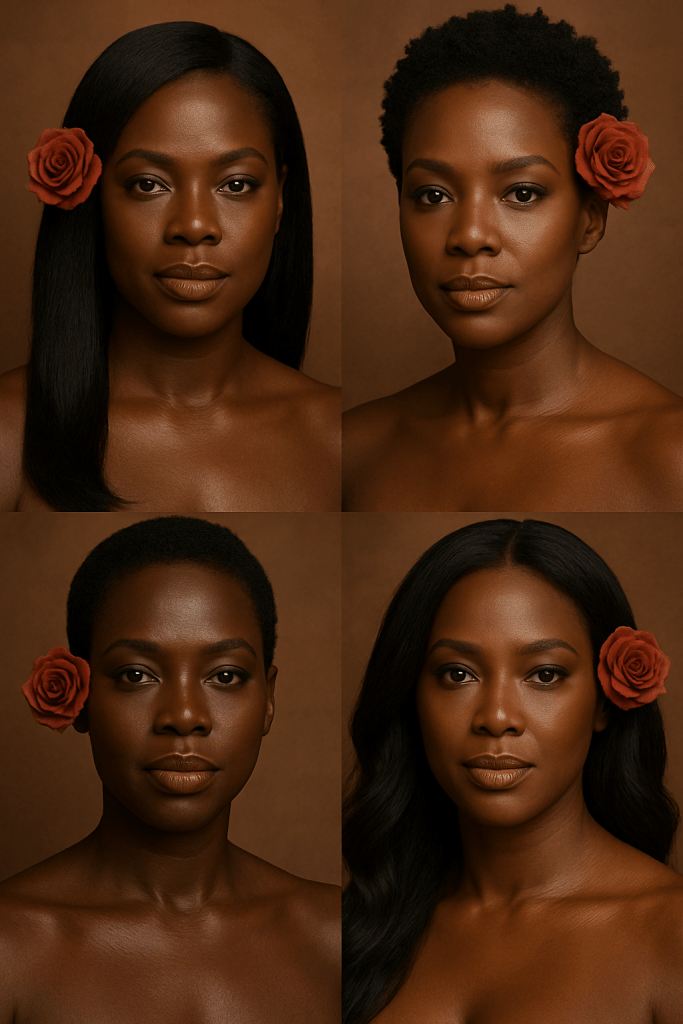
Beauty has always been both a mirror and a weapon—reflecting societal values while often wounding those who fall outside its narrow definitions. The phenomenon known as pretty privilege reveals how beauty grants unspoken advantages, yet historically, this privilege has excluded darker-skinned individuals, especially within the Black community. In this installment, “Faces of the Sun,” we turn toward the light that has too often been dimmed—celebrating the deepest, richest complexions as the living embodiment of radiance, history, and divine artistry.
The term “Faces of the Sun” symbolizes more than melanin; it signifies resilience, warmth, and illumination born from struggle. The sun does not discriminate—it shines equally, yet some societies have long taught people to seek its opposite. In many cultures, including those shaped by colonial influence, dark skin was unjustly stigmatized while lightness became the aesthetic ideal (Hunter, 2007). This bias—rooted in colorism—still permeates beauty industries, employment opportunities, and social hierarchies today.
For centuries, enslaved Africans and their descendants were taught that proximity to whiteness equated to superiority. Light skin was rewarded; darker complexions were marginalized. This internalized system of value manipulation fractured collective identity (Russell, Wilson, & Hall, 2013). Yet, against all odds, the darkest hues endured, retaining the ancestral glow of the first people—the original faces of the sun.
To understand the beauty of dark skin, one must first unlearn Eurocentric paradigms of beauty that prioritize symmetry and fairness as universal standards. In truth, African beauty has always been multidimensional—defined by strength, spirit, and natural brilliance. Anthropologists note that the deep pigmentation found in African populations is an evolutionary masterpiece, perfectly adapted to protect against ultraviolet radiation (Jablonski & Chaplin, 2000). The melanin that once symbolized “less than” is, scientifically, a shield of life.
This scientific truth carries profound cultural and spiritual implications. The same melanin that protects the body also metaphorically protects identity, grounding it in ancestry and divinity. Within many African cosmologies, the sun is a sacred source of life. To call dark-skinned people “faces of the sun” is to affirm that their complexions are celestial—not accidental. It is to remind them that they carry within them the warmth, depth, and eternal glow of creation itself.
Modern media, however, continues to struggle with accurate representation. While there has been progress—through figures like Lupita Nyong’o, Viola Davis, and Duckie Thot—dark-skinned women and men still face underrepresentation or tokenization. Nyong’o (2014) once described her journey to self-acceptance as a process of “learning to see beauty where it had not been taught.” Her words echo a broader cultural awakening that beauty is not defined by the dominant gaze but reclaimed by those once unseen.
Social media has been instrumental in reshaping beauty narratives. Movements like #MelaninPoppin and #BlackGirlMagic have become affirmations of identity and resistance. These digital spaces serve as modern-day salons of empowerment, where dark-skinned individuals can finally see themselves reflected with dignity and admiration (Hobson, 2018).
Yet, the celebration of melanin must not merely be a trend; it must be an enduring cultural correction. Too often, society commodifies Black beauty while ignoring Black pain. It sells the “aesthetic” but not the struggle. The Faces of the Sun series challenges this hypocrisy by centering the full humanity behind the beauty—the intellect, spirituality, and power embedded in every deep shade.
For men, the experience of colorism is often overlooked but equally profound. Dark-skinned Black men are sometimes fetishized as symbols of masculinity and virility while simultaneously criminalized in social perception (Monk, 2014). This duality reveals how colorism not only shapes attraction but also social justice outcomes, influencing employment, sentencing, and media portrayals. The path to healing requires both genders to unlearn these destructive binaries.
Psychologically, internalized colorism affects self-esteem, dating preferences, and even family dynamics. Studies show that darker-skinned individuals report higher instances of discrimination from both white and nonwhite peers (Keith & Herring, 1991). Healing begins with naming these experiences and dismantling the shame attached to skin tone. The mind must be decolonized before the mirror can truly reflect beauty.
Spiritually, celebrating the deepest shades is an act of restoration. In scripture, the Song of Solomon proclaims, “I am black, but comely” (Song of Solomon 1:5, KJV)—a poetic affirmation of divine beauty long before Western constructs defined worth. The “but” in that verse was not an apology; it was a declaration of mystery and majesty, a proclamation that darkness is as sacred as light.
Artists and photographers who celebrate deep skin tones are participating in a form of cultural reclamation. Through careful lighting and composition, they capture how dark skin interacts with illumination—absorbing and reflecting it with unmatched depth. This interplay of light and shadow becomes a metaphor for resilience: the darker the hue, the more it thrives in the brilliance of the sun.
Cinematically, we are witnessing a renaissance in the portrayal of deep-toned characters. Films like Black Panther (2018) and The Woman King (2022) have redefined representation, highlighting beauty, power, and leadership within African diasporic narratives. These works not only entertain but reeducate the collective imagination about what heroism and beauty look like when liberated from whitewashed ideals.
Fashion, too, has begun to embrace the richness of melanin. Designers like Hanifa, Pyer Moss, and LaQuan Smith intentionally feature models with deeper complexions, challenging industries long dominated by Eurocentric aesthetics. This rebalancing is not simply inclusion—it is justice in fabric form.
Still, the work is far from done. Representation cannot end on runways or screens; it must reach classrooms, boardrooms, and pulpits. The next generation must grow up seeing dark skin as divine design, not deviation. Education and media literacy are vital tools in dismantling colorist conditioning and restoring collective dignity.
The celebration of deep shades also invites global unity. Across the diaspora—from Sudan to Jamaica to Atlanta—our varied tones tell stories of migration, resilience, and rebirth. Each hue is a historical archive, holding ancestral wisdom that no bleaching cream or algorithm can erase.
By honoring “faces of the sun,” we acknowledge that beauty was never lost—it was merely unrecognized. When dark skin is illuminated correctly, the world witnesses the art of survival and the poetry of existence written in human form. This illumination is both literal and symbolic: a reminder that true radiance comes from embracing one’s God-given tone, not conforming to someone else’s lens.
In celebrating the deepest shades among us, we resist erasure and affirm life itself. Every melanin-rich face carries the memory of the beginning, when humanity first emerged under African skies. To be dark is not to be shadowed—it is to be kissed by the origin of light. The sun does not apologize for shining, and neither should we.
Ultimately, Pretty Privilege: Faces of the Sun is not just a visual or cultural movement; it is a theological and psychological restoration. It reclaims what colonization and capitalism once devalued—the inherent holiness of Blackness. It reminds us that we are not merely beautiful because we are seen, but because we are of the sun.
References
- Hobson, J. (2018). The Black body in Hollywood: Visual culture and race politics. Routledge.
- Hunter, M. L. (2007). The persistent problem of colorism: Skin tone, status, and inequality. Sociology Compass, 1(1), 237–254.
- Jablonski, N. G., & Chaplin, G. (2000). The evolution of human skin coloration. Journal of Human Evolution, 39(1), 57–106.
- Keith, V. M., & Herring, C. (1991). Skin tone and stratification in the Black community. American Journal of Sociology, 97(3), 760–778.
- Monk, E. P. (2014). Skin tone stratification among Black Americans, 2001–2003. Social Forces, 92(4), 1313–1337.
- Nyong’o, L. (2014). Essence Magazine Interview: Lupita Nyong’o on embracing her beauty. Essence.
- Russell, K., Wilson, M., & Hall, R. (2013). The color complex: The politics of skin color among African Americans. Anchor Books.
Discover more from THE BROWN GIRL DILEMMA
Subscribe to get the latest posts sent to your email.
 THE BROWN GIRL DILEMMA