
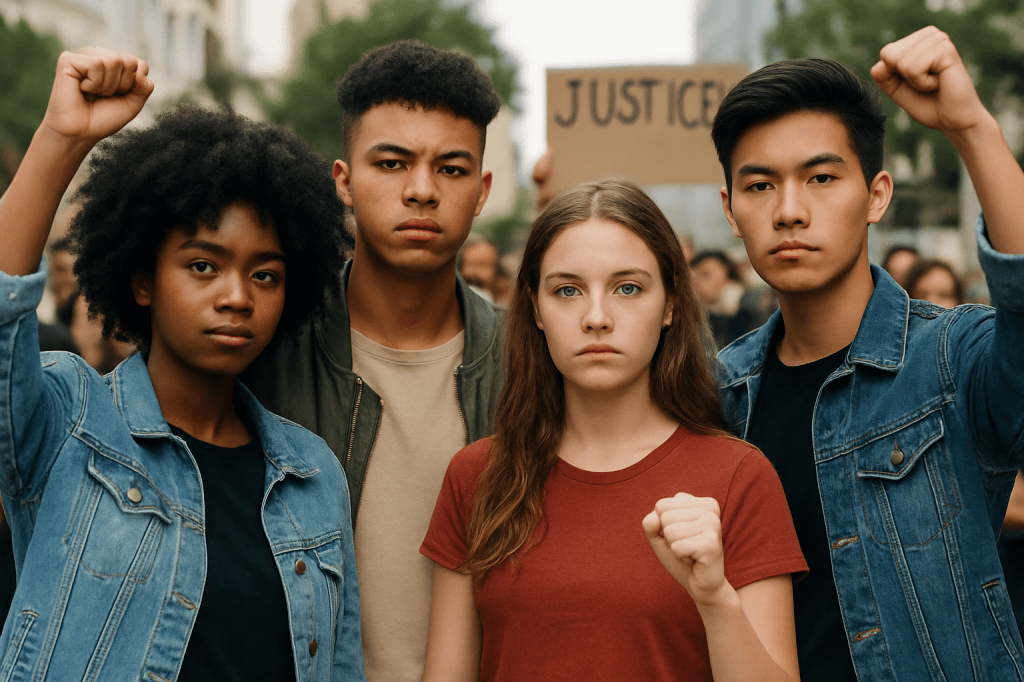
Gen Z has emerged as a generation marked by urgency, upheaval, and unfiltered honesty. Born into a world already trembling with economic uncertainty, political polarization, and spiritual confusion, their revolt is not one of senseless destruction but of fierce introspection. They challenge norms because the norms have failed them. They question authority because authority has historically ignored their voices. Their rebellion is, in many ways, a righteous outcry for meaning in an age of contradiction.
This generation grew up online, absorbing information at a pace no previous generation could imagine. The internet exposed them to global injustice early—police brutality, climate catastrophe, racism, and corruption were not distant stories but daily realities scrolling across their screens. This constant exposure created a generation hyper-aware of the world’s brokenness, yet determined to push for something better.
Gen Z’s revolt is also deeply tied to identity. They reject strict labels and refuse to let society force them into predefined boxes. Whether discussing race, gender, religion, or individuality, they assert autonomy over the narratives that once silenced young people. Their self-expression—through fashion, art, music, activism, and digital culture—is a statement of defiance against conformity.
Economically, Gen Z has witnessed the crumbling of the so-called “American Dream.” They saw their parents lose homes during the recession, watched millennials drown in student debt, and now face rising prices, unstable job markets, and inflation that threatens their future. Their revolt is a refusal to enter systems that seem rigged from the start.
Spiritually, this generation is both lost and searching. Many reject organized religion but still yearn for purpose, connection, and truth. Their skepticism is not rebellion against God but against institutions that have too often failed to reflect divine love, justice, and compassion. Their spiritual revolt is an effort to reclaim authenticity over tradition.
Socially, Gen Z is bold. They speak openly about mental health, trauma, and emotional intelligence. They refuse to romanticize suffering or accept silence where healing is needed. Their vulnerability is revolutionary because it breaks generational curses of suppression and secrecy.
Gen Z is also a generation of creators. They build businesses from their phones, produce art from their bedrooms, and influence culture with every post. Their creativity is a weapon—one that challenges outdated systems and empowers them to rewrite the rules.
Politically, they are fierce. They protest, vote, organize, and demand change. They have no patience for hypocrisy or empty promises. Their revolt is grounded in a desire for accountability, transparency, and justice within institutions that have long functioned on exclusivity.
Culturally, Gen Z elevates voices once ignored. They celebrate Blackness, queerness, womanhood, and multicultural identity with a richness that previous generations often suppressed. Their revolt is a collective embrace of the marginalized.
Gen Z challenges capitalism’s excesses. They reject blind consumerism while still navigating a world saturated with ads, influencers, and brands. Their relationship with materialism is complex—they are both shaped by it and rebelling against it.
Technology is both their battlefield and their sanctuary. They use it to connect, mobilize, and create movements. Yet they also struggle under the weight of social comparison, digital burnout, and algorithmic manipulation. Their revolt is a fight for digital freedom and mental peace.
Education for Gen Z is less about degrees and more about skills, understanding, and relevance. They challenge outdated curricula and advocate for learning that reflects real-world issues—social justice, financial literacy, mental wellness, and global awareness.
In relationships, Gen Z seeks emotional honesty. They reject performative love, toxic cycles, and misogynistic norms. Their revolt is a refusal to repeat generational patterns of broken homes, silent suffering, and unspoken wounds.
Gen Z is redefining family structures. They build communities outside of bloodlines and choose people who uplift them. Their revolt challenges the notion that family must tolerate abuse, neglect, or dysfunction.
They are also unafraid to critique the systems that harm them—schools, governments, corporations, and even older generations. Their criticism is often dismissed as entitlement, yet it is rooted in observant clarity. They see the world for what it is and refuse to pretend otherwise.
Despite their boldness, Gen Z carries heavy burdens: anxiety, depression, isolation, and the constant pressure to succeed. Their revolt includes learning boundaries, rest, and self-preservation. They fight for their mental health as fiercely as they fight for justice.
Their relationship with truth is complex. Raised in an age of misinformation, they are skeptical but deeply curious. Their revolt is a search for authenticity in a world overflowing with illusions.
Gen Z’s creativity extends into activism—art as protest, fashion as statement, social media as megaphone. They transform pain into power, struggle into strategy, and outrage into organized resistance. Their revolt is as artistic as it is political.
Yet beneath their resistance lies a deep desire: to build a world where dignity is not negotiable. Their rebellion is rooted in hope, even when expressed through frustration. They are not destroying the world—they are demanding that it finally become livable.
Ultimately, Gen Z’s revolt is a prophetic call for transformation. They are not the problem. They are the warning, the mirror, and the spark. They are the youth in revolt—not against order, but against injustice; not against tradition, but against oppression; not against elders, but against silence. And in their rising, they force the world to reckon with truth, change, and possibility.
References
Anderson, M., & Jiang, J. (2018). Teens, social media & technology. Pew Research Center. https://www.pewresearch.org
Baron, D. (2020). Identity formation in the digital age: How online environments shape youth development. Journal of Adolescent Research, 35(4), 451–470.
Carter, R. T. (2007). Racism and psychological well-being of young people of color. The Counseling Psychologist, 35(1), 13–16.
Dimock, M. (2019). Defining generations: Where Millennials end and Generation Z begins. Pew Research Center. https://www.pewresearch.org
Friedman, U. (2018). The changing politics of American youth. The Atlantic. https://www.theatlantic.com
Haidt, J., & Twenge, J. (2021). Social media and adolescent mental health: A review. The Journal of Child Psychology and Psychiatry, 62(5), 545–554.
Jenkins, H. (2006). Convergence culture: Where old and new media collide. NYU Press.
Kellner, D. (2020). Youth resistance, social movements, and digital activism. American Journal of Cultural Sociology, 8(3), 325–352.
Parker, K., Graf, N., & Igielnik, R. (2019). Generation Z looks a lot like Millennials on key social and political issues. Pew Research Center. https://www.pewresearch.org
Putnam, R. D. (2015). Our kids: The American dream in crisis. Simon & Schuster.
Sawyer, S. M., Azzopardi, P. S., Wickremarathne, D., & Patton, G. C. (2018). The age of adolescence. The Lancet Child & Adolescent Health, 2(3), 223–228.
Seemiller, C., & Grace, M. (2016). Generation Z goes to college. Jossey-Bass.
Shanafelt, A. (2020). Economic instability and youth labor experiences in post-recession America. Sociology Compass, 14(10), e12837.
Smith, A. (2015). Technology, smartphones & the digital generation. Pew Research Center.
Strauss, W., & Howe, N. (1997). The fourth turning: An American prophecy. Broadway Books.
Twenge, J. M. (2017). iGen: Why today’s super-connected kids are growing up less rebellious, more tolerant—and completely unprepared for adulthood. Atria Books.
Wang, H., & Wellman, B. (2010). Social connectivity in the digital era: Youth and online networks. Information, Communication & Society, 13(3), 373–396.
Watts, R. J., Griffith, D. M., & Abdul-Adil, J. (1999). Sociopolitical development in urban youth. Journal of Community Psychology, 27(2), 157–171.
Williams, J. (2020). Rebels with a cause: Youth activism in the 21st century. Oxford University Press.
Zuboff, S. (2019). The age of surveillance capitalism. PublicAffairs.
Discover more from THE BROWN GIRL DILEMMA
Subscribe to get the latest posts sent to your email.
 THE BROWN GIRL DILEMMA