
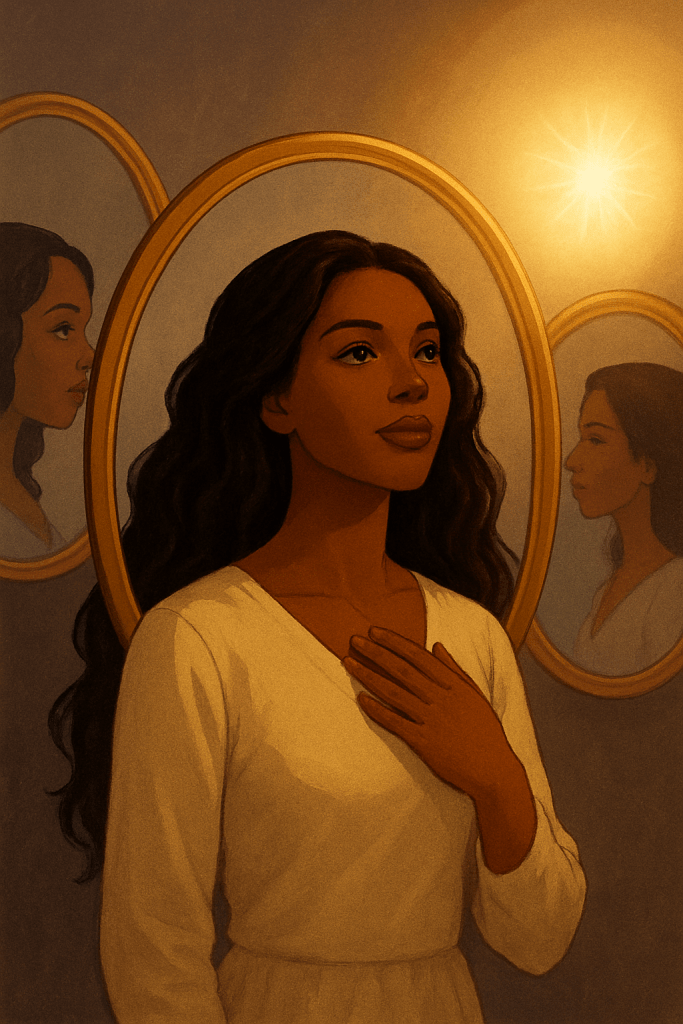
The woman in the mirror is both familiar and mysterious. She is a reflection of flesh and spirit, of past trials and future potential. Every line on her face tells a story, every curve carries memory, and every gaze carries both judgment and longing. In her eyes, she searches for approval, validation, and sometimes redemption, yet the mirror is not always truthful—it shows only the surface, while the soul beneath waits to be seen (hooks, 1992).
From youth, women are conditioned to scrutinize their reflections. Beauty standards are often external, fleeting, and unattainable. Society measures worth in shades of skin, symmetry of features, and conformance to cultural ideals. Yet the mirror is a teacher, reflecting both society’s pressures and the internalized messages women carry. It asks a silent question: Who am I beyond the reflection? (Walker, 1983).
The woman in the mirror often battles dualities. She is strong yet soft, capable yet vulnerable, radiant yet haunted by insecurities. The mirror can magnify flaws, both real and imagined, making imperfections appear larger than they are. But in that reflection lies a choice—to embrace, to reject, or to transform what she sees. True beauty emerges when she recognizes that her value is not merely in appearance but in character, resilience, and purpose.
In the context of faith, the mirror becomes a spiritual metaphor. The Bible compares the Word of God to a mirror: “But whoso looketh into the perfect law of liberty, and continueth therein, he being not a forgetful hearer, but a doer of the work, this man shall be blessed in his deed” (James 1:25, KJV). The reflection becomes more than physical; it is moral, spiritual, and eternal. The woman who sees herself through God’s eyes begins to understand her worth beyond skin and stature.
Internalized biases and societal pressures often distort a woman’s reflection. Colorism, lookism, and the subtle hierarchies of beauty can cause even the most confident woman to doubt herself. Darker skin may be unfairly criticized, natural hair may be deemed unprofessional, and unique features may be undervalued. Yet every feature, every tone, and every expression is a testament to heritage, ancestry, and divine artistry (Tharps, 2019).
The mirror also reflects generational memory. The woman sees not only herself but the lineage she represents—the resilience of her mothers, the struggles of her foremothers, and the victories of her ancestors. Each scar, each curve, each wrinkle carries legacy. In that reflection lies both responsibility and pride. To honor the past is to embrace the self with reverence.
Self-perception is often influenced by external relationships. Friends, lovers, and society may distort the image the woman sees. Praise can inflate vanity, while criticism can wound deeply. But the woman in the mirror must learn discernment. Approval from others is fleeting; validation from the Creator is eternal. Psalm 139:14 (KJV) reminds us: “I will praise thee; for I am fearfully and wonderfully made: marvellous are thy works; and that my soul knoweth right well.”
The mirror also reveals the woman’s internal growth. Time reshapes perspective. Youth often seeks external validation, while maturity seeks inner truth. The woman who has learned, struggled, and grown begins to see beauty in resilience, wisdom, and spiritual depth. The reflection evolves from superficiality to substance, from doubt to dignity.
Mirror reflection can also be a tool for introspection. Meditation before the mirror allows her to confront fears, desires, and truths that words alone cannot express. It is a moment of honesty—where pretense is stripped away, and only the authentic self remains. This is where healing begins, where insecurities are addressed, and where the seeds of confidence are planted (hooks, 1992).
Society often places disproportionate emphasis on youth and physical perfection, yet the mirror teaches impermanence. Beauty fades, but character, faith, and kindness endure. The woman who learns to value internal virtues sees herself differently in the mirror—she no longer measures worth by reflection alone but by how she lives, loves, and serves.
In communities where women of color are devalued, the mirror becomes both enemy and ally. It reflects oppression but also resilience. The Black woman, for instance, may see the echoes of colonial beauty standards, but through affirmation, education, and spiritual grounding, she begins to see the truth: her melanin, her features, her heritage, and her intellect are inherently valuable (Tharps, 2019).
The mirror can also reveal dual identities—the public persona versus private reality. The woman may present confidence outwardly, while inwardly wrestling with doubt or pain. Recognition of this duality is essential. Self-awareness allows her to integrate her identities, transforming fragmentation into wholeness.
Spirituality elevates the mirror from vanity to revelation. When the woman looks into the mirror prayerfully, she seeks alignment between her inner life and outer expression. She asks: Does my reflection match the heart I nurture? Does my appearance convey integrity, grace, and purpose? True beauty, then, is the reflection of the soul illuminated by God.
The mirror also invites forgiveness and grace. The woman may see past mistakes etched in her expression or posture. Yet the reflection does not define her future. Psalm 103:12 (KJV) reminds us, “As far as the east is from the west, so far hath he removed our transgressions from us.” The woman learns to forgive herself, to move forward with renewed dignity, and to see potential where she once saw only flaw.
Creativity and self-expression transform the mirror into an ally. Makeup, fashion, hair styling, and posture are not mere vanity—they are forms of artistry, self-respect, and affirmation. The woman who embraces her reflection creatively communicates confidence, identity, and joy, honoring both self and Creator.
Relationships with others also influence mirror reflection. Supportive communities encourage women to see themselves rightly. Mentorship, sisterhood, and intergenerational guidance reinforce self-love, teaching that the reflection is not to be feared but cherished. Proverbs 27:17 (KJV) reminds us, “Iron sharpeneth iron; so a man sharpeneth the countenance of his friend.”
The mirror also reflects potential. Beyond current circumstances, the woman sees what she can become—her talents, her voice, and her destiny. Visioning in the mirror, when paired with action, becomes a spiritual practice. It is both prophecy and motivation, reminding her that God has a plan for her life (Jeremiah 29:11, KJV).
A holistic view of the mirror also includes health, self-care, and wellness. The woman who honors her body as the temple of the Holy Spirit (1 Corinthians 6:19, KJV) treats her reflection with respect. Nourishment, exercise, rest, and mindfulness are acts of worship, allowing the mirror to reflect vitality, strength, and divine care.
Ultimately, the woman in the mirror is a witness of God’s handiwork. Each reflection carries beauty, intelligence, history, and spirit. Recognition of this sacredness transforms everyday self-reflection from critique to celebration, from insecurity to empowerment.
The mirror is both a challenge and a gift. It challenges the woman to confront truths about herself, society, and her spiritual journey. It is a gift because it provides feedback, affirmation, and the opportunity for growth. To look into the mirror is to see the image of God within oneself, as Genesis 1:27 (KJV) declares, “So God created man in his own image, in the image of God created he him; male and female created he them.”
In conclusion, the woman in the mirror is never just a reflection—she is history, destiny, spirit, and body combined. Her gaze invites honesty, her presence commands respect, and her image embodies divine creativity. When she learns to see herself fully, she lives fully—confident, courageous, and crowned in both beauty and purpose.
References
- hooks, b. (1992). Black Looks: Race and Representation. South End Press.
- Tharps, L. L. (2019). Same Family, Different Colors: Confronting Colorism in the African American Community. Amistad.
- Walker, A. (1983). In Search of Our Mothers’ Gardens: Womanist Prose. Harcourt Brace Jovanovich.
- The Holy Bible, King James Version (KJV).
Discover more from THE BROWN GIRL DILEMMA
Subscribe to get the latest posts sent to your email.
 THE BROWN GIRL DILEMMA