
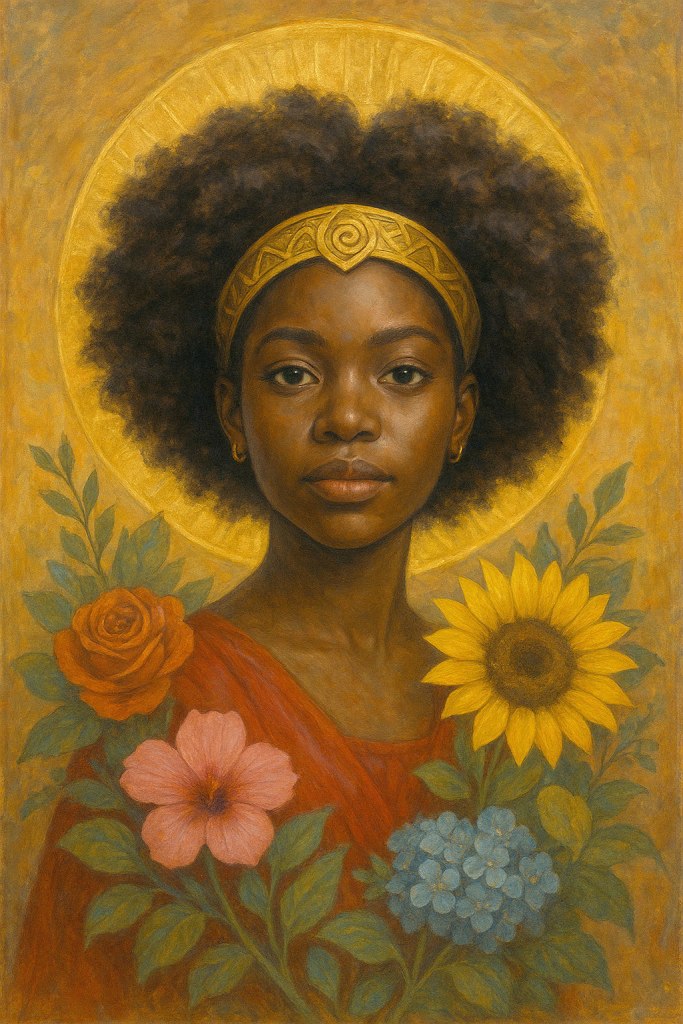
The dawn of a new era is unfolding—a Brown Girl Renaissance, where women of rich melanin hues are rediscovering their divine reflection in a world that once distorted their image. This renaissance is not merely aesthetic; it is spiritual, intellectual, and psychological. It is the reclamation of dignity from centuries of misrepresentation and the restoration of a beauty that was always divine, never diminished.
This awakening begins with remembrance. The brown girl’s story does not begin with slavery or struggle—it begins with sovereignty. Before colonization, African civilizations celebrated womanhood as sacred, powerful, and life-giving. Queens such as Hatshepsut, Nzinga, and Makeda embodied grace and authority. Their melanin was not marginalized; it was majestic. To reclaim this heritage is to re-anchor identity in truth, not trauma.
In today’s social climate, where Eurocentric standards still dominate media and marketing, the Brown Girl Renaissance is a necessary rebellion. It challenges the subtle conditioning that equates lighter skin and looser curls with desirability. Instead, it amplifies the allure of deep tones, full lips, and textured hair—features once ridiculed but now revered. This cultural shift signifies not just representation, but restoration.
Art and media have become crucial battlegrounds for this transformation. Filmmakers, photographers, and designers are intentionally showcasing brown women in all shades and styles, dismantling the myth of monolithic beauty. From Lupita Nyong’o’s radiant grace to Viola Davis’s commanding presence, visibility has become a form of healing. Every authentic portrayal whispers to the next generation: You are seen. You are beautiful. You are enough.
This renaissance is not fueled by vanity but by vision. It is about reclaiming narrative power. When a brown woman defines her own beauty, she liberates herself from the colonized gaze. She ceases to perform for approval and begins to live in alignment with her purpose. As bell hooks (1992) asserted, “Representation is a political act.” The act of loving one’s reflection becomes a declaration of freedom.
The mirror, once a site of doubt, now becomes a sanctuary. In it, the brown girl no longer sees flaws but features that tell stories—heritage encoded in hue, ancestry reflected in every curve. The act of self-acceptance transforms from self-indulgence into self-worship of the divine kind—the recognition that she is made in the image of God, whose palette includes every shade of creation.
This movement also redefines what it means to be feminine. For centuries, femininity was portrayed as fragile, dainty, and fair. The Brown Girl Renaissance reimagines it as resilient, radiant, and revolutionary. The softness of a brown woman does not negate her strength; it complements it. Her love, intellect, and leadership are all expressions of her spiritual femininity—a force that uplifts rather than conforms.
Social media has become a powerful altar for this awakening. Platforms like Instagram and TikTok, once breeding grounds for comparison, are now digital stages where brown women celebrate natural hair, melanin glow, and cultural fashion. Hashtags such as #MelaninPoppin and #BrownSkinGirl have transformed into global affirmations. This digital sisterhood amplifies collective healing, creating spaces where beauty is affirmed, not contested.
Education also plays a vital role in sustaining this renaissance. When schools teach African history, art, and literature that honor brown womanhood, they dismantle generational bias. Representation in textbooks and classrooms empowers young girls to see themselves as scholars, scientists, and saints. The more they see women who look like them celebrated in history, the more they believe in their own potential.
Faith remains the cornerstone of this restoration. Scripture declares, “Thou art all fair, my love; there is no spot in thee” (Song of Solomon 4:7, KJV). This divine affirmation transcends complexion. It calls every brown girl to walk in the confidence of her creation. When she internalizes that her worth is not defined by pigment but by purpose, she breaks the curse of comparison and walks in covenant with her Creator.
In theology, melanin is not a coincidence—it is intentional design. It symbolizes protection, endurance, and divine creativity. The melanin molecule itself absorbs light and transforms it into energy, a literal manifestation of resilience. Thus, the brown girl’s skin tells a spiritual story: she is light embodied, not light deprived.
Culturally, the Brown Girl Renaissance also addresses economic and social empowerment. Beauty brands owned by Black women, such as Fenty Beauty and Juvia’s Place, have revolutionized inclusivity in the industry. By creating products that honor deeper tones, they have transformed visibility into viability. Financial independence becomes a form of resistance—an act of reclaiming power from industries that once profited from exclusion.
This renaissance also honors the everyday brown woman—the teacher, the mother, the artist, the healer. Her beauty is not defined by celebrity, but by character. In her laughter, perseverance, and faith lies the true essence of womanhood. She is the unsung muse of her lineage, the living testament of survival and grace.
Psychologically, this movement is a response to generational trauma. Healing involves unlearning centuries of self-doubt and rediscovering cultural pride. Therapy, affirmations, and sisterhood circles have become sacred spaces for reclaiming mental and emotional wholeness. Healing is no longer a private struggle—it is a communal celebration of becoming whole again.
Art therapy and storytelling also play roles in this rebirth. Through poetry, film, and painting, brown women are rewriting history from their own voices. Their art becomes theology—visual sermons that preach self-love and divine affirmation. Each brushstroke, lyric, and lens captures what the world tried to erase.
Men, too, have a role in this renaissance. When they affirm, protect, and honor brown women, they restore balance to a fractured community. True kings recognize the sacredness of the queen’s hue. Together, they build a new cultural narrative where love is not color-coded but covenant-rooted.
The Brown Girl Renaissance also speaks to future generations. It tells little girls with coily hair and dark skin that their beauty is timeless, not trendy. It tells them that they are the daughters of queens, heirs of excellence. This renaissance is not fleeting—it is foundational, shaping how beauty, identity, and spirituality will be taught for centuries to come.
In essence, this is more than a movement—it is a resurrection. The brown girl, once hidden by history, now stands as the mirror of divine beauty and ancestral strength. Her reflection tells the truth: that she was never too dark, too loud, or too strong—she was perfectly designed for her purpose.
As Isaiah 61:3 (KJV) declares, God gives “beauty for ashes, the oil of joy for mourning.” The Brown Girl Renaissance is the fulfillment of that prophecy. Out of centuries of ashes rises a generation clothed in glory. They no longer ask, “Am I pretty enough?” for they have learned to answer their own reflection: I am the image of beauty itself.
References
- The Holy Bible, King James Version (KJV)
- hooks, b. (1992). Black Looks: Race and Representation. South End Press.
- Davis, A. (1981). Women, Race, and Class. Vintage Books.
- Lorde, A. (1984). Sister Outsider: Essays and Speeches. Crossing Press.
- Hunter, M. (2007). The Persistent Problem of Colorism: Skin Tone, Status, and Inequality. Sociology Compass, 1(1), 237–254.
- Russell, K., Wilson, M., & Hall, R. (1992). The Color Complex: The Politics of Skin Color Among African Americans. Doubleday.
- Morrison, T. (1987). Beloved. Knopf.
- Nyong’o, L. (2014). Lupita Nyong’o’s Speech on Beauty. Essence Black Women in Hollywood Awards.
Discover more from THE BROWN GIRL DILEMMA
Subscribe to get the latest posts sent to your email.
 THE BROWN GIRL DILEMMA