
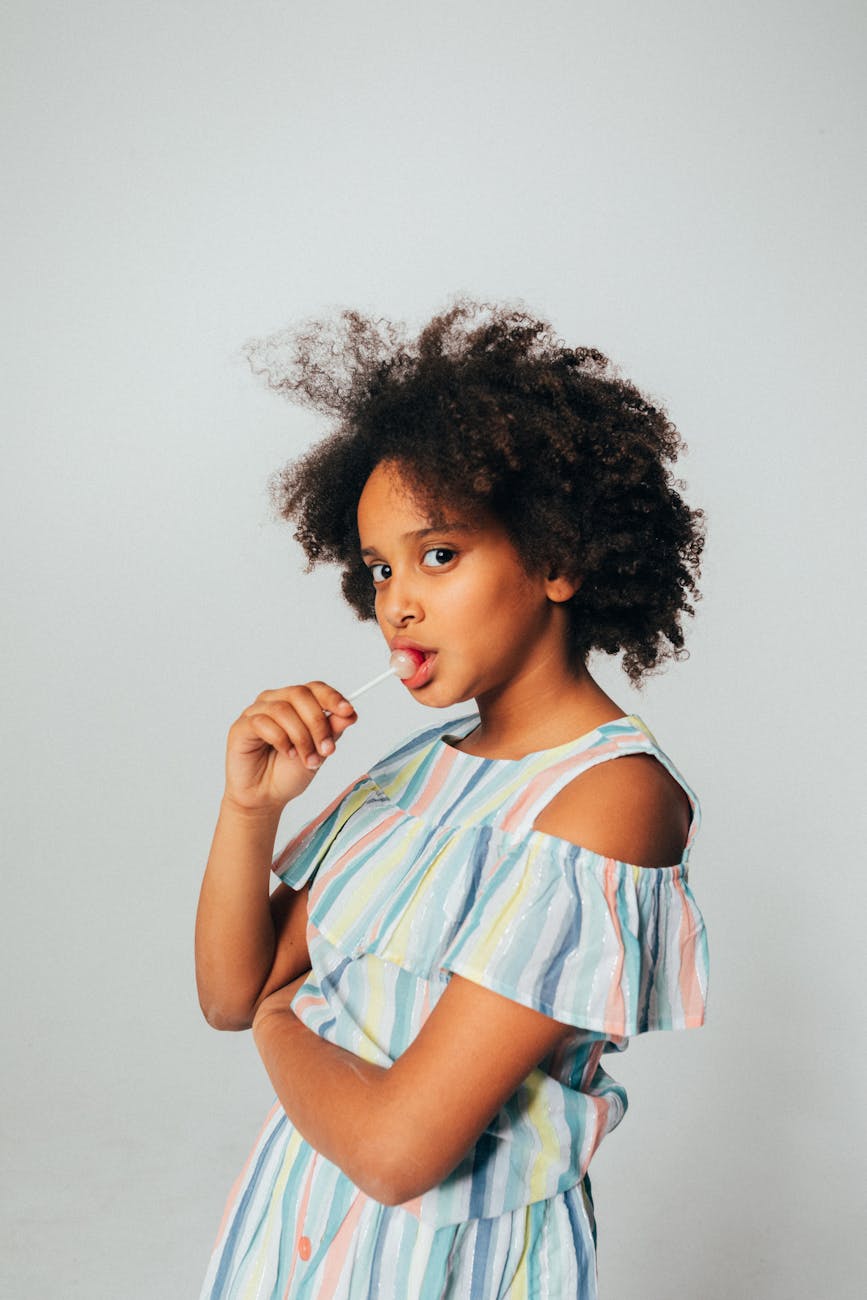
The question, “Why don’t you do something with your hair?” may seem harmless to some, but to many Black women, it cuts deeper than strands and styles—it reaches the roots of identity, history, and self-worth. Beneath the surface of that question lies centuries of cultural conditioning, where European aesthetics became the measuring rod for beauty, and anything deviating from that ideal was deemed unkempt, unruly, or undesirable.
For the brown girl, hair has never been “just hair.” It has been a site of both pride and pain, rebellion and respectability, resistance and reinvention. The texture of Black hair tells a story—one of survival through enslavement, assimilation through colonization, and reclamation through self-love. When society asks her to “do something” with it, it’s not simply asking for grooming—it’s demanding conformity.
Historically, enslaved African women were stripped not only of their homeland but also of their cultural expressions. Hair, once a symbol of tribal identity and spirituality, was forcibly shaved or hidden beneath rags. This act was psychological warfare—a way to erase selfhood. The lingering echo of that erasure still reverberates when a Black woman is told that her natural curls, coils, or kinks are “unprofessional” or “too much.”
The “Brown Girl Blues” emerge when the pressure to assimilate collides with the yearning to be authentic. Straightening, relaxing, and weaving became not merely beauty choices but survival tactics. For decades, many Black women internalized the message that straight hair equaled success, and natural hair equaled defiance. The corporate world, media, and even schools reinforced these codes of respectability through policies and imagery that favored Eurocentric beauty.
The Crown Act, passed in several U.S. states, sought to challenge these biases by legally protecting natural hairstyles. Yet, laws alone cannot undo generations of psychological conditioning. The battle over Black hair is not only fought in courtrooms but also in mirrors, classrooms, and boardrooms—everywhere a brown girl silently wonders if she’s “enough.”
In biblical terms, hair has always been symbolic of identity and covenant. Samson’s strength was connected to his locks (Judges 16:17), and a woman’s hair was often referred to as her “glory” (1 Corinthians 11:15). Yet for Black women, this glory has been distorted by societal judgment. The question, “Why don’t you do something with your hair?”, becomes not about maintenance but about value—an attempt to measure worth through assimilation.
The modern natural hair movement represents a spiritual and cultural awakening. It is a declaration that Black beauty, in its raw and natural form, is divine. Afro-textured hair defies gravity—it rises upward, toward the heavens—symbolizing resilience, creativity, and connection to something higher than human approval. Each coil, each curl, is a fingerprint of divine design.
However, the journey toward self-acceptance is not always smooth. Many brown girls recall being teased in childhood for their “nappy” hair or “kitchen.” These early wounds leave imprints that resurface in adulthood, influencing how they view their reflection. Healing requires unlearning not only external prejudice but internalized shame.
This healing is both emotional and theological. When a Black woman begins to see herself as fearfully and wonderfully made (Psalm 139:14), her relationship with her hair transforms. What was once a burden becomes a crown—an emblem of divine artistry. The process of detangling, twisting, and moisturizing becomes a sacred ritual of self-love and restoration.
Still, the societal gaze remains relentless. Even as representation increases, media often celebrates “acceptable” versions of natural hair—looser curls, lighter skin, or “manageable” textures—while sidelining tighter coils and darker complexions. Thus, colorism and texturism intertwine, creating a hierarchy within Black beauty itself.
The “Brown Girl Blues” is not just a personal lament; it is a cultural diagnosis. It asks: why must the Black woman still defend her right to simply be? Why must her hair still be politicized, policed, or tokenized? Why must she apologize for the crown God gave her? These questions echo through generations of women who have fought to redefine beauty on their own terms.
In academia, thinkers like bell hooks and Audre Lorde have explored how hair politics reflect the intersection of race, gender, and power. Lorde (1984) argued that self-care is an act of political warfare; for the Black woman, wearing her natural hair is exactly that—a rebellion against centuries of aesthetic colonization. It is a declaration that her beauty needs no validation from oppressive systems.
Faith and psychology converge here. While the world critiques, God affirms. The anxious heart that once craved acceptance learns to rest in divine identity. As Romans 12:2 urges, “Be not conformed to this world, but be ye transformed by the renewing of your mind.” Transformation begins internally, when the brown girl realizes her reflection already bears the image of God—no alterations necessary.
Black hair, in all its forms, is a metaphor for spiritual resilience. It bends but does not break; it shrinks yet expands; it endures heat, tension, and pressure but always finds a way to thrive. That endurance mirrors the Black woman’s soul—a living testimony of beauty born from struggle.
Community has been vital in reclaiming this narrative. Natural hair expos, YouTube tutorials, and sister circles have become spaces of affirmation where brown girls uplift one another and rediscover pride in their roots. These collective affirmations function like modern-day psalms—songs of freedom and healing sung through shared experience.
Still, not every Black woman chooses natural hair, and that, too, deserves respect. True liberation means freedom of choice, not obligation to any one aesthetic. Whether she wears braids, wigs, locs, or silk presses, her worth is not in the texture but in her authenticity. The problem was never the style—it was the shame.
To dismantle “Brown Girl Blues,” society must stop pathologizing Blackness. It must stop framing Black beauty as a problem to be solved and begin honoring it as a reflection of cultural genius. The question must shift from “Why don’t you do something with your hair?” to “What stories does your hair tell?”—because every strand carries history, faith, and pride.
Ultimately, the healing of the brown girl begins with reclaiming her divine mirror. She looks at her reflection and no longer sees deficiency, but design. She hears the old question—“Why don’t you do something with your hair?”—and smiles, because she already did: she learned to love it.
In that moment, the blues fade into gold, and her crown—once questioned—now glows with the glory of a woman who finally knows she was never the problem. Her hair, her hue, her heritage—all of it—is holy.
References
- The Holy Bible, King James Version.
- hooks, b. (1994). Outlaw culture: Resisting representations. Routledge.
- Lorde, A. (1984). Sister outsider: Essays and speeches. Crossing Press.
- Byrd, A. D., & Tharps, L. L. (2014). Hair story: Untangling the roots of Black hair in America. St. Martin’s Griffin.
- Johnson, T. A., & Bankhead, T. (2014). Hair it is: Examining the experiences of Black women with natural hair. Open Journal of Social Sciences, 2(1), 86–100.
- Tate, S. A. (2007). Black beauty: Shade, hair and anti-racist aesthetics. Ethnic and Racial Studies, 30(2), 300–319.
Discover more from THE BROWN GIRL DILEMMA
Subscribe to get the latest posts sent to your email.
 THE BROWN GIRL DILEMMA