
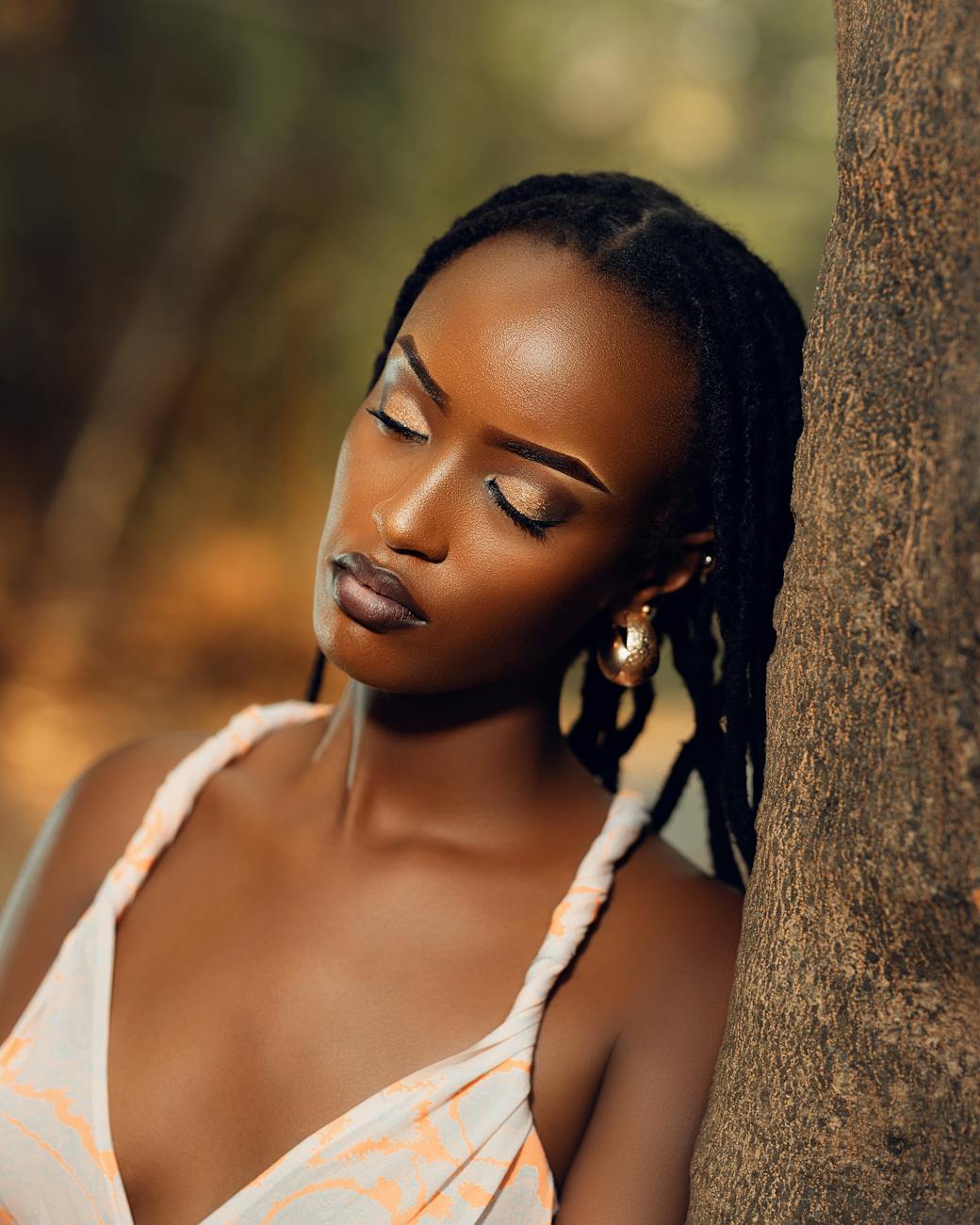
There is a quiet story that lives beneath my skin, one painted in shades of bronze and buried beneath years of misunderstanding. I have carried this melanin like both a crown and a curse—an inheritance too heavy to celebrate without apology. In the mirror, I see generations of women who learned to whisper their beauty instead of shouting it. This is my confession: that I am still learning to love the color I was told to hide.
I was born the color of dusk, where the day meets the night and light begins to soften. My mother’s hands, darker than mine, held both love and warning. “Stay out of the sun,” she would say, not out of vanity but survival. For her, color was protection and punishment, memory and mark. Her words carried the echo of centuries when darker skin meant harder labor and harsher judgment. She wanted me safe, even if it meant small.
As a girl, I envied light. The girls with honey skin and loose curls were called “pretty” before they even spoke. Teachers smiled longer at them. Boys looked longer too. I learned early that my reflection came with footnotes—beautiful for a dark girl, smart but intimidating. Compliments became backhanded blessings that taught me my worth depended on proximity to something else.
My skin, rich and warm, began to feel like an apology I never owed. I remember standing under fluorescent lights in a department store, trying on foundation shades that stopped two tones before me. I laughed to hide the sting. Beauty, it seemed, had a boundary, and I was standing just outside of it.
Colorism does not always scream; sometimes it sighs. It hides in the way cameras wash out brown tones, in casting calls that demand “racially ambiguous,” in the way a family photo subtly favors the fair. It’s in the whispered advice to “marry light,” to “improve the bloodline,” as if love were a ladder out of darkness.
But I have come to realize that my color is not a flaw in the palette of creation—it is the very hue of resilience. My skin remembers the sun of my ancestors, the soil of kingdoms before captivity. Within every cell of melanin lives a story of survival, brilliance, and divine intention. This brown is not burden; it is blueprint.
Still, confession means honesty, and honesty means I have wept over this skin. I have prayed for lighter mornings, wondered if the world would love me more if I were less of me. I have worn long sleeves in summer and smiled at jokes that bruised me. There were seasons I wanted invisibility more than visibility, peace more than pride.
There is a peculiar exhaustion that comes from constantly explaining your beauty. From having to convince the world that your darkness does not need redemption. From seeing your shade turned into a trend when it decorates others but remains a stigma when it clothes you.
Yet healing began in the mirror. The day I stopped comparing, stopped apologizing, stopped shrinking into palatable shades of brown, I met myself anew. I looked at my reflection not as something to correct but as a miracle. My melanin is the poetry of creation—God’s intentional brushstroke against the backdrop of existence.
In learning to love my skin, I began to reclaim language. I stopped calling it “dark” as if it were a warning. I began to call it sun-kissed, bronzed by divine fire, rooted in earth. Words matter. They shape the self before the world ever does.
There is also joy in being brown—a quiet, grounded joy. The way sunlight deepens into me, the way my skin gleams like copper and cocoa, the way strangers see strength in my stride. I have learned that this hue holds power: the power to absorb light and reflect it stronger.
Culturally, being brown is more than complexion; it is history embodied. It connects me to the diaspora, to women who carried water, wisdom, and worlds within them. It ties me to India’s spices, Africa’s soil, the Caribbean’s rhythm, and the American South’s sorrow songs. My melanin is global—it is the map of migration, memory, and majesty.
Yet colorism remains an unspoken war among sisters. We compare, compete, and sometimes wound each other with the same weapons used against us. The healing must begin within us—when we stop measuring worth by shade and start celebrating every tone as a note in our shared harmony.
Psychologically, loving brown skin in a world that profits from insecurity is rebellion. It means unlearning centuries of propaganda that sold bleach in bottles and shame in magazines. It means confronting the colonial ghosts that still whisper in beauty aisles and boardrooms. It is both radical and restorative to say, I am enough as I am.
Spiritually, my melanin feels sacred. It reminds me that I was formed from dust and destined for light. Scripture says, “I am fearfully and wonderfully made” (Psalm 139:14, KJV), and I believe that includes every shade of brown, every curl and kink, every feature the world once mocked. The divine does not make errors in pigment.
This confession is also a love letter—to every brown girl who has been told she was too dark to dream or too visible to belong. To the girls who hid from cameras or edited their photos until their skin forgot its truth. To the women who are rediscovering their beauty after years of silence. You are the color of endurance, the reflection of sun and soil, the embodiment of balance.
Brown is not less; it is more—more ancient, more layered, more luminous. It holds the past and the promise. It does not fade; it deepens. To be brown is to carry the world’s warmth in your skin and to shine even when unseen.
My confession ends where my healing begins: I no longer whisper my beauty. I let it echo. I let it speak in the language of confidence and softness, in the rhythm of self-acceptance. My melanin no longer hides—it radiates. I am the daughter of dusk and dawn, and I no longer apologize for the color of my becoming.
References
hooks, b. (1992). Black looks: Race and representation. South End Press.
Fanon, F. (1952). Black skin, white masks. Grove Press.
Hunter, M. (2007). The persistent problem of colorism: Skin tone, status, and inequality. Sociology Compass, 1(1), 237–254.
Russell, K., Wilson, M., & Hall, R. (1992). The color complex: The politics of skin color among African Americans. Anchor Books.
Tate, S. A. (2016). Black beauty: Aesthetics, stylization, politics. Routledge.
Discover more from THE BROWN GIRL DILEMMA
Subscribe to get the latest posts sent to your email.
 THE BROWN GIRL DILEMMA