
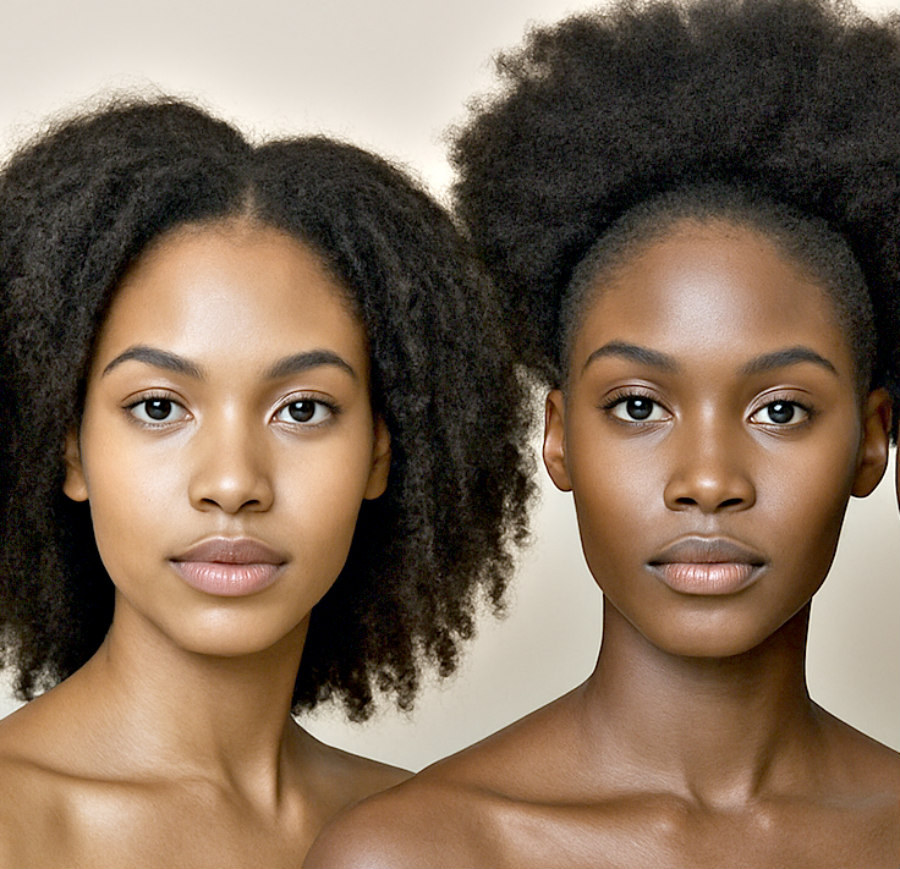
Café au Lait and Chocolate had been best friends since childhood—two girls from the same neighborhood, two souls molded by different shades of brown. Though bound by sisterhood, they were divided by perception. The world, with its unspoken hierarchies of hue, loved one loudly and ignored the other quietly. Their friendship became a mirror reflecting not just affection, but the wounds colorism leaves in its wake.
Café au Lait—born Alana Monroe—was the girl everyone noticed. Her skin was a soft golden-beige that shimmered in the sunlight. “You’re so beautiful,” people would say, often before learning her name. Her loose curls, amber undertones, and hazel eyes made her the standard of “Black beauty” that the world found palatable. She never asked for that attention, but it followed her everywhere—from school hallways to social media. Yet behind her perfect selfies and confident laughter, Alana carried a secret guilt. She knew her best friend, Chocolate, absorbed the shadows of the praise she received.
Chocolate—real name Brianna Cole—had skin the color of deep mahogany, radiant and royal, though the world seldom told her so. Growing up, she was called “too dark,” “too strong,” “too plain.” Boys overlooked her, teachers underestimated her, and even some family members compared her to Alana as if beauty came with a shade card. Each insult chipped away at her reflection until she stopped looking in mirrors altogether. She learned to make herself small—to blend into the background, where invisibility felt safer than rejection.
Their friendship was a paradox—built on love but haunted by society’s lies. Alana defended Brianna often, calling her beautiful, but the words never sank deep. Compliments from a lighter-skinned friend, Brianna thought, were pity wrapped in sincerity. She couldn’t understand why God made her so dark in a world obsessed with light. She prayed quietly for lighter skin, not realizing she was asking God to erase His intentional artistry.
As they grew older, life began to test their bond. Alana entered the modeling industry, where her “exotic look” was praised but her Blackness was diluted. She was told to “stay out of the sun” and “keep her tone golden,” as though her worth depended on preserving her lightness. Fame felt hollow when built on erasure. Meanwhile, Brianna struggled through bouts of depression, using makeup to lighten her skin and filters to alter her tone. She was tired of pretending, but too wounded to stop.
One Sunday morning, by divine design, both women found themselves at the same church after years of distance. The sermon that day came from Song of Solomon 1:5 (KJV): “I am black, but comely, O ye daughters of Jerusalem.” The pastor spoke with conviction: “God didn’t make a mistake in your shade. Every tone of melanin is a divine brushstroke of glory.” Tears streamed down Brianna’s face. For the first time, she heard Scripture affirm what the world denied.
After service, Alana found her outside, sitting under the church oak tree, crying and smiling at once. “I’ve hated my skin for so long,” Brianna whispered. “But today, I finally felt seen by God.” Alana took her hand and said, “Maybe we were both broken—me for being praised for the wrong reasons, and you for being ignored for the wrong ones. But maybe God’s been trying to show us that we were both beautiful all along.”
That moment became their turning point—a covenant of sisterhood renewed by faith. Together, they began a journey of redemption. Alana left the modeling agency that demanded she diminish herself and began mentoring young girls about authentic self-worth. Brianna started a podcast called “Unfiltered Melanin,” where she spoke openly about colorism, depression, and divine healing. Their friendship became a living testimony that healing is found not in complexion, but in connection.
As the years passed, both women discovered that beauty had never been the problem—perception had. Alana learned to carry her light with humility, using it to illuminate others rather than outshine them. Brianna learned to see her darkness not as burden, but as blessing—the color of earth, creation, and strength. Their friendship became a mosaic of faith and forgiveness, proof that even broken mirrors can reflect divine truth when restored by grace.
One evening, they returned to that same church, now hosting a women’s conference on self-worth and colorism. Standing side by side, Alana introduced Brianna as her sister in spirit and healing. Brianna smiled, radiating confidence the world once denied her. “We are not light versus dark,” she said into the microphone. “We are light and dark—together—beautiful, balanced, and beloved by God.” The congregation erupted in applause, but more than that, Heaven rejoiced.
In the end, Café au Lait and Chocolate were never opposites—they were two shades of the same divine image. Their journey taught them that redemption begins when love outshines insecurity, when faith replaces fear, and when beauty is seen through the eyes of the Creator, not the critic.
Because in God’s palette, every shade of melanin is sacred.
Scriptural References (KJV):
- Song of Solomon 1:5 — “I am black, but comely, O ye daughters of Jerusalem.”
- Psalm 139:14 — “I will praise thee; for I am fearfully and wonderfully made.”
- 1 Samuel 16:7 — “Man looketh on the outward appearance, but the Lord looketh on the heart.”
- Romans 12:2 — “Be not conformed to this world: but be ye transformed by the renewing of your mind.”
- Colossians 3:14 — “And above all these things put on charity, which is the bond of perfectness.”
References
- Banks, T. A. (2019). Colorism and the politics of beauty. Journal of Black Studies, 50(3), 243–261.
- Hunter, M. (2007). The persistent problem of colorism: Skin tone, status, and inequality. Sociology Compass, 1(1), 237–254.
- hooks, b. (1992). Black looks: Race and representation. South End Press.
- The Holy Bible, King James Version. (1611).
Discover more from THE BROWN GIRL DILEMMA
Subscribe to get the latest posts sent to your email.
 THE BROWN GIRL DILEMMA