
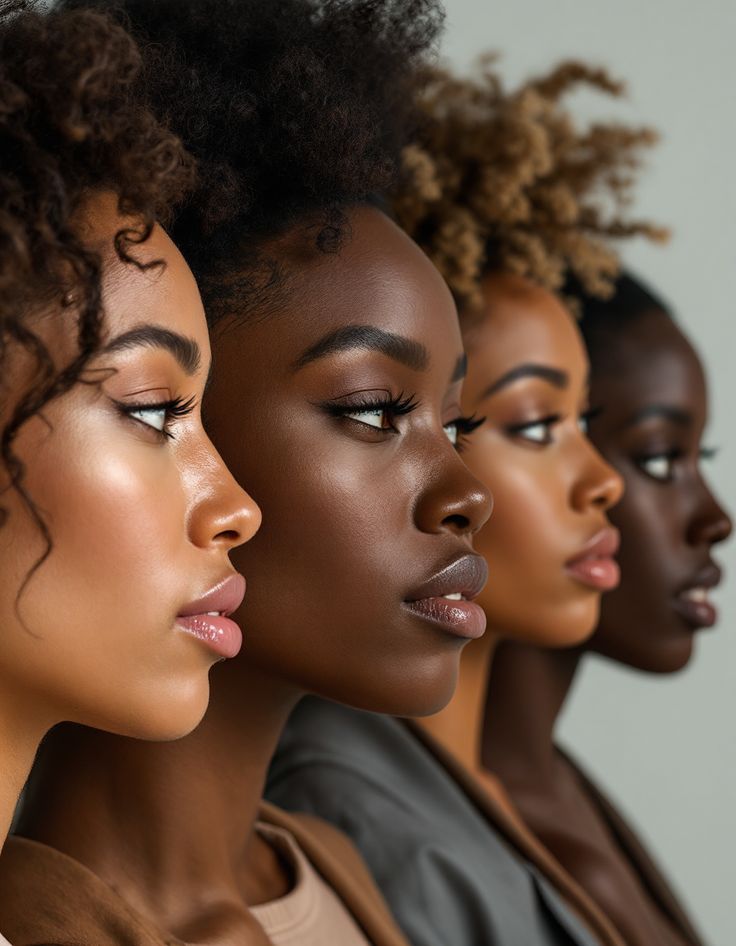
In the complex spectrum of Black identity, there exists an often-overlooked struggle—the experience of those who occupy the middle shades of brown. Neither deemed “light enough” to receive societal privilege nor “dark enough” to be fully embraced in the movement of color pride, these individuals often live in a liminal space of identity. This is the middle shade myth: the illusion that existing between extremes should grant acceptance, when in truth, it often yields invisibility.
Colorism, a byproduct of colonialism, created hierarchies that divided the Black community by hue. Historically, lightness was rewarded for its proximity to whiteness, while darkness was punished as the visual mark of servitude. Yet those in the middle—honey, chestnut, bronze, caramel—found themselves in a paradoxical position. Their skin became a canvas of contradiction: sometimes praised, sometimes overlooked, but rarely celebrated in full context.
On the plantation, skin tone determined labor and treatment. Light-skinned enslaved people were often placed in domestic roles, while darker-skinned ones toiled in the fields. Those in between were shifted as needed, their value determined by convenience rather than identity. This created generations of individuals who learned to navigate acceptance as a matter of adaptability, not authenticity.
Post-slavery, the same dynamics lingered within Black society. The “Blue Vein Societies” and other elite groups of the 19th and early 20th centuries enforced color hierarchies that excluded darker tones but also imposed unspoken boundaries on those in the middle. Middle-toned individuals could sometimes “pass” in certain spaces, but their belonging was conditional—always dependent on how others perceived them.
In modern times, the middle shade myth manifests through subtle biases in media, beauty, and relationships. Hollywood frequently casts actors of medium complexion as “safe Black”—palatable enough to appeal to white audiences, yet brown enough to signify diversity. From Halle Berry to Zendaya, these roles symbolize representation filtered through comfort, not authenticity. The middle shade becomes the compromise between extremes, rather than the celebration of self.
In the realm of beauty, those in the middle often face dual scrutiny. They are sometimes told they are “lucky” to have a certain tone—“not too light, not too dark”—as though their worth lies in being digestible. Yet within their own communities, they may be deemed “not dark enough” to fully relate to darker-skinned struggles or “not light enough” to benefit from privilege. This tension breeds quiet confusion and emotional isolation.
Psychologically, this middle-ground experience can lead to identity fatigue. Constantly being compared to others’ shades creates an environment of self-surveillance—an internal questioning of where one fits in the racial mosaic. The middle shade myth teaches that belonging must be earned, not inherent. Such conditioning perpetuates insecurity even among the most self-assured.
Social media has amplified these dynamics. Online debates about “color preference” often reduce complex experiences to competition, forcing individuals to defend their shade as either oppressed or advantaged. In these spaces, middle-shade individuals may find themselves without a clear narrative—too light to claim darkness, too dark to claim lightness. Their stories fall between hashtags and headlines.
Spiritually, this liminality echoes a biblical truth: that identity confusion is the enemy of divine purpose. The Bible says, “A double-minded man is unstable in all his ways” (James 1:8, KJV). The middle shade myth thrives on double-mindedness—it divides individuals internally before society can divide them externally. Healing, therefore, begins with reclaiming wholeness beyond complexion.
Historically, colonial and Eurocentric systems defined value through binary oppositions—good versus bad, light versus dark, pure versus impure. The middle shade defies these categories; it represents fluidity, nuance, and intersection. That is precisely why it was destabilized. Systems of control thrive on division, not complexity. The middle, by nature, threatens those systems with ambiguity—and ambiguity is power.
From a sociological lens, middle-shade individuals embody the crossroads of cultural expectation. In Latin America, the term “mestizo” became synonymous with mixed heritage and middle hue—celebrated for diversity but marginalized for impurity. Similarly, in the United States, terms like “redbone” or “high yellow” were used to rank people along a color ladder, turning the middle into a balancing act between privilege and prejudice.
Culturally, the music industry has reflected this tension. Many R&B and soul artists have had their images molded to appeal to both Black and white audiences—skin tone subtly curated through lighting, makeup, and album art. Their sound and look had to straddle the color line to remain profitable. In this way, the middle shade became commodified as crossover currency.
Emotionally, those who live in this in-between space often develop acute racial empathy. They understand privilege and prejudice simultaneously, embodying the contradictions of color politics. This duality, though heavy, grants a unique sensitivity—an awareness of how race and complexion operate in layered ways. The challenge is transforming that sensitivity from burden into bridge.
The middle shade myth also has gendered dimensions. Middle-toned women are often fetishized as “exotic,” a label rooted in colonial fantasies. Middle-toned men, meanwhile, are alternately praised as “ideal” or overlooked in favor of lighter or darker extremes. Both experiences reinforce that complexion, rather than character, continues to shape desirability.
Breaking free from the middle shade myth requires confronting internalized colorism. Healing starts when we stop measuring beauty through contrast and begin celebrating it through connection. Every shade of brown exists on the same spectrum of divine design. There is no hierarchy in hue—only harmony.
Education plays a crucial role. Teaching children the historical roots of color bias empowers them to resist its modern manifestations. When we show them that colonial structures created the shade divide, they learn that these myths can—and must—be dismantled. Understanding history liberates identity.
Culturally, artists are leading the way toward healing. Painters, filmmakers, and photographers are capturing the full spectrum of Blackness with intentional diversity. By illuminating middle shades with the same reverence as deep or light tones, they reclaim what the colonial lens distorted. The visual narrative becomes whole again.
Theologically, the Creator’s palette has no hierarchy. Genesis declares, “And God saw everything that He had made, and, behold, it was very good” (Genesis 1:31, KJV). Every shade of melanin is a divine brushstroke—intentional, sacred, complete. The middle is not a mistake; it is the meeting point of balance and beauty.
Ultimately, the middle shade myth reveals how deeply society fears ambiguity. Yet in that ambiguity lies freedom—the power to transcend categories designed to divide. To be “not light enough” or “not dark enough” is to stand in the place of transformation. The middle shade is not the absence of identity; it is the bridge between worlds, carrying the truth that every tone, from ivory to ebony, reflects the same eternal light.
References
- The Holy Bible, King James Version (James 1:8; Genesis 1:31).
- hooks, b. (1992). Black Looks: Race and Representation. South End Press.
- Russell, K., Wilson, M., & Hall, R. (1992). The Color Complex: The Politics of Skin Color Among African Americans. Doubleday.
- Tate, S. (2009). Black Beauty: Aesthetics, Stylization, Politics. Routledge.
- Hunter, M. (2007). The Persistent Problem of Colorism: Skin Tone, Status, and Inequality. Sociology Compass, 1(1), 237–254.
- Hall, S. (1997). Representation: Cultural Representations and Signifying Practices. Sage.
- Craig, M. L. (2002). Ain’t I a Beauty Queen?: Black Women, Beauty, and the Politics of Race. Oxford University Press.
- Morrison, T. (1992). Playing in the Dark: Whiteness and the Literary Imagination. Vintage.
- Hill Collins, P. (2000). Black Feminist Thought. Routledge.
- hooks, b. (2000). All About Love: New Visions. William Morrow.
Discover more from THE BROWN GIRL DILEMMA
Subscribe to get the latest posts sent to your email.
 THE BROWN GIRL DILEMMA