
The beauty of Brown women is deeply intertwined with culture, history, and resilience. From ancestral traditions to modern fashion runways, Brown women have navigated societies that often imposed Eurocentric standards while cultivating unique forms of self-expression, artistry, and elegance. Exploring this trajectory—from historical roots to contemporary visibility—reveals not only aesthetic contributions but also the resilience and empowerment embedded in the legacy of Brown women.
Ancestral Traditions and Cultural Significance
Throughout African, Caribbean, and Latin American societies, beauty has historically been expressed through hairstyles, skin care, adornments, and textiles. Braided and twisted hairstyles, body art, and vibrant clothing often carried social, spiritual, or cultural meaning, signaling status, heritage, or community affiliation (Byrd & Tharps, 2014). These traditions celebrated melanin-rich skin, facial features, and natural hair textures long before the imposition of colonial beauty standards. Beauty, in these contexts, was both personal and collective—a reflection of identity and heritage.
Colonialism, Slavery, and the Imposition of Eurocentric Standards
The transatlantic slave trade and colonial regimes brought systemic oppression that devalued darker skin and natural features. European ideals of beauty—fair skin, straight hair, and Eurocentric facial features—became markers of social privilege and desirability (Hunter, 2007). Despite these pressures, Brown women preserved cultural beauty practices, maintaining pride in their appearance and transmitting ancestral knowledge through generations. This resistance demonstrates that beauty has always been inseparable from resilience and identity affirmation.
African American Beauty Culture and the Harlem Renaissance
In the United States, the Harlem Renaissance (1920s–1930s) provided a platform for Black artistic expression, including beauty and fashion. Women like Josephine Baker, with her daring style and signature elegance, challenged mainstream perceptions while celebrating African aesthetics. Beauty salons became cultural hubs where women exchanged styling techniques, supported one another, and fostered community identity (Perry, 2009). These spaces cultivated confidence, creativity, and empowerment, demonstrating that beauty is not merely aesthetic but also sociocultural.
Modern Visibility and Runway Influence
In contemporary fashion, Brown women increasingly claim visibility and redefine industry standards. Models like Adut Akech, Duckie Thot, and Naomi Campbell have dominated international runways, demonstrating that melanin-rich beauty is not niche but universal. Designers are incorporating diverse features and complexions into campaigns, acknowledging the historical exclusion and striving toward inclusion. Social media further amplifies these voices, allowing Brown women to influence global perceptions directly.
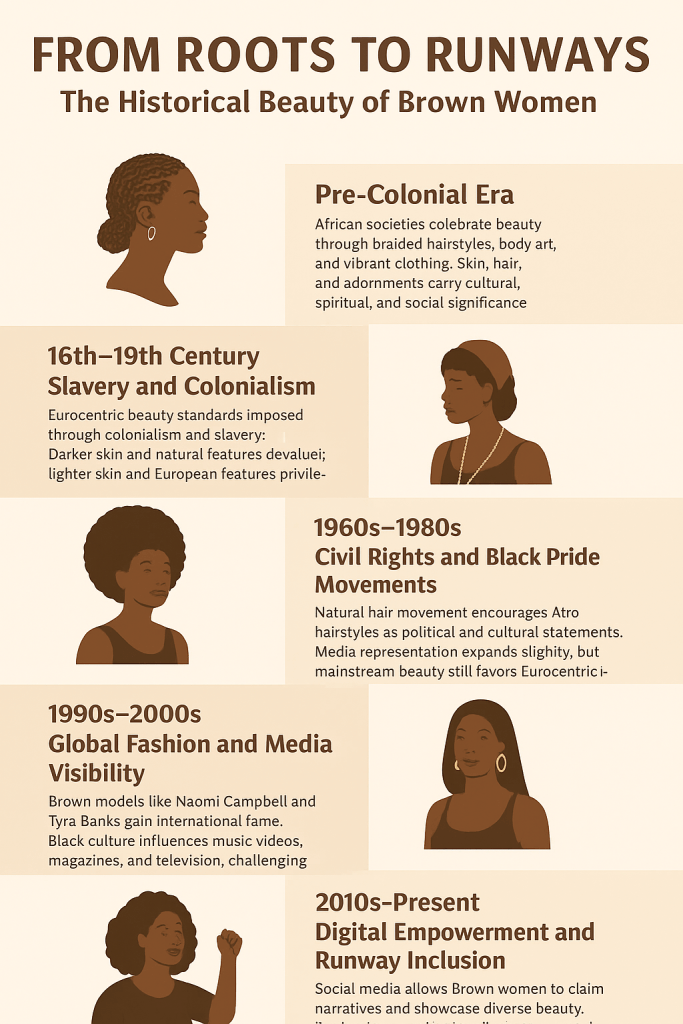
Timeline: The Historical Beauty of Brown Women
Pre-Colonial Era
- African societies celebrate beauty through braided hairstyles, body art, and vibrant clothing.
- Skin, hair, and adornments carry cultural, spiritual, and social significance.
16th–19th Century: Slavery and Colonialism
- Eurocentric beauty standards imposed through colonialism and slavery.
- Darker skin and natural features devalued; lighter skin and European features privileged.
- Brown women preserve cultural beauty practices covertly or in safe community spaces.
1920s–1930s: Harlem Renaissance
- Black artistic expression flourishes; women like Josephine Baker challenge mainstream norms.
- Beauty salons become cultural hubs for skill-sharing, empowerment, and community.
1960s–1980s: Civil Rights and Black Pride Movements
- Natural hair movement encourages Afro hairstyles as political and cultural statements.
- Media representation expands slightly, but mainstream beauty still favors Eurocentric ideals.
1990s–2000s: Global Fashion and Media Visibility
- Brown models like Naomi Campbell and Tyra Banks gain international fame.
- Black culture influences music videos, magazines, and television, challenging stereotypes.
2010s–Present: Digital Empowerment and Runway Inclusion
- Social media allows Brown women to claim narratives and showcase diverse beauty.
- Models like Adut Akech, Duckie Thot, and public figures like Lupita Nyong’o redefine global standards.
- Colorism awareness movements (#MelaninMagic, #BrownSkinPoppin) increase representation and self-love advocacy.
Present & Future
- Celebration of melanin-rich skin, natural hair, and diverse features continues to grow globally.
- Beauty becomes a tool of empowerment, cultural pride, and resistance against systemic bias.
Media Representation and Colorism
While progress has been made, media representation continues to favor lighter-skinned women. Colorism—preference for lighter shades within communities of color—persists, reinforcing hierarchical beauty standards (Hunter, 2007). Visibility of darker-skinned models, actresses, and influencers challenges these norms, offering representation that affirms a broader spectrum of beauty. Public figures like Lupita Nyong’o and Tracee Ellis Ross exemplify this shift, inspiring younger generations to embrace their natural features proudly.
Beauty as Resistance and Empowerment
The historical beauty of Brown women reflects both aesthetic expression and resistance. Maintaining traditional hairstyles, advocating for natural skin care, and claiming space in fashion and media are acts of empowerment. Each choice affirms identity, challenges dominant beauty paradigms, and honors ancestral legacy. Brown women’s beauty has always been inseparable from cultural pride, resilience, and agency.
Conclusion
From roots to runways, the beauty of Brown women is a testament to heritage, resilience, and self-expression. Historical traditions, artistic contributions, and contemporary visibility reveal that beauty is not merely physical; it is cultural, social, and political. Celebrating this legacy affirms the value of melanin-rich skin, natural hair, and diverse features, ensuring that the beauty of Brown women continues to inspire confidence, empowerment, and cultural pride for generations to come.
References
- Byrd, A. D., & Tharps, L. L. (2014). Hair story: Untangling the roots of Black hair in America. St. Martin’s Press.
- Hunter, M. (2007). The persistent problem of colorism: Skin tone, status, and inequality. Sociology Compass, 1(1), 237–254.
- Perry, I. (2009). Prophets of the hood: Politics and poetics in Hip Hop. Duke University Press.
Discover more from THE BROWN GIRL DILEMMA
Subscribe to get the latest posts sent to your email.
 THE BROWN GIRL DILEMMA