
With six championships, five MVPs, and a flawless Finals record, Michael Jordan isn’t just the GOAT—he’s the standard by which greatness is measured, also beyond the game. Michael Jordan, Air Jordan, and the Making of a Cultural Empire.
In the pantheon of global sports figures, Michael Jordan’s name occupies an almost mythic place. He is more than a retired professional basketball player; he is a brand, an icon, and a case study in the fusion of athleticism, entrepreneurship, and cultural influence. The Air Jordan brand—launched through his collaboration with Nike—did not merely change sportswear; it redefined the relationship between athletes and corporate branding. This report examines Michael Jordan’s biography, his partnership with Nike, his business ventures, controversies, and enduring influence, drawing on historical, economic, and sociocultural contexts.
Early Life and Career
Michael Jeffrey Jordan was born on February 17, 1963, in Brooklyn, New York, and raised in Wilmington, North Carolina. The fourth of five children to James and Deloris Jordan, he developed an early love for sports. After being famously cut from his high school varsity team as a sophomore, Jordan’s relentless work ethic propelled him to basketball stardom at the University of North Carolina at Chapel Hill, where he hit the game-winning shot in the 1982 NCAA Championship (Lazenby, 2014).
Jordan entered the NBA in 1984, drafted third overall by the Chicago Bulls. His explosive athleticism, combined with an unmatched competitive drive, quickly transformed him into one of the league’s most marketable stars.
The Nike Partnership and Birth of Air Jordan
In 1984, Nike—a company then struggling to regain its market share—offered Jordan a five-year endorsement deal worth $2.5 million, an unprecedented sum for an NBA rookie (Katz, 2013). At the time, Adidas and Converse dominated basketball shoes, but Nike took a risk on a player who had yet to play an NBA game.
The original Air Jordan I, designed by Peter Moore, debuted in 1985 and was banned by the NBA for violating uniform color rules. Nike capitalized on the controversy, marketing the sneakers with the tagline, “On October 15, Nike created a revolutionary new basketball shoe. On October 18, the NBA threw them out of the game. Fortunately, the NBA can’t stop you from wearing them.” The ban fueled demand, and sales skyrocketed to over $126 million in the first year (Nike Archives, 2020).
The Cultural Impact of Air Jordan
The Air Jordan brand transformed sneaker culture from simple athletic gear into a status symbol. Jordan’s on-court dominance—winning six NBA championships, five MVP awards, and ten scoring titles—was mirrored by his off-court marketing mastery. Nike commercials, including the iconic “It’s Gotta Be the Shoes” campaign with Spike Lee as “Mars Blackmon,” merged basketball with hip-hop culture, fashion, and urban identity.
By 2023, the Air Jordan line generated over $5 billion in annual revenue for Nike (Forbes, 2023). The brand’s limited-edition releases and retro models became a global phenomenon, inspiring sneaker resale markets and collector subcultures.
Business Ventures and Billionaire Status
Jordan’s financial empire extends beyond Nike. He owns the Charlotte Hornets NBA franchise (recently selling majority control while retaining a minority stake), has investments in restaurants, car dealerships, and tequila brands (Cincoro Tequila), and holds equity in DraftKings. According to Forbes (2023), his net worth surpassed $3 billion, making him one of the wealthiest former athletes in history.
Personal Life and Tragedy
Jordan married Juanita Vanoy in 1989, with whom he had three children—Jeffrey, Marcus, and Jasmine. The couple divorced in 2006. In 2013, he married Yvette Prieto, and they have twin daughters.
A pivotal tragedy occurred in 1993 when his father, James Jordan Sr., was murdered during a robbery in North Carolina. The incident profoundly impacted Jordan, leading to his first retirement from basketball.
Controversies and Criticism
Although celebrated as the greatest of all time (“GOAT”) by many, Jordan has faced criticism. Some in the Black community argue that he has not been as vocal on social justice issues as other athletes, famously summarized in his alleged quip, “Republicans buy sneakers too”—a statement he later clarified as a joke (Smith, 2020). Others point to incidents involving gambling and reports of a demanding, sometimes abrasive personality with teammates.
Basketball Legacy and Statistics
Jordan’s career statistics are staggering:
- Points per game: 30.1 (highest in NBA history)
- NBA titles: 6 (1991–1993, 1996–1998)
- MVP Awards: 5
- All-Star Selections: 14
- Olympic Gold Medals: 2 (1984, 1992 Dream Team)
His silhouette, captured in the “Jumpman” logo, is now one of the most recognizable symbols in global marketing.
Memorialization and Statues
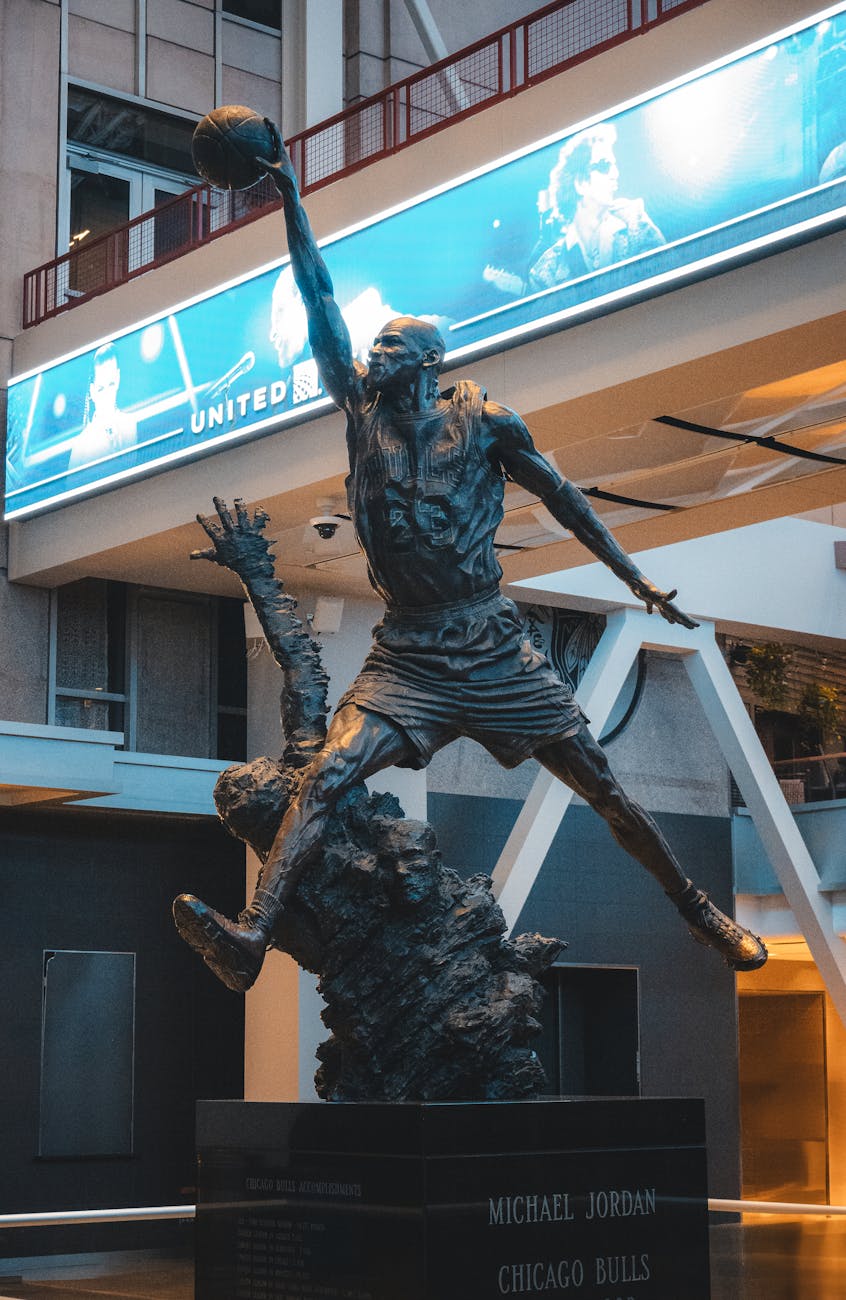
The Michael Jordan Statue, “The Spirit,” stands outside the United Center in Chicago, unveiled in 1994. It immortalizes his soaring dunk, symbolizing excellence, flight, and determination.
Marketing Slogan: “Be Like Mike”
In 1991, Gatorade launched the “Be Like Mike” campaign, cementing Jordan as a model of aspiration for millions of young fans. The commercials showcased him as approachable yet extraordinary—a balance that fueled his lasting appeal.
Conclusion
Michael Jordan’s journey from a determined teenager in North Carolina to a global icon encapsulates the synergy between sports excellence, branding mastery, and cultural influence. The Air Jordan brand is not merely a commercial product—it is a socio-cultural artifact, representing ambition, identity, and global capitalism. Jordan’s legacy is multifaceted: a legendary athlete, a savvy businessman, a cultural influencer, and a symbol of aspiration, particularly for Black entrepreneurs navigating both the challenges and opportunities of American capitalism.
References
- Forbes. (2023). Michael Jordan Net Worth. Retrieved from https://www.forbes.com
- Katz, D. (2013). When Michael Met Nike: The Birth of Air Jordan. Sports Illustrated.
- Lazenby, R. (2014). Michael Jordan: The Life. Little, Brown and Company.
- Nike Archives. (2020). The History of Air Jordan. Nike, Inc.
- Smith, S. (2020). Michael Jordan and Social Responsibility: Context and Controversy. Journal of Sports and Society, 12(3), 45-57.
Discover more from THE BROWN GIRL DILEMMA
Subscribe to get the latest posts sent to your email.
 THE BROWN GIRL DILEMMA