
Rachel Dolezal, a former president of the Spokane, Washington, chapter of the NAACP, became a national figure of controversy when it was revealed in 2015 that she was a white woman who had been presenting herself as Black for years. Despite having been born to white parents of European descent, Dolezal had altered her appearance, including tanning her skin, curling her hair, and adopting African American vernacular and culture. Her case raises profound questions about racial identity, cultural appropriation, and societal double standards.
Ironically, while Black women are frequently criticized or pathologized for assimilating into Eurocentric beauty norms—whether through hair straightening, skin lightening, or other means—Dolezal, a white woman, was initially celebrated within a Black community organization for her performance of Black identity. Her work with the NAACP and advocacy on behalf of civil rights may have been well-intentioned, but the deception surrounding her racial identity challenges the principles of authenticity and transparency essential to public leadership.
Psychologically, her case touches on what scholars term “racial identity appropriation,” wherein individuals adopt the cultural markers and struggles of a group to which they do not belong, often as a means of securing identity, belonging, or moral authority. This phenomenon is distinct from transracial adoption or cultural exchange; it often stems from deeper issues related to identity confusion, desire for empathy or attention, or the allure of perceived moral high ground.
The public backlash against Dolezal revealed not only the societal discomfort with ambiguous racial boundaries but also exposed how white individuals are often extended forgiveness or curiosity when crossing cultural lines. In contrast, Black individuals, particularly women, are rarely afforded the same grace. Her actions highlight the privileges of whiteness, even in spaces ostensibly dedicated to racial justice.
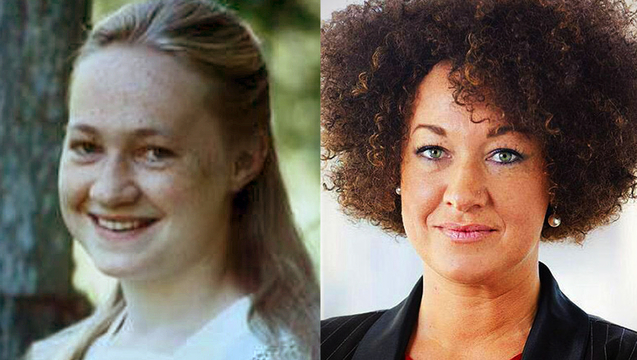 |
| Rachel Dolezal (left to right) These photographs are the property of their respective owners. |
💔 Why Do Some Black People Hate Themselves or Each Other?
This phenomenon isn’t due to a moral failing, but rather the psychological residue of slavery, colonialism, and white supremacy. It is what scholars call internalized racism—when oppressed people begin to absorb the lies told about them by the dominant society.
1. Slavery and the Destruction of Identity
Slavery was not only about physical bondage—it was about erasing the identity of a people. Africans were stripped of their languages, names, families, religions, and cultural pride. They were forcibly renamed, reclassified, and psychologically reprogrammed to believe they were inferior.
“If you can convince the lowest white man he’s better than the best colored man, he won’t notice you’re picking his pocket.” — Lyndon B. Johnson
During slavery, enslaved Africans were:
-
Divided by complexion: lighter-skinned slaves (often the result of rape) were given house duties, while darker-skinned slaves labored in the fields. This bred resentment and laid the foundation for colorism—a hierarchy within the race based on skin tone.
-
Pitted against each other: as outlined in the infamous (and possibly apocryphal) Willie Lynch Letter, enslavers used fear, distrust, and division to keep enslaved people from uniting.
2. Post-Slavery: The Birth of Colorism and Eurocentric Standards
Even after emancipation, the proximity to whiteness became the measure of beauty, intelligence, and worth. Black features—like broad noses, kinky hair, or dark skin—were mocked, while lighter skin and long straight hair were celebrated.
This legacy persists today:
-
Colorism: Lighter-skinned Black people often receive more favorable treatment in media, hiring, dating, and society.
-
Hair Discrimination: Natural hairstyles like afros, locs, and braids are still viewed as “unprofessional” in many institutions.
-
Self-Rejection: Some Black people bleach their skin, avoid the sun, or use harmful chemicals to straighten their hair—not out of vanity, but as a survival mechanism in a world that devalues their natural state.
3. Internalized Racism and “Self-Hate”
Black people—like all people—are shaped by the media, education, and culture. When all of those systems portray whiteness as good and Blackness as bad, a subconscious belief can form: “There must be something wrong with me.”
This shows up in:
-
Jealousy or suspicion of each other’s success (“crabs in a barrel”).
-
Mocking natural Black features.
-
Dividing ourselves by skin tone, hair texture, dialect, or region.
🌱 What Does Being a Hater Really Mean?
A hater is someone who resents another person’s success, beauty, confidence, or uniqueness. In our community, this often stems from:
-
Low self-esteem.
-
Unhealed trauma.
-
Feeling powerless in a system built against us.
As Malcolm X said:
“Who taught you to hate the texture of your hair? Who taught you to hate the color of your skin…?”
💡 Why Is Light Skin and Long Hair Still Seen as More Desirable?
It’s rooted in colonialism and media conditioning:
-
For centuries, the lighter you were, the more human you were considered.
-
Beauty standards were crafted by European ideals—pale skin, straight hair, and thin features were exalted, while Black features were demonized.
-
Even today, movies, magazines, dating apps, and TV often showcase light-skinned Black people as the default representation of beauty.
✊🏾 So What’s the Solution?
1. Reclaim Our History and Identity
Learn the truth about African civilizations, the African diaspora, and the richness of Black culture. When you understand your roots, you stop seeing yourself as inferior.
2. Practice Self-Love and Cultural Pride
Celebrate your skin, your hair, your body, your ancestry. Uplift those around you. Affirm your children. Support Black businesses. Wear your culture proudly.
3. Challenge Internalized Racism
Call out colorism when you see it. Unlearn negative beliefs. Don’t measure yourself by Eurocentric standards. Demand representation in media, leadership, and institutions.
4. Mental Health Matters
Therapy, especially with culturally competent Black therapists, can help unpack trauma, self-esteem issues, and patterns of self-hate.
5. Faith and Community Healing
In texts like Baruch 4:6 and Deuteronomy 28, many believe that Black people’s suffering is tied to disobedience to divine commandments, but also that restoration is possible. Healing is not just psychological, but also spiritual. Return to the Most High God!
🔥 A Final Quote to Reflect:
“We’ve been conditioned to hate ourselves and love their wealth… That’s why Black sell crack and we act like we’re not smart.” — Kanye West, “All Falls Down”
📚 References
-
Akbar, N. (1996). Breaking the Chains of Psychological Slavery. Mind Productions.
-
hooks, b. (1992). Black Looks: Race and Representation. South End Press.
-
Fanon, F. (1967). Black Skin, White Masks. Grove Press.
-
Russell-Cole, K., Wilson, M., & Hall, R. E. (2013). The Color Complex: The Politics of Skin Color in a New Millennium. Anchor Books.
-
American Psychological Association. (2019). Ethnic and Racial Disparities in Mental Health Care.
Brubaker, R. (2016). Trans: Gender and Race in an Age of Unsettled Identities. Princeton University Press.
This work explores how Rachel Dolezal’s case illustrates the complexities and controversies of identity in contemporary society, including comparisons between transgender and “transracial” identities.
Discover more from THE BROWN GIRL DILEMMA
Subscribe to get the latest posts sent to your email.
 THE BROWN GIRL DILEMMA